
The YouTube Money Machine: A Creator’s Income Breakdown
What Is YouTube Creator Income? (Real Numbers for 2026)

YouTube creator income varies enormously — from a few dollars a month to millions per year. Here’s a quick snapshot of what creators actually earn:
| Channel Size | Monthly Ad Revenue | With Diversified Income |
|---|---|---|
| 1K–10K subscribers | $50–$200 | $500–$2,000 |
| 10K–50K subscribers | $200–$1,000 | $2,000–$7,400+ |
| 100K subscribers | $1,000–$5,000 | $8,000–$30,000 |
| 500K+ subscribers | $10,000–$25,000 | $25,000–$150,000+ |
- YouTube pays creators 55% of ad revenue from regular videos and 45% from Shorts
- Ad earnings per 1,000 views (RPM) typically range from $0.50 to $25, depending on niche and audience country
- Finance and investing channels earn the highest RPM ($10–$25), while gaming channels average much less ($0.55–$3)
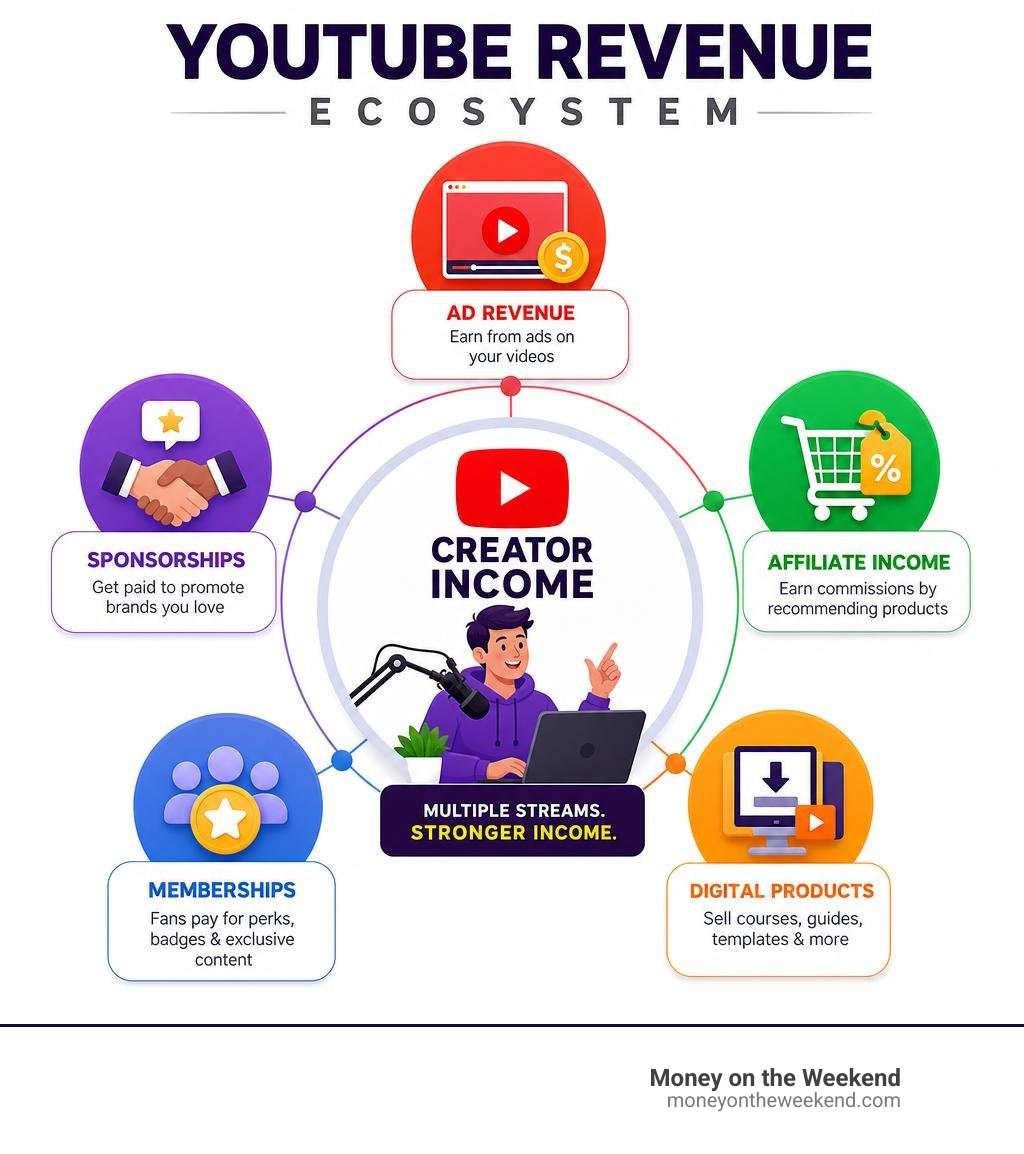
- Most successful creators earn the majority of their income outside of ads — through sponsorships, affiliates, and digital products
So you’ve heard that people make real money on YouTube — but the actual numbers are hard to pin down. One creator posts a screenshot showing $10,000 from a million views. Another says they barely covered their coffee budget. Both can be true at the same time.
The gap comes down to a handful of factors most people don’t fully understand: your niche, where your audience lives, how long your videos run, and whether you’re relying on ads alone or stacking multiple income streams.
This guide breaks it all down with real numbers, no hype, and a clear picture of what it actually takes to turn a YouTube channel into consistent income.
Simple guide to youtube creator income:
Demystifying YouTube Creator Income: CPM vs. RPM
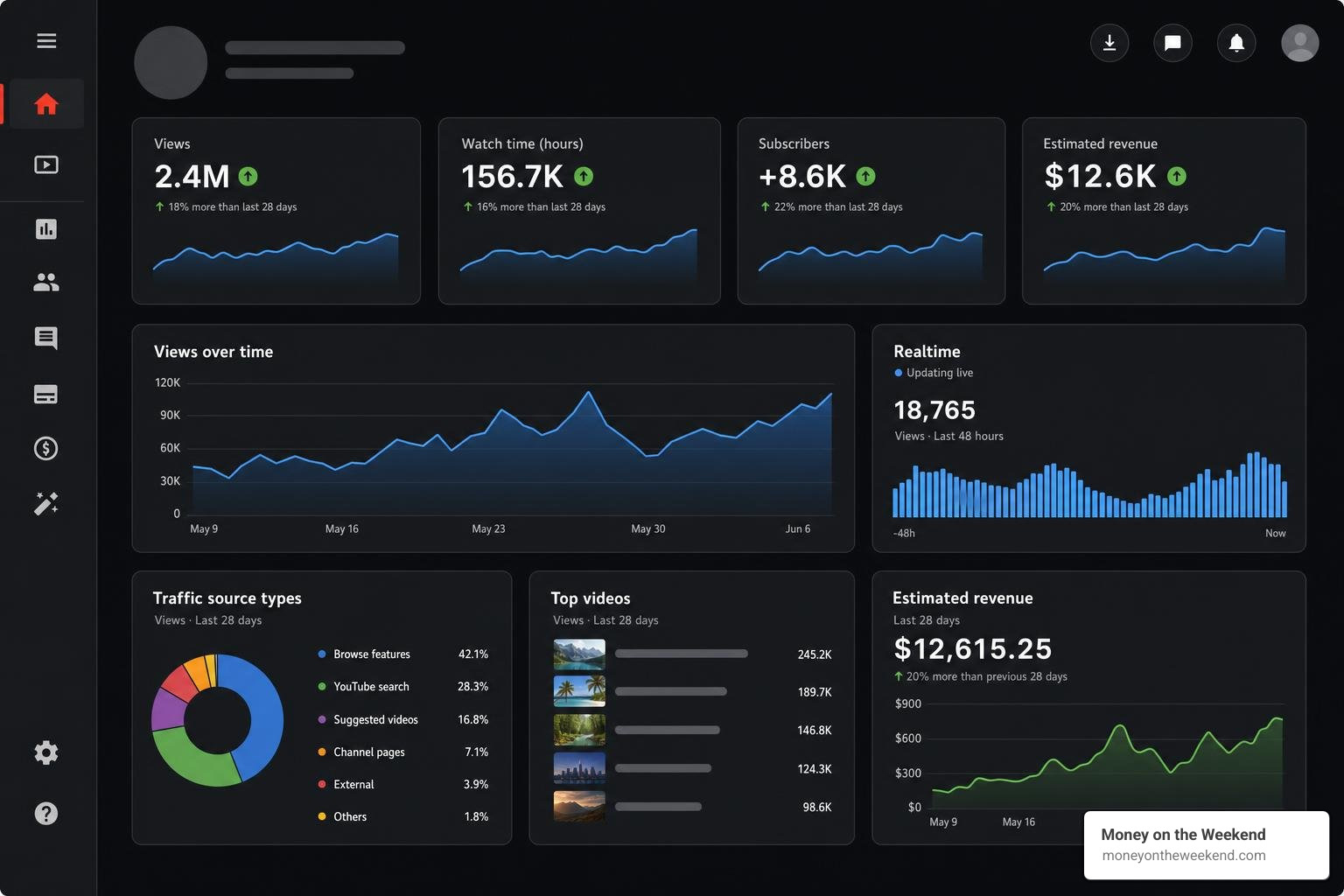
If you have ever spent more than five minutes researching how to make money on YouTube, you have probably run headfirst into a wall of confusing acronyms. The two biggest culprits are CPM and RPM. Let’s break them down so you can understand what actually lands in your bank account.
CPM stands for Cost Per Mille (Mille being Latin for thousand). This is the cost an advertiser pays to YouTube to serve 1,000 ad impressions on your video. It represents the gross ad spend before anyone takes a cut.
RPM stands for Revenue Per Mille. This is the holy grail metric for creators. It measures how much money you actually keep per 1,000 views after YouTube takes its platform cut, and it includes other monetization features like YouTube Premium revenue, Super Chats, and channel memberships.
Under the standard YouTube Partner Program terms, the revenue split is highly specific:
- Long-form videos: YouTube keeps 45% of the ad revenue, and the creator receives 55%.
- Shorts Feed ads: YouTube keeps 55% of the ad revenue, and the creator receives 45%.
Because of this split, your RPM will always be lower than your CPM. For example, if a finance advertiser pays a $20 CPM, your ad-based RPM will hover around $11. Furthermore, not every single view on your channel will serve an ad. Viewers using ad-blockers, skipping ads quickly, or watching on devices that do not support certain ad formats will lower your overall RPM.
To see how these numbers translate to real-world earnings, you can run your own projections using our YouTube Views to Money Calculator.
| Metric | Who It Measures | What It Includes | Typical Range (2026) |
|---|---|---|---|
| CPM (Cost Per Mille) | What advertisers pay YouTube | Gross ad revenue per 1,000 ad impressions | $2.00 – $45.00 |
| RPM (Revenue Per Mille) | What creators actually keep | Net ad revenue, YouTube Premium, fan funding | $0.25 – $25.00 |
How Audience Demographics Impact YouTube Creator Income
Your audience’s geographic location is one of the most powerful and overlooked factors dictating your youtube creator income. Advertisers bid significantly more to get their products in front of viewers in wealthy nations with high purchasing power.
These high-paying regions are known as Tier 1 countries and include the United States, Canada, the United Kingdom, Australia, and Germany. For instance, a tech review channel whose audience is 80% based in the US or Australia might enjoy a healthy $10 to $15 RPM.
Conversely, viewers in Tier 3 countries like India, Pakistan, or Bangladesh have much lower advertiser bidding power. If your audience is primarily located in South Asia, your RPM might fall to $0.20 to $1.50. This means a creator with 100,000 views from the United States can easily out-earn a creator pulling in 1,000,000 views from a lower-CPM region. If you want to estimate these geographic swings, check out the YouTube Views to Money Calculator.
How Video Length and Seasonality Drive YouTube Creator Income
Two videos in the exact same niche with the exact same audience can still make vastly different amounts of money due to video length and the calendar year.
First, let’s talk about video length. If your video is 8 minutes or longer, you unlock the ability to place mid-roll ads. Instead of just showing an ad at the beginning (pre-roll) or end (post-roll) of your video, you can insert ads throughout the content. This single setting can easily double or triple your ad impressions, boosting your RPM dramatically. However, to keep viewers around long enough to actually see those mid-rolls, you need to understand What Is a Good Average View Duration on YouTube and design your content to maximize retention.
Second, seasonality plays a massive role. Advertisers budget their spending based on retail cycles. The fourth quarter (Q4), spanning October through December, is the holiday shopping gold rush. Brands compete fiercely for ad space, driving CPMs up by 30% to 50% or more. Many creators earn up to 40% of their annual ad revenue in November and December alone. In contrast, January is notoriously dry; advertiser budgets reset, and RPMs plummet. If you notice a sudden dip in the winter, don’t panic and ask Why Aren’t My YouTube Videos Getting Views — it is likely just the classic post-holiday ad slump.
How to Qualify for the YouTube Partner Program and Get Paid

To start earning ad revenue directly from your videos, you must join the YouTube Partner Program (YPP). YouTube has structured this program with clear milestones to ensure channels are established and safe for advertisers.
To qualify for the full monetization suite (including Watch Page ads and Shorts ads), you must meet the following thresholds:
- 1,000 subscribers
- Either 4,000 valid public watch hours on long-form videos within the past 12 months, or 10 million valid public Shorts views within the past 90 days.
Once you hit these numbers, you can submit your application through YouTube Studio. YouTube will manually review your channel to ensure you comply with the YouTube Policy to Earn Money. This review checks for original content, community guideline compliance, and advertiser-friendly topics. If your channel is approved, you must link an active AdSense for YouTube account to receive your payouts.
AdSense processes payments monthly. Your finalized earnings from the previous month are transferred to your AdSense balance between the 7th and 12th of the current month. If your balance meets the local payment threshold (typically $100 in the US), AdSense will issue your payment via direct deposit or wire transfer between the 21st and 26th of the month. If you are curious about other channels’ monetization status, you can learn How to Tell If a YouTube Video Is Monetized. For more details on this process, you can read the official guide on the Creator Economy: Income Through YouTube.
Shorts Monetization vs. Long-Form Videos
Shorts are incredible for explosive channel growth and rapid discovery, but they are notoriously poor direct earners compared to long-form videos.
Monetization for Shorts works on a pooled model. Instead of placing ads directly on your video, YouTube displays ads between videos in the Shorts Feed. YouTube aggregates this ad revenue, subtracts music licensing costs, and places the remaining money into a Creator Pool. This pool is then distributed to creators based on their share of total views.
Because of this pooled system, the revenue share is 45% for creators, and the resulting RPM is incredibly low — typically ranging from $0.03 to $0.10 per 1,000 views.
To put this in perspective:
- 1 million views on a long-form video at a standard $4.00 RPM yields $4,000.
- 1 million views on a Short at a $0.05 RPM yields only $50.
We highly recommend treating Shorts as a top-of-funnel tool to build your brand and drive traffic to your long-form videos, rather than relying on them as your primary source of income. To dive deeper into how this works, check out our resources on YouTube Shorts Income, YouTube Shorts Earn, YouTube Short Video Monetization, and YouTube Short Monetization 2026.
Stacking Revenue Streams: How to Earn Beyond AdSense
Relying solely on AdSense is one of the most common mistakes new creators make. Ad revenue is volatile, subject to seasonal swings, and entirely dependent on the platform’s algorithm. The most successful creators treat AdSense as their income floor, not their ceiling. By stacking multiple revenue streams, you can build a highly resilient, highly profitable business even with a relatively small audience.
One of the most lucrative ways to monetize is through brand sponsorships. When a brand pays you to integrate their product or service into your video, you keep 100% of that money (minus any agency fees). Unlike AdSense, sponsorship rates are negotiated directly between you and the brand, and they are largely unaffected by geographic RPM fluctuations.
Typically, sponsor rates scale with your average view counts rather than your subscriber count. A common industry benchmark is $20 to $50 per 1,000 views for an integrated 30-to-60-second ad read. For example:
- A channel averaging 10,000 views per video can charge $200 to $500 per integration.
- A channel averaging 100,000 views can command $2,000 to $5,000+ per video.
To see how these deals are structured and how to pitch brands, read our guide on How Much Do Sponsors Pay YouTubers. For a brilliant blueprint on how to scale a smaller channel to thousands of dollars per month without massive view counts, check out Earn $7K/Mo: YouTube Creator Monetization Beyond AdSense.
Affiliate Marketing and Digital Products
If you want to turn your channel into a hands-off, passive income generator, affiliate marketing and digital products are your best friends.
With affiliate marketing, you place tracking links in your video descriptions and pinned comments for products you recommend. When a viewer clicks your link and makes a purchase, you earn a commission. This is incredibly powerful because you do not need to create a product, handle shipping, or deal with customer service. Software and digital tools often pay recurring commissions of 20% to 50%, while physical goods (like camera gear via Amazon) pay smaller 3% to 8% commissions. To see how quickly these small clicks can add up to a full-time wage, check out How Much Money Can You Make with Affiliate Marketing.
If you want to capture the absolute highest profit margins, you should create and sell your own digital products. These can include:
- Lightroom presets or video editing templates
- PDF guides, cheat sheets, or budget planners
- Full-scale online courses and masterclasses
- Paid 1:1 consulting calls
Because digital products cost virtually nothing to replicate and distribute, your profit margins are close to 99%. A small channel with only 5,000 highly engaged subscribers can easily make $2,000 a month selling a specialized $49 digital course. We cover this entire strategy in detail in our Passive Income YouTube Ultimate Guide.
Memberships, Super Chats, and Communities
Another fantastic way to diversify is through fan funding. YouTube provides built-in tools like Channel Memberships, Super Chats, and Super Thanks to let your most loyal viewers support you directly.
With Channel Memberships, viewers pay a monthly recurring fee (usually ranging from $1.99 to $14.99) to unlock custom badges, emojis, and exclusive content like members-only live streams or early video access. Super Chats and Super Thanks allow viewers to pay to highlight their messages during live streams or pin a highlighted comment on your standard uploads. YouTube takes a 30% cut of all fan funding transactions, which is a bit steep but highly convenient.
Many creators are bypassing YouTube’s heavy cuts entirely by moving their audiences to independent paid community platforms. Stacking a private community, a newsletter, or a membership program is a highly stable way to build predictable monthly recurring revenue (MRR). For a real-world look at how top creators structure these communities to replace ad-dependency, read How Much Do YouTubers Make? Full Revenue Breakdown | Paprika.bot.
Realistic Timeline: From Zero to Full-Time Creator
Building a profitable YouTube channel is a marathon, not a sprint. While there are rare stories of viral channels monetizing in a few weeks, the vast majority of creators follow a predictable multi-year journey. Here is a realistic timeline based on industry averages:
- Months 0 to 6 (The Ghost Town Phase): You are learning how to edit, design thumbnails, and speak to a camera. Your views are low, and your audience consists mostly of friends and family. Your primary goal here is consistency — aim to publish 1 to 2 videos per week and focus on improving your production quality.
- Months 6 to 12 (The Monetization Milestone): Your channel begins to pick up organic search and algorithmic traffic. You hit the coveted 1,000 subscriber and 4,000 watch hour thresholds and qualify for the YouTube Partner Program. You earn your first AdSense paycheck (which will likely cover your hosting fees and coffee).
- Months 12 to 18 (The Side Hustle Phase): Your AdSense earnings grow to $200–$1,000 per month. You start inserting affiliate links and secure your first small brand sponsorships. Your channel is now a legitimate side hustle.
- Months 18 to 30 (The Full-Time Transition): You have stacked multiple revenue streams (ads, sponsorships, affiliates, and digital products). Your monthly income reaches $3,000 to $8,000+, allowing you to confidently transition into full-time digital entrepreneurship.
If you want to compare this career path to other digital ventures, explore our 10 Best Passive Income Ideas and our comprehensive Passive Income Ideas Ultimate Guide.
Frequently Asked Questions About YouTube Earnings
How accurate are YouTube money calculators?
Most basic online YouTube money calculators are incredibly oversimplified. They usually ask for your daily view count and apply a generic, outdated CPM range (like $1 to $4) to estimate your earnings.
These calculators completely miss critical variables like:
- Audience geography: A view from the US can pay 15 times more than a view from India.
- Seasonality: Q4 views pay significantly more than Q1 views.
- Video length: Videos over 8 minutes can display mid-roll ads, dramatically increasing RPM.
- Alternative revenue: They ignore sponsorships, affiliate links, and digital products, which often make up 70% to 80% of a creator’s actual income.
For a highly accurate estimate that accounts for these variables, we recommend using our customized YouTube Views to Money Calculator. You can also cross-reference estimates using tools like the YouTube RPM Calculator 2026 – Calculate Real Revenue Per 1,000 Views (Free), the Estimated YouTube Money Calculator by Social Blade, the YouTube Money Calculator: Estimate Your YouTube Earnings, or the YouTube Money Calculator | FinToolSuite.
Which niches pay the highest CPM?
The niche you choose is the single most important factor determining your ad revenue. Advertisers are willing to pay massive premiums to place their ads in front of viewers who are actively looking to spend money or make investments.
- High-CPM Niches ($10 to $30+ CPM): Personal finance, investing, real estate, software tutorials, business, and digital marketing. Advertisers in these spaces (like banks, brokers, and software companies) have incredibly high customer lifetime values and are willing to pay top dollar to acquire users.
- Medium-CPM Niches ($4 to $10 CPM): Technology reviews, health and fitness, lifestyle, and educational content.
- Low-CPM Niches ($1 to $4 CPM): Gaming, comedy, beauty vlogs, and general entertainment. While these niches can generate massive view counts easily, the advertisers (often consumer goods or movie studios) pay much lower rates per thousand views.
What are the biggest mistakes that prevent creators from earning consistently?
Many talented creators fail to make a consistent income because of a few easily avoidable mistakes:
- Inconsistent uploads: The YouTube algorithm rewards channels that keep viewers coming back regularly. If you upload three videos in one week and then disappear for a month, you will struggle to build momentum.
- Poor audio quality: Viewers will tolerate average video quality, but they will click away instantly if your audio is scratchy, echoey, or quiet. Invest $50 to $100 in a decent USB or lavalier microphone before upgrading your camera.
- Ignoring thumbnails and titles: It doesn’t matter how incredible your video is if nobody clicks on it. Spend at least 30 to 60 minutes crafting an eye-catching thumbnail (using bright colors, readable text, and expressive faces) and a compelling title for every video you publish.
Conclusion
Building a substantial youtube creator income is one of the most exciting paths to financial freedom and digital entrepreneurship. While the platform’s ad revenue system is a fantastic foundation, the real magic happens when you treat your channel as a business and diversify into sponsorships, affiliate marketing, and digital products.
At Money on the Weekend, we are dedicated to helping you turn your spare time into consistent, life-changing income. If you are ready to stop watching from the sidelines and start building your own digital asset, take the first step today and Build your passive income stream on YouTube.