
What Passive Income Really Means (And Why It Matters)

Passive income ideas are strategies that generate money with minimal ongoing effort after an initial investment of time, energy, or capital. Unlike a traditional job where you trade hours for dollars, passive income allows you to earn while you sleep, travel, or focus on other priorities.
Top 7 Passive Income Ideas:
- Dividend Investing – Earn from company profits through stocks and ETFs
- Affiliate Marketing – Monetize your content with product recommendations
- Digital Products – Create ebooks, courses, or templates once and sell repeatedly
- Real Estate Investing – Generate rental income or invest in REITs
- Peer-to-Peer Lending – Earn interest by lending money directly to borrowers
- YouTube Channel – Build an audience and earn from ads and sponsorships
- Asset Rentals – Rent out your car, parking space, or unused items
Let’s be clear: passive income isn’t truly passive at the start. As one financial coach puts it, “passive income involves upfront work.” You’ll need to invest time, money, or both before the income flows.
But here’s why it matters: when your passive income exceeds your expenses, you achieve financial freedom. That’s the goal. Whether you want to quit your 9-to-5, retire early, or just have more breathing room in your budget, passive income gives you options.
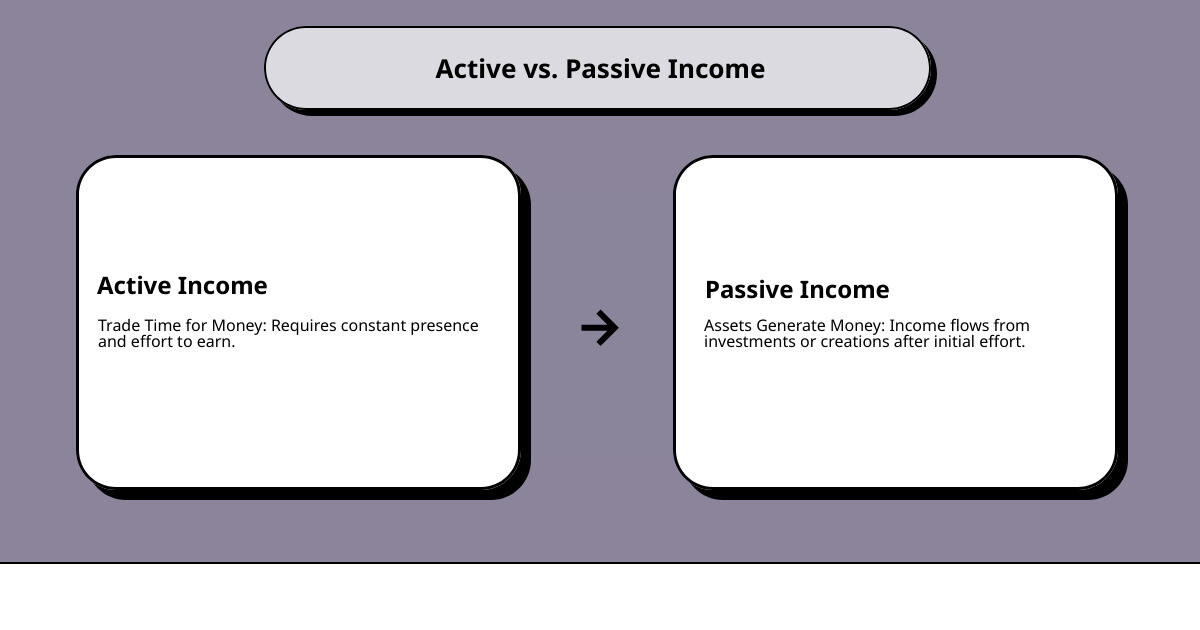
The key difference between active income and passive income is simple. Active income requires your constant presence – you work, you get paid, you stop working, the money stops. Passive income keeps flowing after you’ve done the upfront work.
With interest rates around 4-5% on bonds and high-yield savings accounts, dividend yields averaging 1.3% on the S&P 500, and platforms like REITs targeting 7-12% returns, the opportunities are real. But you need to choose the right strategy for your situation.
In this guide, we’ll walk through seven proven passive income ideas, what they require to start, and how to choose the best fit for you.
Understanding the Spectrum of Passive Income
When we talk about passive income ideas, it’s important to understand that there’s a broad spectrum of options, each with different requirements for upfront investment and ongoing effort. The Internal Revenue Service (IRS) defines passive income as regular earnings from sources other than an employer or contractor, specifically citing rental property or a business in which one does not actively participate, such as book royalties or stock dividends. However, in practice, the term encompasses much more.
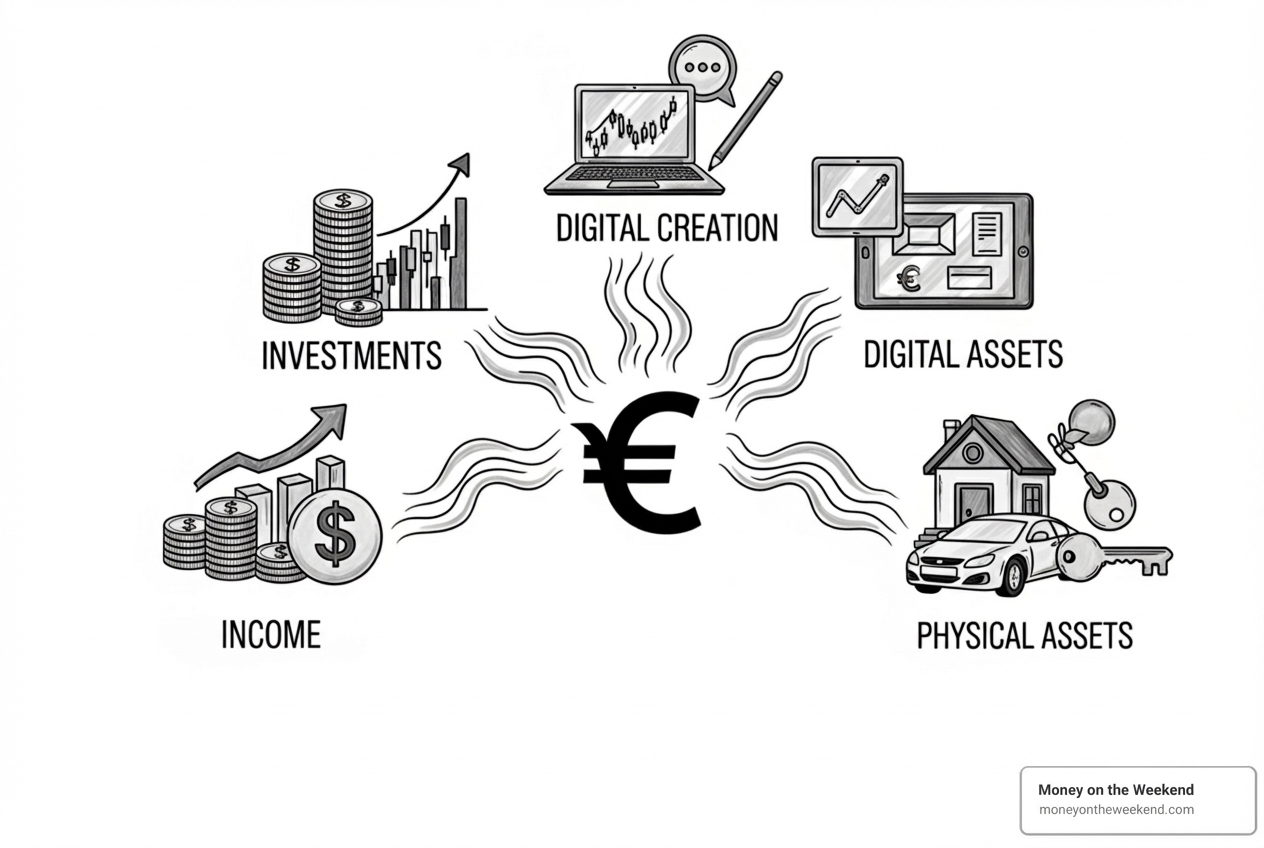
We categorize passive income into three main areas: Investment-Based, Creative/Digital, and Asset-Based income.
Investment-Based Income
This category typically requires a financial investment upfront. The goal is for your money to work for you. Examples include:
- Dividend Stocks & Bonds: Earning regular payouts from company profits or interest from loans to governments/corporations.
- High-Yield Savings & Certificates of Deposit (CDs): Guaranteed returns, often FDIC-insured, for parking your money. High-yield savings accounts in Canada, for example, are insured by the Canada Deposit Insurance Corporation (CDIC) up to $100,000 per account.
- Real Estate Investment Trusts (REITs): Investing in a portfolio of income-generating real estate without directly owning property.
- Peer-to-Peer (P2P) Lending: Lending money to individuals or small businesses through online platforms for interest.
- Private Equity & Startup Investments: Investing in private companies, often with higher risk but potentially higher returns.
- Crypto Staking: Earning rewards by holding specific cryptocurrencies in a wallet to support network operations.
Creative and Digital Income
This type of passive income leverages your skills, knowledge, or creative output. It often requires a significant upfront time and effort investment to create a product or system, which then generates income with minimal ongoing work.
- Ebooks & Online Courses: Creating educational content that can be sold repeatedly.
- Digital Templates & Designs: Selling spreadsheet templates, graphic designs, or website themes.
- Stock Photos & Music: Licensing your creative work for others to use.
- Blogging & YouTube Channels: Building an audience and monetizing through ads, affiliate marketing, or sponsorships.
- Mobile Apps: Developing an application that generates revenue through sales, subscriptions, or ads.
- Print-on-Demand & Dropshipping: Setting up an online store where products are created or shipped by a third party only after a sale is made.
Asset-Based Income
This category involves monetizing physical assets you own or control.
- Rental Properties: Earning income from residential or commercial real estate.
- Unused Space Rentals: Renting out storage space in your home, garage, or even a parking spot.
- Vehicle Rentals & Ads: Renting out your car, RV, or boat, or earning money by displaying advertisements on your vehicle.
- Vending Machines: Owning and operating machines that sell products.
Risk Tolerance, Capital, and Time Investment
The “best” passive income idea depends heavily on your individual circumstances. Some ideas require substantial capital (like direct real estate investment), while others demand significant upfront time and effort (like creating an online course or building a blog). Your risk tolerance is also a major factor; high-yield investments often come with higher risk. As we explore these ideas, consider which aligns best with your resources and comfort level.
For more information on how we guide individuals to financial freedom, visit our Passive Income page.
7 Top Passive Income Ideas to Build Wealth
Now, let’s dive into some of the most effective and popular passive income ideas that can help you build long-term wealth.
1. Dividend Investing: Earn from Company Profits
Dividend investing is a classic strategy for generating passive income. When you invest in dividend stocks, you purchase shares in companies that regularly distribute a portion of their earnings to shareholders. These payouts are typically made quarterly and can be a steady source of income.
For example, Coca-Cola (KO) paid a quarterly dividend of $0.48 per share in 2024, totaling $1.92 per share annually. To generate $12,000 a year from Coca-Cola at $60 per share, you’d need to invest nearly $375,000. For broader market exposure, the S&P 500’s dividend yield is currently under 1.3%, meaning you’d need over $700,000 invested to earn $10,000 a year. This illustrates that significant capital is often required for substantial dividend income.
To diversify and reduce risk, many investors opt for Dividend Exchange-Traded Funds (ETFs). These funds hold a collection of dividend-paying stocks, giving you exposure to many companies without having to research each one individually. When selecting dividend stocks or ETFs, it’s wise to focus on “Dividend Aristocrats”—companies that have consistently raised their dividends for at least 25 consecutive years.
A powerful aspect of dividend investing is compounding returns. By reinvesting your dividends to buy more shares, you increase your future payouts, accelerating your wealth growth over time.
While dividend investing can be quite passive once set up, it’s not without risks. Market volatility can affect stock prices, and a company might cut its dividend if its financial health declines. Therefore, we always recommend you ask yourself these questions before making any investment decisions.
2. Affiliate Marketing: Monetize Your Content
Affiliate marketing is an excellent way to earn passive income by promoting products or services you love and trust. It involves earning a commission when someone purchases through your unique referral link. The commission for affiliate marketing might range from 3% to 7%, but some programs offer much higher rates. For instance, Shopify affiliates earn an average of $58 for every user who signs up for a paid plan.
The beauty of affiliate marketing is that you don’t need to create your own products, handle inventory, shipping, or customer service. Your main job is to drive traffic and make recommendations.
To succeed, you need to choose a niche selection that aligns with your interests and expertise. This could be anything from personal finance and tech gadgets to health and beauty. Once you have a niche, you’ll need a platform to share your recommendations. A Blogging website or a strong social media presence are common choices.
Content creation is at the heart of affiliate marketing. You’ll need to produce valuable content—reviews, tutorials, guides, comparisons—that genuinely helps your audience. The upfront work involves consistently creating high-quality content and actively working on building an audience. This takes time, but once established, your content can continue to generate income long after it’s published.
While it has high earning potential, affiliate marketing requires significant upfront effort to build an audience and trust. It’s not a “set it and forget it” strategy; you’ll need to maintain your content and adapt to market changes. For a comprehensive guide on getting started, check out our Affiliate Marketing Beginners Guide.
3. Digital Products: Create Once, Sell Forever
Digital products are one of our favorite passive income ideas because they offer high-profit margins and virtually no overhead costs once created. You put in the work once, and then you can sell it an infinite number of times.
This category includes:
- Ebooks: If you have expertise in a particular area or a story to tell, writing an ebook can be a fantastic option. Platforms like Amazon Kindle make self-publishing accessible. While a reporter for Vice earned “a few dollars per day” selling an ebook, royalties typically range from 7.5% to 12.5% of the sale price. The real work comes in the writing and, crucially, the marketing.
- Online Courses: Share your knowledge and skills by creating an online course. Platforms like Teachable or Courses Plus can host your content and handle payments, making it easy to get started. The average online course earns about $3,000, with top earners diversifying their offerings. It’s labor-intensive to create, but once launched, it can provide consistent income.
- Templates: From spreadsheet templates for budgeting to graphic design templates for social media, digital templates are in high demand. Etsy seller Emily McDermott, for instance, claims to have made over $200,000 in less than two years selling Excel and Google Sheet templates.
The key benefits here are low overhead (no physical inventory, manufacturing, or shipping) and high-profit margins. The challenges lie in the upfront work of creation and marketing to stand out in a crowded market. However, with compelling value and effective promotion, digital products can become robust passive income streams. Learn more about effective Content Creation to make your digital products shine.
4. Real Estate Investing: Build Tangible Wealth
Real estate has long been a cornerstone of wealth building, and it offers several avenues for passive income.
- Rental Properties: Owning rental properties can provide steady monthly income. While often considered passive, it requires significant upfront investment and can involve ongoing work like maintenance, tenant management, and property upkeep. The average annual income for landlords in the United States was reported at $87,280 in 2025, but this varies widely. To make it more passive, you can hire a property manager, though this will reduce your net income. We can also consider renting out a spare room in your home. Hosting guests in a spare room or property can bring in hundreds to thousands of dollars per month; the average annual earnings for an Airbnb host in the US are around $14,000.
- Real Estate Investment Trusts (REITs): If you want exposure to real estate without the hassle of direct property ownership, REITs are an excellent option. A REIT is a company that owns and manages income-producing real estate across various sectors (e.g., apartments, shopping centers, hotels). REITs are legally required to distribute at least 90% of their taxable income to shareholders annually, making them a great source of passive income. Platforms like Fundrise typically target returns of 7% to 12%, and you can often start with a minimum investment of $500. What is a REIT?
- Real Estate Crowdfunding: This involves pooling money with other investors to fund larger real estate projects. It offers a way to invest in private real estate deals with lower capital requirements than direct ownership.
The upfront capital for direct rental properties can be substantial, though REITs and crowdfunding offer lower entry points. Risks include market downturns, property damage, and tenant issues. However, with careful planning and diversification, real estate can be a powerful wealth-building tool. For those starting on a budget, consider exploring other 10 Businesses You Can Start on a Budget in 2024.
5. Peer-to-Peer (P2P) Lending: Become the Lender
Peer-to-peer (P2P) lending allows individuals to lend money directly to other individuals or small businesses, bypassing traditional financial institutions. This can be a rewarding way to earn passive income through interest payments.
Platforms like Prosper.com and Worthy connect borrowers with lenders. On Prosper.com, the minimum investment per loan is as low as $25, making it accessible for beginners. Interest returns typically average around 5% to 10% annually, making it more attractive than traditional savings accounts.
Diversification is crucial in P2P lending. Instead of putting all your money into one loan, spread it across multiple loans to mitigate the risk of borrower default. While platforms use algorithms to help with risk assessment, it’s still important to do your own research into the borrower’s credit history and loan purpose where possible.
The main risks include borrower default (the borrower doesn’t repay the loan) and platform risk (the lending platform itself fails). However, with careful selection and diversification, P2P lending can be a viable passive income idea. To understand the mechanics in more detail, read our guide on How P2P lending works.
6. YouTube Channel: Turn Passion into Paychecks
Starting a YouTube channel might not sound immediately “passive,” but once your videos are created and gaining traction, they can generate income for years to come with minimal ongoing effort. A whopping 2.7 billion people worldwide use YouTube every month, representing a massive audience.
The key is to choose a compelling niche idea that you’re passionate about and knowledgeable in. This could be anything from cooking tutorials and gaming commentaries to educational content or product reviews.
Monetization methods for YouTube channels are diverse:
- Ad Revenue: Once you meet the YouTube Partner Program requirements (a minimum number of views and subscribers), you can earn money from ads displayed on your videos. Most estimates put the average earnings per YouTube ad view at 1¢ to 3¢.
- Affiliate Marketing: Integrate affiliate links into your video descriptions, recommending products related to your content.
- Sponsorships & Brand Deals: As your channel grows, brands may pay you to promote their products or services.
- Selling Your Own Products: Use your channel to drive sales for your digital products (like those mentioned above) or merchandise.
The upfront work for a YouTube channel is significant. You’ll need to consistently create high-quality video content, learn about video editing, search engine optimization for YouTube, and actively engage with your audience to build subscribers. However, once a video goes “evergreen” and continues to attract viewers over time, it becomes a truly passive income stream. For guidance on getting started, check out our Create Great YouTube Channel Guide and explore various YouTube Video Ideas.
7. Asset Rentals: Monetize What You Already Own
One of the most straightforward passive income ideas involves leveraging assets you already possess. The sharing economy has made it easier than ever to rent out unused items or spaces.
- Car Rentals: Do you have a car that sits idle for extended periods? Services like Turo allow you to rent out your vehicle to others. A Reddit discussion among Turo users reveals it’s possible to make “several hundred dollars per month.” This is a great way to offset car ownership costs or generate extra cash while you’re on vacation. Remember to check your insurance coverage!
- Space Rentals: If you have extra space—a spare room, a garage, a basement, or even an unused shed—you can rent it out for storage. The storage industry is expected to grow 5.9% annually until 2030, indicating a strong demand. Platforms like Neighbor, Peerspace, and StoreAtMyHouse connect you with people looking for storage.
- Parking Spaces: In urban areas, a dedicated parking spot can be a valuable asset. Some rented parking spaces in New York, for example, earn “more than $300 per month.” You can list your spot on platforms like Spacer or local classifieds.
The beauty of using existing assets is that your primary investment is already made. The risks involve potential damage to your assets, liability concerns, and the effort required to manage bookings and interactions. However, with proper contracts and insurance, asset rentals can be a steady and relatively effortless source of income. Explore more about How to rent out your car or space and find other Weekend Income Opportunities that leverage what you already have.
Key Questions About Passive Income Ideas
We often get asked common questions about passive income. Here are our insights:
How many passive income streams should I have?
There’s no magic number for the ideal amount of passive income ideas to pursue. You can have as many streams as you want, but we generally recommend starting with one or two. It’s crucial to focus on quality over quantity, especially when you’re beginning. As the financial literacy evangelist Tiffany Grant wisely notes, “All passive income projects involve some form of time, energy, or financial commitment on the onset… Sometimes people will give up before it has a chance to truly take root and grow.”
Once you’ve successfully established one or two streams and they’re generating consistent income, you can then consider diversifying over time. This approach allows for better manageability and reduces the risk of spreading yourself too thin. Diversification across non-correlated assets is also recommended to safeguard your income against market fluctuations.
What are the best passive income ideas for beginners?
For those just starting or with limited capital, we recommend focusing on passive income ideas that require less financial investment and more leveraging of your time and skills.
- High-Yield Savings Accounts & CDs: These are low-risk options with guaranteed returns. With yields around 4% for Certificates of Deposit (CDs), they offer a safe way to earn interest. In Canada, high-yield savings accounts are insured by the CDIC up to $100,000. Consider CD laddering to generate consistent income.
- REIT ETFs: Investing in a Real Estate Investment Trust ETF provides diversified exposure to real estate with a relatively low minimum investment, without the complexities of direct property ownership.
- Affiliate Marketing: As discussed, this can be started with minimal financial outlay, primarily requiring time to build content and an audience. Our Affiliate Marketing guide is a great starting point.
- Digital Products: Leveraging your existing knowledge to create an ebook or simple templates requires time and expertise, not necessarily capital.
While investing in index funds or dividend stocks can be considered easy, generating substantial income from them typically requires significant capital. For beginners, the focus should be on building momentum and understanding the principles of passive income generation.
How can I start generating passive income with no money?
If you have limited or no money to invest, you’ll need to lean heavily on your time, effort, and existing skills. The good news is there are several passive income ideas that fit this bill:
- Leverage Time and Skills: As we’ve emphasized, many passive income streams are front-loaded with effort. You’re trading your time and knowledge for future income.
- Blogging: Starting a blog requires consistent content creation and promotion to build an audience, which can then be monetized through ads, affiliate marketing, or selling your own digital products. It takes time, but costs can be minimal.
- Starting a YouTube Channel: Similar to blogging, this requires a significant investment in content creation and audience building, but the financial outlay can be very low if you start with basic equipment.
- Writing an Ebook: If you have expertise, writing and self-publishing an ebook costs little beyond your time.
- Affiliate Marketing: As highlighted before, this is a prime example of an income stream that can be started with little to no capital, relying on your ability to create compelling content and build trust with an audience.
- Selling Digital Designs or Templates: If you have design skills, you can create and sell digital products like spreadsheet templates, logos, or website themes on marketplaces. Etsy seller Emily McDermott made over $200,000 selling spreadsheet templates, proving the potential without significant capital.
- Renting Out Existing Assets: This is a fantastic way to generate income without spending more money. Rent out your spare room, your car on Turo, or even unused storage space in your home.
The common thread among these no-money passive income ideas is the trade-off: what you lack in capital, you must make up for in dedication, learning, and consistent effort.
Conclusion: Your First Step Towards Financial Freedom
We’ve explored a diverse range of passive income ideas, from dividend investing and real estate to digital products and asset rentals. What ties them all together is the principle of putting in initial work or capital to create a system that generates ongoing income with minimal additional effort.
Passive income is a journey, not a destination, and certainly not a get-rich-quick scheme. Building significant passive income takes time, strategy, and often, substantial upfront investment. For example, many successful digital entrepreneurs spend years building their portfolios to a point where their passive income allows them to leave a traditional job and pursue their passions.
Successful passive income generation hinges on careful planning and strategy. It involves researching opportunities, assessing risks, understanding tax implications, and consistently nurturing your income streams. Diversifying your passive income streams is a best practice, as it provides resilience against economic downturns and market volatility.
At Money on the Weekend, our mission is to guide you towards financial freedom through online income generation and digital entrepreneurship. We believe that by strategically implementing passive income ideas, you can empower yourself to find financial freedom in your spare time.
So, take the first step today. Choose an idea that resonates with your skills, interests, and resources, and commit to the upfront work required. Your future self will thank you.