
Why Building Passive Income Streams Is Your Path to Financial Freedom
The 10 best passive income ideas in this guide can genuinely change your financial future. But let’s be clear: passive income isn’t about getting rich overnight. It’s about putting in focused work upfront to build income streams that eventually require minimal maintenance.
Quick Answer: The 10 Best Passive Income Ideas
- Dividend Stocks – Earn 1-6% annual yields from company profits
- Real Estate Crowdfunding – Invest in property with as little as $5,000
- Affiliate Marketing – Earn commissions promoting products you trust
- Online Courses – Package your expertise once, sell repeatedly
- Digital Products – Create downloadable templates, art, or ebooks
- Blog or YouTube Channel – Build an audience, monetize with ads and sponsors
- Dropshipping – Run an e-commerce store without holding inventory
- Rent Out Your Assets – Turn your car, room, or storage space into income
- Peer-to-Peer Lending – Earn 5-10% returns lending to individuals
- Rental Properties – Generate $16,000+ annually per property
Most passive income requires an upfront investment of money (like buying stocks), time (like creating a course), or both. For example, generating just $10,000 annually from S&P 500 dividends could require over $700,000 invested.
But you don’t need hundreds of thousands to start. Many of these ideas require minimal capital if you’re willing to invest your time and skills. The opportunities are real and expanding, with industries like affiliate marketing and online learning growing rapidly.
This guide cuts through the hype to show you what actually works. We’ll break down the investment, potential returns, and pros and cons for each idea, helping you find the right path whether you have time, money, or both.
What is Passive Income (And Why You Need It)
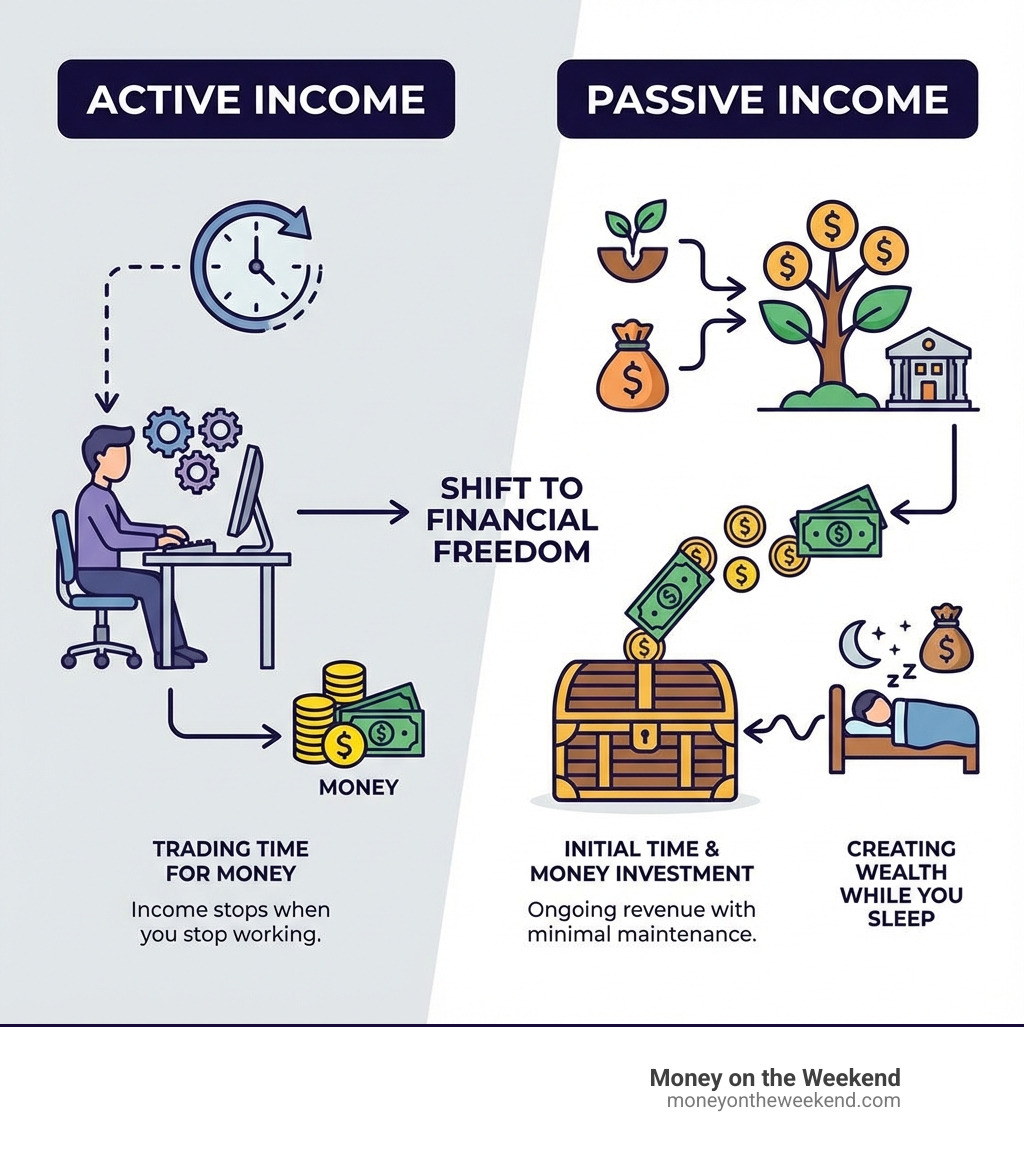
Passive income is money earned with minimal ongoing effort after an initial setup. The IRS defines it as earnings from a rental property or a business where you don’t actively participate. This is the opposite of active income, which you earn by trading your time directly for money at a job. If you stop working, your active income stops.
Passive income works differently. It requires an upfront investment of time or money to create an asset—like a rental property, a portfolio of stocks, or a digital product. Once that asset is established, it generates revenue for you with much less active involvement, like a fruit tree that produces fruit year after year after being planted.
Why is this crucial for financial success? Because it’s a powerful tool for building wealth and achieving financial freedom. When your passive income exceeds your living expenses, you’re no longer solely dependent on a paycheck. This creates a safety net and gives you the freedom to pursue passions, travel, or even retire early.
However, it’s important to debunk the “get rich quick” myth. Every one of the 10 best passive income ideas requires upfront dedication. But once established, these income streams can work for you around the clock, providing the foundation for true financial independence.
The 10 Best Passive Income Ideas to Build Wealth
To help you steer the diverse world of passive income, we’ve compiled a table comparing our top 10 ideas across key metrics. This includes investment-based income options, those rooted in business ventures, and real estate income streams.
| Idea | Upfront Investment (Time/Money) | Potential Return | Passivity Level |
|---|---|---|---|
| 1. Dividend Stocks | Medium to High Capital | 1-6% yield + appreciation | Very High |
| 2. Real Estate Crowdfunding | Low to Medium Capital | 7-12% | High |
| 3. Affiliate Marketing | Low Cost, High Time | Varies widely | Medium |
| 4. Online Courses | Low Cost, Very High Time | High, thousands per month | Medium to High |
| 5. Digital Products | Low Cost, Medium Time | Varies, side income to full-time | High |
| 6. Blog or YouTube Channel | Low Cost, Very High Time | Varies, $0 to six figures | Medium |
| 7. Dropshipping | Low Cost, Medium Time | Average around $41,000/year | Medium |
| 8. Rent Out Your Assets | None if you own the asset | Hundreds to thousands per month | Medium |
| 9. Peer-to-Peer (P2P) Lending | Low to Medium Capital | 5-10% | High |
| 10. Own Rental Properties | Very High Capital and Time | Average $16,000+/year | Low to Medium |
1. Invest in Dividend Stocks
Investing in dividend stocks is a classic, truly passive way to generate income. When you own a dividend stock, you own a piece of a company that shares a portion of its profits with you, typically every quarter.

Some of the most reliable payers are “Dividend Aristocrats”—companies that have increased their dividends for at least 25 consecutive years. While the S&P 500’s average yield is low, some stable dividend stocks can offer yields from 4% to over 6%. To generate significant income, however, you need substantial capital. For example, earning $12,000 a year from a stock like Coca-Cola would require an investment of nearly $375,000.
Pros:
- Truly passive: Once invested, you simply collect payments.
- Compounding returns: Reinvest dividends to buy more shares and accelerate growth.
- Diversification: Can help stabilize a portfolio.
Cons:
- Market risk: Stock values can fall, and dividends aren’t guaranteed.
- Requires significant capital: Substantial income requires a large initial investment.
Upfront Investment: Medium to high capital.
Potential ROI: 1-6% yield plus potential stock appreciation. For a diversified approach, consider dividend-paying Exchange Traded Funds (ETFs).
2. Real Estate Crowdfunding
For those who want real estate income without being a landlord, real estate crowdfunding is an excellent option. This method lets you pool your money with other investors to buy into large-scale commercial or residential properties.
Platforms like Fundrise allow you to invest in diversified property funds with as little as $100, targeting returns of 7% to 12%. Another popular avenue is investing in Real Estate Investment Trusts (REITs), which are companies that own income-producing real estate. REITs are required to pay out at least 90% of their taxable income to shareholders. Historically, REITs have performed well, with average returns of about 12.6% from 1972 to 2024.
Pros:
- Low capital entry: Start with as little as $100.
- No landlord duties: Professionals manage the properties.
- Diversification: Invest in a portfolio of properties.
Cons:
- Illiquid: Your money may be tied up for several years.
- Platform fees: Most crowdfunding platforms charge management fees.
- Market volatility: REITs are traded like stocks and their value can fluctuate.
- Accredited investor requirements: Some deals are limited to accredited investors.
Upfront Investment: Low to medium capital.
Potential ROI: 7-12% (crowdfunding targets), REITs average 12.6%.
3. Start Affiliate Marketing
Affiliate marketing is earning a commission by promoting products or services you trust. When someone makes a purchase through your unique affiliate link, you get paid. With the market projected to hit $12 billion in 2025, it’s a major driver of online sales.
The appeal is that you don’t need to create products, manage inventory, or handle customer service. Your job is to create valuable content—like blog posts or reviews—that integrates product recommendations. Commissions vary, but some programs offer high payouts; for instance, Shopify affiliates can earn an average of $58 per paid signup.
Pros:
- Low startup cost: Mainly requires time to create content.
- High-income potential: Income can scale as your audience grows.
- No product management: Focus solely on marketing.
- Flexibility: Work from anywhere.
Cons:
- Time-intensive: Building a trusted audience takes time.
- Competition: Many others are promoting similar products.
- Dependent on others: Your income relies on the brands you promote.
Upfront Investment: Low cost, high time.
Potential ROI: Varies widely, but can become a significant income stream.
Affiliate Marketing Passive Income
What is Affiliate Marketing?
4. Create and Sell an Online Course
If you have expertise in a specific skill, you can package it into an online course and sell it repeatedly. The online learning market is booming, with a projected annual growth rate of 19% from 2025 to 2030.
Once you create your course and upload it to a platform like Teachable or Udemy, it can generate income for years. You create the content once, and it works for you 24/7. While top earners can make thousands per month, success depends heavily on market demand and your marketing efforts. For example, on Udemy, 75% of instructors make less than $1,000 annually, highlighting the importance of choosing a popular topic.
Pros:
- High-profit margins: Very low cost per sale after creation.
- Scalable: Sell to an unlimited number of students.
- Leverages your expertise: Turn your knowledge into an asset.
- Builds authority: Establishes you as an expert.
Cons:
- High upfront time investment: Creating a quality course takes significant effort.
- Marketing required: You must promote your course to find students.
- Competition: The market is growing and can be competitive.
Upfront Investment: Low cost, very high time.
Potential ROI: High, potentially thousands per month for successful courses.
5. Sell Digital Products
Selling digital products allows you to create something once and sell it infinitely without managing physical goods. This includes items like e-books, printable planners, spreadsheet templates, digital art, or music. The digital art market alone is growing at a predicted 14% CAGR.
Your product is a file that customers purchase and download instantly, eliminating the logistical headaches of shipping and inventory. Success stories abound, like Emily McDermott, who made over $200,000 in two years selling spreadsheet templates on Etsy. Marketplaces like Whop report that sellers can earn over $2,000 a month.
Pros:
- Create once, sell forever: Excellent leverage of your time.
- No inventory or shipping: Eliminates logistical costs and hassles.
- High-profit margins: Minimal costs after the initial creation.
- Global reach: Sell to anyone, anywhere.
Cons:
- Niche saturation: Some markets can be crowded.
- Requires creation skills: You need to produce high-quality products.
- Marketing effort: You still need to promote your products.
Upfront Investment: Low cost, medium time.
Potential ROI: Varies, from a side income to a full-time living.
What are the Different Types of Digital Content Creators?
6. Start a Blog or YouTube Channel: One of the 10 best passive income ideas for creatives
For storytellers and educators, a blog or YouTube channel can become a powerful income engine. While it requires a significant upfront time investment to build an audience, the rewards can be substantial. YouTube alone has 2.7 billion monthly users, offering a massive potential audience.
Once you have traffic, you can monetize through:
- Advertising: Displaying ads on your site or in videos.
- Affiliate marketing: Recommending relevant products.
- Sponsored content: Partnering with brands.
- Selling your own products: Courses, e-books, or merchandise.
Established blogs can generate over $30,000 per month, and successful YouTubers can also earn six-figure incomes. However, this is a long game. It takes time, consistency, and high-quality content to build a loyal following and see a return.
Pros:
- Multiple income streams: Diversify your revenue sources.
- Builds authority: Establishes you as a leader in your niche.
- Long-term asset: Old content can generate income for years.
Cons:
- Very slow to start: It can take months or years to see significant income.
- High competition: Standing out requires unique value and effort.
- Requires consistent content: Not entirely passive, especially at first.
Upfront Investment: Low cost, very high time.
Potential ROI: Varies dramatically, from $0 to six figures annually.
How to Start Making Money on YouTube Fast
Passive Income / Blogging
7. Dropshipping
Dropshipping is an e-commerce model where you run an online store without holding inventory. When a customer places an order, a third-party supplier ships the product directly to them. This saves you from investing in stock and managing logistics. The dropshipping market is projected to grow immensely, reaching a value of $143 trillion by 2030.
Your main tasks are setting up your store, finding reliable suppliers, marketing, and customer service. According to a Ziprecruiter survey, the average dropshipper earns around $41,000 per year, though income can vary significantly based on trends and marketing.
Pros:
- Low startup cost: No need to buy inventory upfront.
- Wide product selection: Easily offer a variety of products.
- Flexibility: Operate your business from anywhere.
Cons:
- Low margins: Profit per sale can be small.
- Customer service challenges: You are responsible for supplier mistakes.
- Supplier dependency: Quality control and shipping are out of your hands.
- High competition: It’s a crowded market.
Upfront Investment: Low cost, medium time.
Potential ROI: Varies, with an average around $41,000 per year.
8. Rent Out Your Assets
The sharing economy makes it easy to turn underused assets into income. You can monetize your car, spare room, storage space, or even a parking spot.
- Spare Room/Home: Platforms like Airbnb let you list your property for short-term stays. The average US host earns around $14,000 annually.
- Your Car: If your car sits idle, services like Getaround or Turo let you rent it out, with many users making several hundred dollars per month.
- Storage Space: An unused garage, attic, or shed can be rented out on platforms like Neighbor. With the average self-storage unit costing over $100/month, you can offer a competitive rate.
- Parking Spot: In urban areas, a parking spot can be a goldmine, earning over $300 per month in cities like New York.
Pros:
- Monetize what you own: Generate income from existing assets.
- Relatively low effort: Platforms often handle bookings and payments.
- Flexible: You control availability and pricing.
Cons:
- Wear and tear: Your assets will see more use and potential damage.
- Liability: Ensure you have proper insurance coverage.
- Local regulations: Be aware of rules and taxes for short-term rentals.
Upfront Investment: None if you already own the asset.
Potential ROI: Hundreds to thousands of dollars per month.
9. Peer-to-Peer (P2P) Lending
Peer-to-peer (P2P) lending platforms connect individual lenders with borrowers, bypassing traditional banks. As an investor, you fund portions of various loans and earn interest as they are repaid. This can offer higher returns than savings accounts, with investors averaging about 5% to 10% per year. For example, the historical average return on the platform Prosper is 5.3%.
Platforms like Prosper allow you to start with as little as $25 per loan. To minimize risk, it’s wise to diversify your investment across many different loans. This way, a single borrower default won’t severely impact your overall portfolio.
Pros:
- Higher returns: More attractive interest rates than traditional savings.
- Passive income: Receive monthly repayments with interest after funding.
- Diversification: A good way to diversify beyond stocks and bonds.
- Low entry point: Start with a small amount of capital.
Cons:
- Default risk: Borrowers may not repay their loans.
- Unsecured loans: Many P2P loans have no collateral.
- Illiquidity: Your money is tied up for the loan’s term.
Upfront Investment: Low to medium capital.
Potential ROI: 5-10% annual returns.
10. Own Rental Properties: One of the 10 best passive income ideas for long-term wealth
Investing in physical rental properties is a classic way to build wealth. While often called passive, it’s more “semi-passive” due to the upfront effort and ongoing management required. Income comes from tenant rent, and you also benefit from long-term property appreciation.
The average landlord made just over $16,000 from a leased property in 2024. For tax purposes, the IRS generally considers this passive income if you are not a real estate professional, which can offer certain tax advantages.
Pros:
- High potential returns: Combines monthly cash flow with asset appreciation.
- Tax benefits: Deductions for expenses, depreciation, and more.
- Inflation hedge: Rents and property values tend to rise with inflation.
- Tangible asset: You own a physical property.
Cons:
- High capital and time investment: Requires a large down payment and management.
- Not truly passive: Can involve dealing with tenants and maintenance.
- Market fluctuations: Property values and rental demand can fall.
- Legal complexities: Landlord-tenant laws can be intricate.
Upfront Investment: Very high capital and time.
Potential ROI: Average income over $16,000/year per property, plus appreciation.
How to Choose the Right Idea for You
Choosing the best passive income ideas for your situation depends on your available capital, skills, and risk tolerance.
For Beginners with Little Capital:
If you’re starting with limited funds, focus on leveraging your time and skills. Options like affiliate marketing, creating digital products, or starting a blog require minimal financial investment but a significant time commitment. You’re substituting time for capital. Renting out assets you already own is another great, no-capital starting point.
10 Businesses You Can Start on a Budget in 2024 is a great resource for low-cost ventures.
For Those with Existing Capital:
If you have money to invest, you can pursue more hands-off options. Dividend stocks, real estate crowdfunding, and P2P lending allow your money to work for you with minimal ongoing management. These prioritize consistent returns and are highly passive.
Diversifying Income Streams:
The best strategy is to diversify. Start with one or two ideas that align with your resources. As you gain experience and capital, you can add more streams. This increases your income and mitigates risk, building a solid foundation for financial freedom.
Legal and Tax Considerations
While the income might be passive, your responsibility to the taxman is not. It’s crucial to understand the legal and tax implications of your earnings.
First, all income is generally taxable. The IRS defines passive income as coming from rental property or a business in which you don’t actively participate. This distinction can affect how deductions and losses are treated.
The biggest tax pitfall is poor record-keeping, which can lead to misreported income and costly errors. We strongly advise meticulous tracking of all earnings and related expenses. Depending on your income source, you may need to pay estimated taxes quarterly.
However, you can often write off legitimate business expenses, which lowers your taxable income. Always keep careful records and consult a qualified tax professional to steer these complexities.
The IRS says passive income can come from two sources
Frequently Asked Questions about Passive Income
How can I make $1,000 a month in passive income?
Achieving this goal is possible, often by combining several income streams. For example, you could pair dividend income with earnings from an affiliate marketing blog and sales from a digital product. A $20,000 investment in a 6% dividend stock yields $100/month. A successful blog might bring in $500/month, and a popular digital product could add another $400/month. Focus on scaling one or two ideas effectively before diversifying.
What is the easiest form of passive income to start?
This depends on your resources:
-
With Capital: The easiest options are investments that require minimal effort after setup, like high-yield savings accounts, CDs, or diversified index funds/REITs. A $10,000 investment in a high-yield savings account with a 5% APY could earn over $40 per month with almost no work.
-
Without Capital: Affiliate marketing or selling digital products are accessible but require a significant upfront investment of time to create content and build an audience. They are low-cost to start but not “easy” in terms of effort.
Do I need to pay tax on passive income?
Yes, all income, whether active or passive, is generally taxable. The type of tax and how it’s calculated depends on the source. Investment income (dividends, interest) is taxed differently than business income (from dropshipping or digital products), which may be subject to self-employment tax. Always keep meticulous records of income and expenses, and consult a tax advisor to understand your specific obligations.
Start Building Your Passive Income Today
We’ve explored 10 best passive income ideas to boost your bank account and move you toward financial freedom. From stock dividends to digital products, the opportunities are vast.
Passive income is a journey that requires an initial investment of time or money. But the long-term rewards of financial independence and flexibility are well worth the upfront work. View it as building an asset that will serve you for years.
Our mission at Money on the Weekend is to empower you to find financial freedom through digital entrepreneurship. Take the first step today. Choose an idea that resonates with you, start small, and stay consistent. Your future self will thank you.