YouTube Cover Songs: Unlocking Your Monetization Potential
Can You Really Make Money from YouTube Cover Songs?

YouTube cover songs monetize — yes, it’s possible, and thousands of creators are doing it right now. Here’s the quick answer:
How cover song monetization works on YouTube:
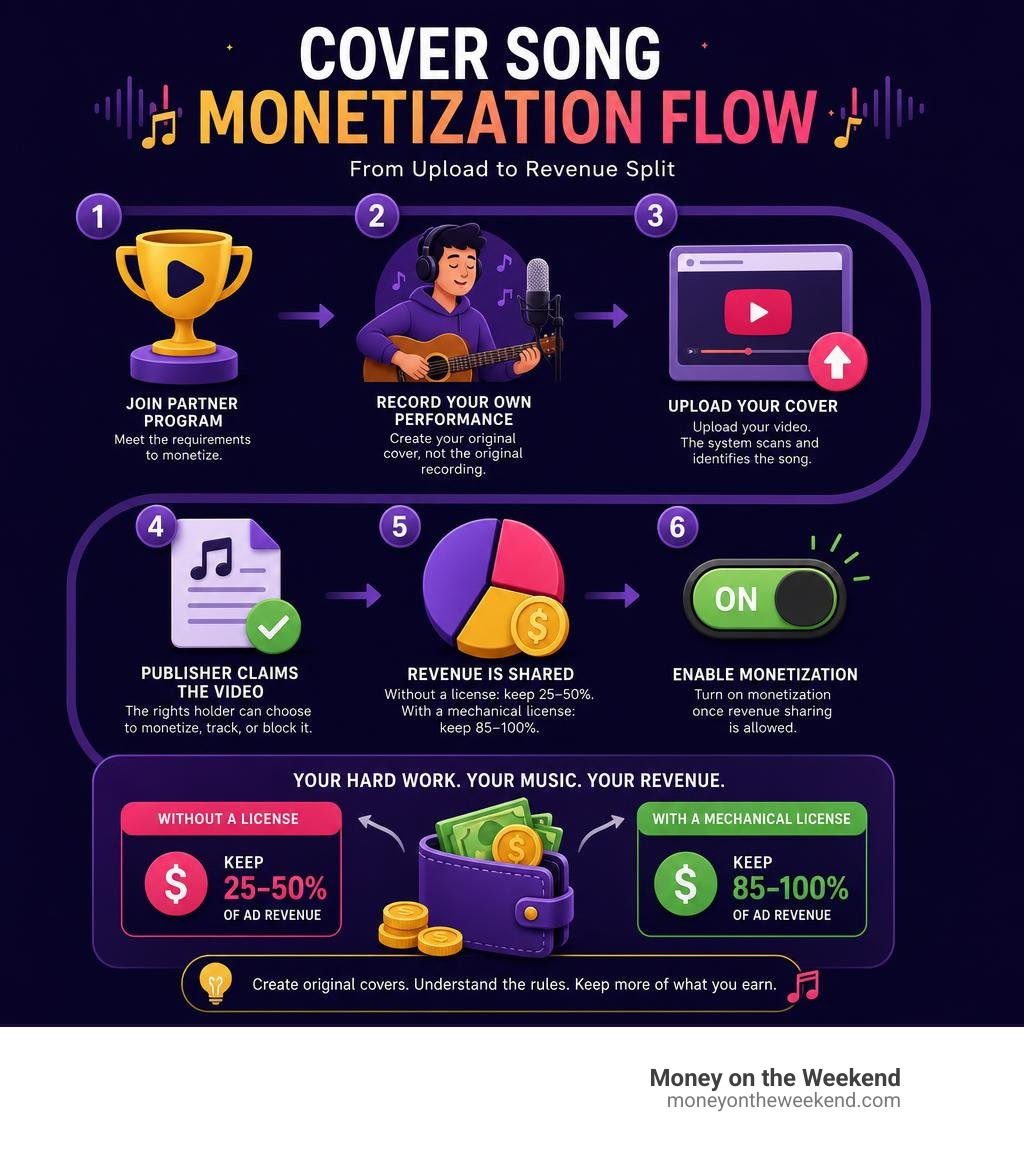
- Join the YouTube Partner Program (YPP) — you need 1,000 subscribers and 4,000 watch hours (or 10M Shorts views)
- Record your own original performance — do not use the original artist’s recording
- Upload your cover — YouTube’s Content ID system automatically scans it and identifies the underlying song
- The music publisher claims the video — they choose to monetize, track, or block it
- Revenue is shared — without a license, you typically keep only 25–50% of ad revenue; with a mechanical license, you can keep 85–100%
- Enable monetization in YouTube Studio — once a publisher claims and allows revenue sharing, you can switch monetization on for that video
Cover songs are one of the most searched music categories on YouTube. Searches like “[song name] cover” happen millions of times every month. That’s a huge built-in audience looking for exactly what you’re creating.
But here’s the catch most creators miss: uploading a cover and actually keeping the money from it are two very different things.
Without understanding how YouTube’s rights system works, you could be leaving half your revenue — or more — on the table. The difference between an unlicensed and a properly licensed cover can mean earning $25 versus $85 on the exact same video.
The good news? The rules are learnable, and the process is more straightforward than it looks.
Simple youtube cover songs monetize glossary:
Understanding YouTube’s Content ID and Copyright Rules
To successfully navigate music on YouTube, we must first understand the technology and legal frameworks running in the background. If you upload a cover song blindly, you are essentially playing roulette with your channel’s monetization status.
When we talk about music copyright, we are actually talking about two distinct rights:
- The Composition Rights: This belongs to the songwriters, lyricists, and their music publishers. It is the actual written music, melody, and lyrics.
- The Sound Recording Rights (Master Rights): This belongs to whoever recorded the audio (typically the performing artist or their record label).
When you record and upload a cover song, you own the sound recording rights because you played the instruments and sang the vocals. However, you do not own the composition rights. That underlying melody still belongs to the original publisher.
Understanding this distinction is key to knowing How to Tell if a YouTube Video is Monetized and how your own cover videos will be treated.
Content ID Claims vs. Copyright Strikes
Many creators panic when they see a copyright notification in their YouTube Studio dashboard. However, there is a massive difference between an automated system claim and a manual legal strike.
- Content ID Claims: This is YouTube’s automated scanning system. Within minutes of uploading, Content ID analyzes your audio against a massive database of fingerprinted files. If it matches a melody owned by a publisher, a “claim” is placed on your video. Content ID claims do not hurt your channel standing, nor do they result in channel termination. The rights holder simply decides whether they want to block your video, track its analytics, or share the ad revenue with you.
- Copyright Strikes (Manual DMCA Takedowns): This is a formal, legal request submitted by a copyright owner to have your video removed. Unlike automated claims, a copyright strike negatively impacts your channel standing. If you accumulate three copyright strikes within a 90-day period, YouTube will permanently terminate your channel. Fortunately, manual strikes are incredibly rare for straightforward cover videos because publishers prefer to monetize your traffic rather than take your video down.
The Role of Mechanical and Synchronization Licenses
If you want to take full control of your earnings and protect your content, you need to understand the two primary licenses associated with cover songs:
- Mechanical License: This grants you the right to reproduce and distribute a copyrighted musical composition as an audio recording. In the United States, mechanical licenses are compulsory, meaning as long as you pay the statutory rate (currently set at $0.14 per cover song in 2026), the original publisher cannot deny you the license.
- Synchronization (Sync) License: This is the right to sync music to moving images (a video). Unlike mechanical licenses, sync licenses are not compulsory. Publishers can charge whatever they want (often $500 to $10,000+ for popular tracks) or refuse to grant them entirely.
This is where the legal gray area of YouTube cover songs lies. Technically, to post a video of a cover song on YouTube, you need a sync license. However, because obtaining individual sync licenses is practically impossible for independent creators, YouTube has negotiated blanket global licensing agreements with major publishers.
These agreements allow the Content ID system to handle the licensing automatically, letting you post covers safely without getting sued. To dive deeper into the legal nuances of these permissions, check out this guide on Cover songs youtube permission.
How to Legally YouTube Cover Songs Monetize in 2026
Now that we understand the legal landscape, let’s explore how we actually turn those views into cold, hard cash. In 2026, the options for cover artists are better than ever, but your strategy will dictate how much of your hard-earned money you actually keep.
When you upload a cover song without any prior licensing, the Content ID system automatically flags it. In most cases, the publisher will opt for a default revenue split. Under this arrangement, you typically keep only 25% to 50% of the ad revenue, while the rest is routed to the publishers.
While a 50% split might sound acceptable for a hobbyist, it is a massive financial leak for anyone trying to build a sustainable online business. By utilizing proper licensing services, you can bypass this default split and retain 85% to 100% of your ad revenue.
To participate in any revenue sharing on YouTube, your channel must first be accepted into the YouTube Partner Program. You can review the updated guidelines in the YouTube Partner Program Terms. Once you are a partner, you can officially begin sharing revenue on eligible cover videos as outlined in the official Monetizing eligible cover videos – YouTube Help documentation.
Step-by-Step Guide: How to YouTube Cover Songs Monetize
If your channel is already monetized under the YPP, enabling revenue sharing on a cover song video is incredibly simple. Here is the exact workflow:
- Upload Your Video: Upload your cover video to YouTube as unlisted or public.
- Wait for Content ID: Allow 1 to 2 hours for YouTube’s automated system to process and scan your video.
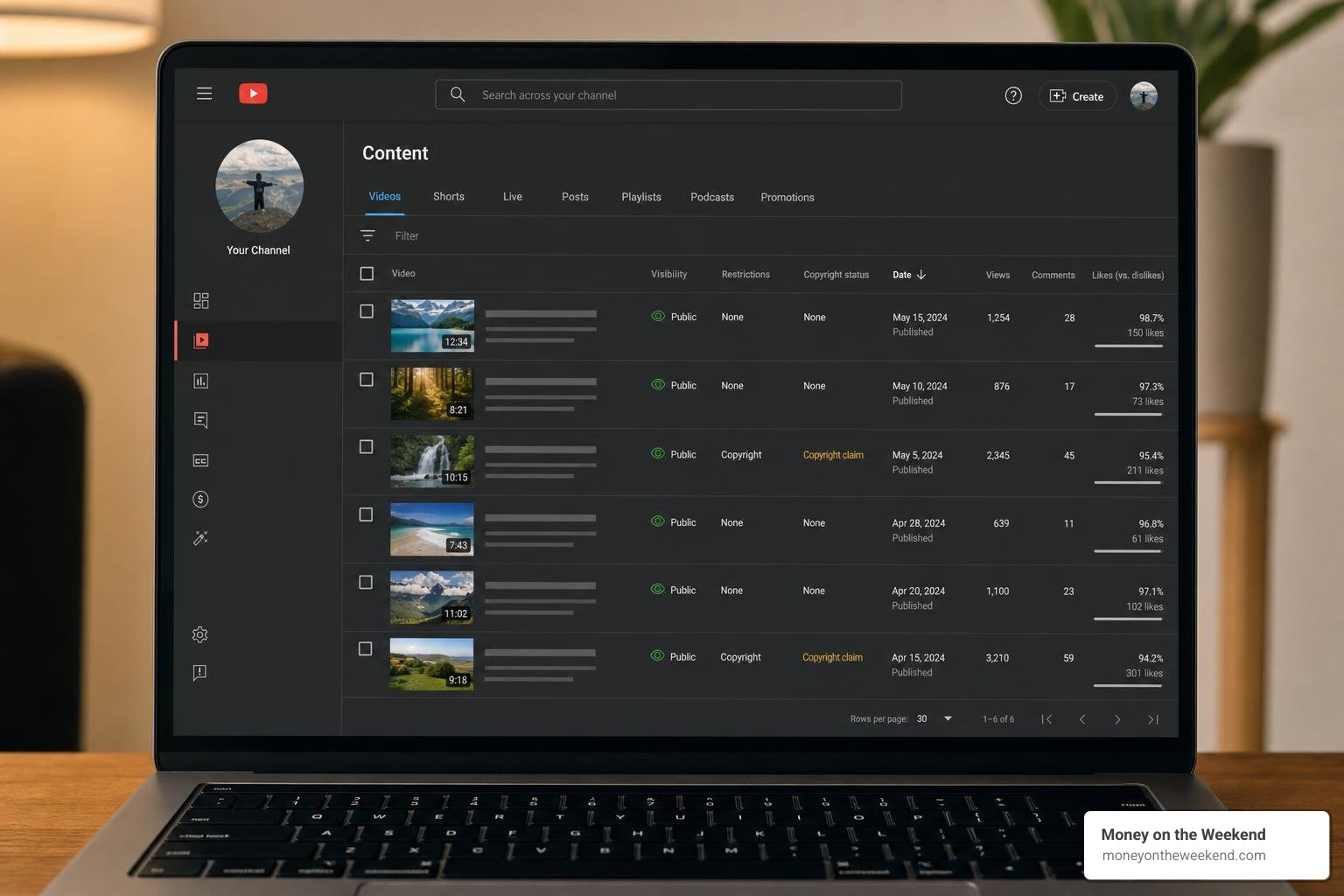
- Check the Content Page: Open your YouTube Studio and head to the Content tab.
- Look for the Copyright Restriction: In the Restrictions column, look for a label that says Copyright.
- Verify Revenue Sharing Eligibility: Hover your mouse over the “Copyright” text. If the song is eligible, you will see a tooltip stating: “The video is eligible to share ad revenue. Monetize this video to share revenue.”
- Toggle Monetization On: Switch the monetization status of the video from Off to On.
By completing these steps, you ensure that you are fully compliant with the YouTube Policy to Earn Money while safely splitting the ad revenue with the original composition owners.
Why You Should YouTube Cover Songs Monetize with Licensing Services
If you want to maximize your earnings, relying on YouTube’s default Content ID revenue split is a losing strategy. Instead, we highly recommend using third-party licensing services like DistroKid, Songfile, or Soundrop to secure a mechanical license.
When you secure a mechanical license, the licensing platform registers your cover song with rights databases. When the song is distributed to platforms like Spotify, Apple Music, and YouTube, the mechanical license applies retroactively. On YouTube, this often triggers the removal of the restrictive Content ID claim within 24 to 48 hours, allowing you to keep up to 100% of your creator share.
Let’s look at the financial reality of licensing your covers.
| Metric / Scenario | Unlicensed Cover (Default Content ID Split) | Licensed Cover (With Mechanical License) |
|---|---|---|
| Mechanical License Cost | $0.00 | $0.14 – $0.50 per song |
| Revenue Retention % | 25% – 50% | 85% – 100% |
| Typical Ad Revenue (per 1k views) | $0.50 – $1.50 | $1.50 – $4.00 |
| Earnings on 100k Views | $50 – $150 | $150 – $400 |
| Break-Even Period | N/A | 2 – 4 weeks |
| Estimated Monthly Earnings (10 Covers) | $250 – $500 | $848 – $998 |
As the data shows, spending a few cents to secure a mechanical license can increase your earnings by 3x to 4x. For serious cover artists, this is an absolute no-brainer.
DistroKid is highly recommended for creators who release both original music and covers, as their annual subscription covers unlimited uploads. If you only upload covers to YouTube and want to avoid recurring subscription fees, a pay-per-song service like Songfile or Soundrop is an excellent alternative.
Maximizing Revenue and Avoiding Common Pitfalls
Building a successful cover song channel requires more than just a great voice and a licensing platform. To secure your financial future, you must understand how to avoid legal traps while capitalizing on high-margin opportunities.
When planning your release schedule, it is highly beneficial to estimate your potential returns. You can use tools like the YouTube Views to Money Calculator to project your earnings based on different view counts and niches.
The Power of Public Domain Songs
What if you want to keep 100% of your revenue without paying a single cent in licensing fees? The answer lies in public domain songs.
In the United States, musical compositions published before 1928 are in the public domain. This includes thousands of legendary classical pieces, traditional folk songs, early jazz standards, and holiday classics.
Because the composition copyrights have expired, there are no rights holders to claim your video. When you record a fresh arrangement of Beethoven’s Moonlight Sonata or a traditional folk ballad, you own both the sound recording and the composition rights. This means you keep 100% of the ad revenue with zero licensing costs. Many classical and fingerstyle guitar channels build highly profitable businesses using this exact strategy.
Risks of Samples, Backing Tracks, and Lyric Changes
While cover songs are generally safe under the Content ID system, there are three critical mistakes that can get your video blocked, muted, or struck down instantly:
- Using Original Master Recordings or Samples: You cannot use the original artist’s backing tracks, vocal stems, or audio samples in your cover. If you do, you are violating the Sound Recording Rights (Master Rights). Unlike composition claims, master rights claims almost always result in your video being blocked worldwide or receiving a copyright strike. Everything in your audio track must be recorded entirely by you.
- Altering the Lyrics or Melody: A standard mechanical license only covers a faithful reproduction of the original song. If you significantly alter the lyrics, change the core melody, or translate the song into another language, the work is legally classified as a derivative work. Derivative works require direct, written permission from the publisher.
- Covering Unreleased Songs: Compulsory mechanical licensing only applies to songs that have already been officially released to the public. If you cover a leaked track or a song performed live but not yet officially distributed, the publisher can easily issue a manual DMCA takedown.
Collecting Performance Royalties with PROs
Many cover artists make the mistake of leaving passive income on the table by ignoring Performing Rights Organizations (PROs) like ASCAP, BMI, and SESAC.
When your cover song is streamed on YouTube or Spotify, it generates two types of royalties: mechanical royalties and public performance royalties. While your digital distributor collects your mechanical royalties, your performance royalties are collected by PROs.
By registering as a songwriter and registering your unique cover arrangements with a PRO, you can tap into an additional stream of passive income. To learn more about how to set up this double-dipping strategy, read the comprehensive guide on Cover Song Monetization [2026]: Earn Royalties on YouTube.
Strategic Business Models for Cover Song Channels
Relying solely on YouTube ad revenue is a fragile business model. The most successful cover artists treat YouTube as a marketing engine rather than their sole source of income.
By building an audience on YouTube, you are establishing a highly valuable digital asset that can be leveraged into multiple streams of Passive Income.
Using Covers as a Discovery Funnel
Why do cover songs work so well for growing a channel? It comes down to built-in search demand.
When you release an original song, no one is searching for it because no one knows it exists. But when you cover a trending hit, you instantly hijack the search traffic of that massive artist.
The smartest strategy is to use cover songs to get discovered, build your subscriber base, and then funnel that traffic toward your original music, merchandise, or email list.
Let’s look at the incredible scale achieved by the world’s top cover channels:
- 7 out of 10 of the top YouTube cover song channels earned six-figure incomes in the last 12 months.
- 7 out of 10 of these channels also exceeded 100 million total views in the same time frame.
- The top-performing cover channel, Boyce Avenue, generated approximately $750,000 in the last 12 months from YouTube ad revenue and related music streams.
These statistics highlight the immense potential of building a music brand online. To understand what happens once you cross your first major milestone, read our guide on What Happens When You Get 1000 Subscribers on YouTube.
Diversifying Income Beyond AdSense
Once you have captured the attention of cover song fans, you must diversify your monetization. This insulates you from algorithm changes and fluctuating ad rates.
- Patreon & Fan Memberships: Offer your most loyal fans exclusive perks, such as early access to videos, high-quality audio downloads (MP3s/WAVs), behind-the-scenes footage, and voting rights on which song you cover next.
- Sponsorships & Brand Deals: Brands are highly eager to work with musicians because music videos have incredibly long shelf lives compared to standard vlogs. To see how much you could earn from these collaborations, check out our breakdown of How Much Do Sponsors Pay YouTubers.
- Live Gigs & Booking: A strong YouTube presence acts as a highly polished digital press kit (DPK). Many successful cover artists use their YouTube videos to book high-paying corporate gigs, weddings, and local venue performances.
Frequently Asked Questions about Monetizing Covers
Can I monetize an instrumental-only cover on YouTube?
Yes, you can absolutely monetize instrumental-only covers, but the exact same copyright rules apply. Even though your cover does not contain vocals, the underlying composition (the melody and chord progression) is still protected by copyright.
If you record a fingerstyle guitar, piano, or violin cover of a popular song, Content ID will still identify the composition and issue a claim. To monetize it legally, you must either accept the default revenue split or obtain a mechanical license. For a deeper discussion on the nuances of instrumental tracks, read this community thread on Can I monetize a cover (instrumental only) of a song in YouTube?.
What happens if I upload a cover without a license?
If you upload a cover song without a license, your video will not be deleted, and your channel will not receive a copyright strike. Instead, YouTube’s Content ID system will flag the video and apply a default revenue split.
While you are legally allowed to keep the video online, you will lose 50% to 75% of your potential earnings to the music publisher. Additionally, the video may be blocked in certain territories if the publisher has regional restrictions. To understand the exact financial implications of unlicensed uploads, read this detailed Can You Monetize Covers on YouTube? Revenue Guide [2026] | Dynamoi guide.
Do YouTube Shorts of cover songs earn money?
Yes! YouTube Shorts of cover songs can be monetized under the updated YouTube Shorts Creator Music guidelines. When you use the “Add Sound” feature inside the Shorts creation tool, YouTube automatically handles the licensing and revenue splits with the rights holders.
This makes short-form content an incredibly lucrative and low-friction way for cover artists to generate income. To maximize your short-form earnings, explore our resources on YouTube Shorts Monetization 2026.
Conclusion
At Money on the Weekend, we believe that financial freedom isn’t about working a grueling 9-to-5 job; it’s about leveraging your passions to build sustainable, passive income streams in your spare time.
Monetizing YouTube cover songs is one of the most exciting ways to combine your musical talents with digital entrepreneurship. By understanding the mechanics of Content ID, utilizing affordable licensing services like DistroKid or Songfile, and treating your channel as a discovery funnel, you can turn your passion into a highly profitable digital asset.
Ready to take your channel to the next level? Dive into our Passive Income YouTube Ultimate Guide and start building your financial freedom today!