The Ultimate Guide to Content Promotion: Tips & Tricks to Amplify Your Message
Why Content Promotion Tips Can Make or Break Your Online Success

Content promotion tips are the practical strategies marketers use to get their content in front of the right people — after it’s been created.
Here are the most effective content promotion tips to start using right now:
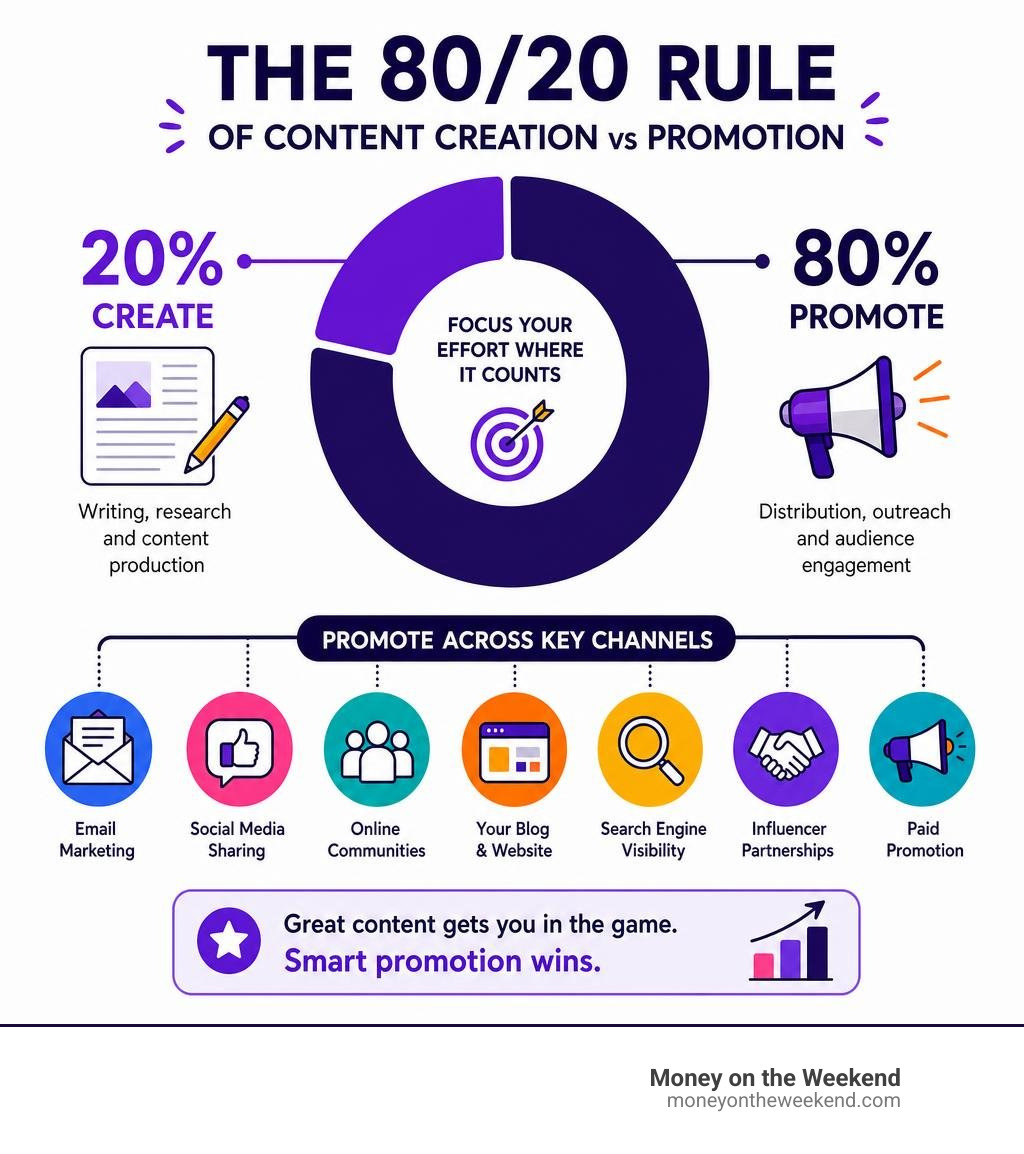
- Follow the 80/20 rule — spend 20% of your time creating content and 80% promoting it
- Build an email list — email campaigns generate 6x more clicks than tweets
- Repurpose content — turn blog posts into short videos, carousels, and infographics
- Optimize for SEO — use long-tail keywords and internal linking to drive organic traffic
- Share on social media multiple times — only a fraction of followers see any single post
- Engage online communities — Reddit, Quora, and niche forums can drive traffic for years
- Use paid promotion selectively — boost content that already performs well organically
- Partner with influencers — micro-influencers (10k–100k followers) often deliver the best results
Here’s the hard truth most people miss: creating great content is only half the job.
Close to 7.5 million blog posts are published every day. Without a promotion plan, even excellent content just sits there — unseen and unread.
Think about it this way. You could write the most helpful article on the internet, but if nobody knows it exists, it generates zero traffic, zero leads, and zero income.
That’s the problem this guide solves.
Whether you’re building a side income through affiliate marketing, growing a blog, or trying to reach more customers — the tips below will help you stop publishing and hoping, and start promoting with purpose.
Must-know Content promotion tips terms:
Understanding Content Promotion vs. Content Creation
To master the art of digital marketing, we must first understand where creation ends and promotion begins.
Content creation is the process of researching, writing, filming, or designing your media assets. It is the foundation of your digital presence. Whether you are drafting a comprehensive blog post, recording a podcast episode, or filming a video tutorial, you are in the creation phase.
Content promotion, on the other hand, is the strategic process of distributing and amplifying that content across various channels to ensure it reaches your target audience. It is the bridge between your hard work in the editing room and the audience you want to impact. Without promotion, your content is like a beautifully designed billboard placed in the middle of an unpopulated desert.

When we build our campaigns, we must leverage three primary types of distribution channels:
- Owned Media: Channels that we control completely. This includes our website blog, our email newsletter list, and our push notification subscribers.
- Paid Media: Any distribution that requires a financial investment. This includes social media ads, search engine marketing (PPC), sponsored newsletters, and influencer partnerships.
- Earned Media: Organic visibility that we gain through other people sharing our work. This includes natural backlinks, social media shares, mentions on online forums, and press coverage.
To learn more about how to produce high-value assets before you begin distributing them, Learn more about content creation.
Why Creation is Only Half the Battle
Many digital creators fall into the “publish and pray” trap. They spend days perfecting a piece of writing, hit the publish button, and immediately move on to drafting the next piece. In June 2026, this approach is a recipe for obscurity.
The online landscape is incredibly saturated. With millions of new pages published daily, search engines and social platforms are crowded. To stand out, we must prioritize audience research. In fact, industry data shows that 47% of marketers view audience research as one of the leading factors contributing to success in content marketing.
If we do not know exactly who our audience is, where they spend their time online, and what challenges they face, we cannot put our message in front of them. Effective promotion ensures that our brand visibility grows consistently, transforming one-time readers into loyal followers and customer leads. To ensure your written assets are structured to convert those visitors once they arrive, Read our content writing tips.
Choosing the Right Distribution Channels
We cannot be everywhere at once, especially when we are managing our marketing campaigns in our spare time. Selecting the right distribution channels requires analyzing where our target audience naturally congregates and matching our resources to those platforms.
For example, B2B decision-makers use an average of 10 or more channels to engage with suppliers, while the average social media user accesses 6.7 platforms monthly. This means an omnichannel approach is often necessary, but we must prioritize based on effectiveness.
| Channel Type | Examples | Pros | Cons | Best For |
|---|---|---|---|---|
| Owned | Email Newsletters, Company Blogs | Full control, direct audience access, immune to algorithm changes | Takes time to build an organic subscriber base | Nurturing leads, driving repeat traffic, building long-term trust |
| Paid | Facebook Ads, Google PPC, Sponsored Posts | Instant traffic, precise demographic targeting, highly scalable | Requires ongoing budget, costs can rise quickly | Promoting high-converting lead magnets, launching new offers |
| Earned | Guest Blogging, Backlinks, Organic Shares | High credibility, long-term SEO benefits, zero direct cost | Hard to control, requires extensive relationship building | Building domain authority, reaching completely new audiences |
To explore how these channels work together to guide prospects from discovery to purchase, you can read about the Content marketing funnel.
Essential Content Promotion Tips for Modern Marketers
To build a sustainable flow of traffic and passive income, we need a repeatable blueprint. Implementing a structured strategy allows us to work smarter, not harder.

When establishing your promotion workflow, it is highly beneficial to look at frameworks used by leading platforms. For a deep dive into how top ecommerce brands scale their reach, check out Shopify’s Guide to Content Promotion.
Email Marketing Content Promotion Tips
Email marketing remains one of the most reliable and highest-converting content promotion channels available. Why? Because you own your email list. Unlike social media networks, where algorithm updates can slash your organic reach overnight, your email list is a direct, uninterrupted line of communication to your audience.
To maximize your email newsletter promotions, implement these actionable steps:
- Write Curiosity-Driven Subject Lines: Your subject line has one job: to get the email opened. Use open loops, intriguing questions, or surprising statistics to encourage clicks.
- Segment Your Audience: Do not blast every piece of content to your entire list. Segment your subscribers based on their interests, past click behavior, or how they signed up. Sending highly relevant content to smaller, targeted segments dramatically improves your click-through rate (CTR).
- Follow Up with Non-Openers: A simple but highly effective trick is to resend your newsletter to subscribers who did not open the first email within three to five days. Simply change the subject line to a different angle. This quick task can increase your total email open rates by 20% to 30%.
- Keep the Layout Clean and Scannable: Focus the email body on what matters to the reader. Use short paragraphs, bullet points, and a single, clear Call to Action (CTA) pointing to your published content.
To learn how to combine email with broader campaigns to grow your digital business, Discover our top content marketing tips.
Social Media Content Promotion Tips
With over 5 billion social media users worldwide, social platforms are essential for broad distribution. However, relying solely on basic organic posts is no longer enough. Algorithms on platforms like LinkedIn, Facebook, and X (formerly Twitter) are designed to keep users on their platforms, which means they often suppress posts containing external links.
To navigate these engagement algorithms and maximize your reach, use these social media content promotion tips:
- Do Not Just Broadcast; Engage: Social networks reward engagement. Instead of simply posting a link with a generic caption, write a compelling summary or share a key insight directly in the post. Invite responses by asking a question, and reply promptly to every comment. This initial wave of activity signals to the algorithm that your post is valuable, boosting its organic reach.
- Time Your Posts Strategically: Use your platform analytics to identify when your target audience is most active online. While general studies show Mondays are great for email open rates and Tuesdays excel for click-throughs, your specific audience might have unique habits.
- Encourage Employee Advocacy: If you have a team, leverage their personal profiles. When team members share company content with their personal networks, it lends human credibility to the brand. People trust individual recommendations far more than corporate accounts.
- Automate and Schedule Your Distribution: You do not need to sit at your computer all day to post. Use scheduling tools to plan a repeating promotion schedule that shares your content multiple times over several weeks, using a different angle, hook, or visual format each time.
For a deeper look into selecting and mastering the right networks for your brand, Explore the content marketing social network.
Advanced Tactics: Repurposing and SEO Optimization
To truly amplify your message without burning out, you must learn to squeeze every drop of value from the assets you have already created. This is where advanced distribution and search engine optimization come into play.
A brilliant way to understand how these advanced systems work in tandem is to study the frameworks built by SEO industry leaders. For a comprehensive list of tactical ideas, explore the Semrush Content Promotion Strategies.
Maximizing Reach Through Content Repurposing
Content repurposing is the process of taking one “pillar” asset (like a comprehensive 2,500-word blog post) and converting it into multiple smaller assets in different formats. This allows you to reach different audience segments on their preferred platforms without starting your creation process from scratch.
Consider these statistics: 91% of companies use video marketing in their overall digital strategies, and 73% of consumers prefer short-form videos when searching for products or services. If you are only publishing text-based blogs, you are missing out on a massive portion of the market.
Here is a simple blueprint to repurpose a single blog post:
- Create Short-Form Videos: Extract 3 to 5 key takeaways from your article and record quick, engaging vertical videos for TikTok, Instagram Reels, and YouTube Shorts. Keep them under 60 seconds and use on-screen captions.
- Design Visual Carousels and Infographics: Turn your data points, step-by-step lists, or conceptual models into visually appealing graphics. These perform exceptionally well on LinkedIn, Pinterest, and Instagram.
- Record a Podcast Episode: Use your blog post as an outline to talk through the topic in a conversational audio format.
- Turn It into a Guest Post: Rewrite the core concepts of your article from a slightly different angle and pitch it to high-authority websites in your niche as a guest post, linking back to your original source.
To keep track of all these moving pieces and schedule your repurposed assets efficiently, Check out our content scheduling tools guide. Additionally, you can find a list of helpful software in our Content Creation Tools Ultimate Guide.
The Role of SEO in Long-Term Promotion
While social media and email marketing provide immediate traffic spikes, search engine optimization (SEO) is what ensures your content continues to drive passive, highly targeted traffic for months and years to come. SEO is essentially automated, long-term content promotion.
To optimize your content for search engine discovery, focus on these core areas:
- Build Topic Clusters: Instead of writing random, disconnected articles, organize your content into topic clusters. Create a comprehensive “pillar” page that gives a broad overview of a subject, and link it to narrower “cluster” pages that dive deep into specific subtopics. This structure demonstrates deep topical authority to search engines.
- Optimize On-Page Elements: Ensure your target keywords are naturally integrated into your page title, meta description, image alt text, and header tags (H2s and H3s). Focus on long-tail keywords with clear user intent and lower competition.
- Use Schema Markup: Add structured data to your website. This helps search engines understand the context of your content and can reward you with rich snippets, review stars, or FAQ dropdowns directly in the search results.
- Master Internal Linking: Whenever you publish new content, find 3 to 5 older, high-authority pages on your site and add internal links pointing to the new piece using descriptive, natural anchor text. This passes “link juice” and signals to search crawlers that your new page is important.
To understand how to align your SEO efforts with the journey your customers take before making a purchase, Understand the content marketing funnel.
Emerging Trends Shaping Content Distribution in 2026
The digital landscape is evolving rapidly. As we navigate the mid-2026 marketing environment, several major technological shifts are changing how users discover and consume information.
Staying ahead of these shifts is vital for maintaining a competitive edge. To explore how modern systems adapt to these changes, read through the Mailchimp Content Promotion Strategy.
Navigating AI and Zero-Click Search
The rise of generative AI and search engine layout changes have introduced “zero-click content.” This refers to search results where the user’s query is answered directly on the search engine results page (SERP) via AI overviews or featured snippets, meaning the user never actually clicks through to a website. Furthermore, 61.4% of marketers have now used AI in their campaigns, leading to an absolute flood of generic, automated content online.
To succeed in this zero-click, AI-driven environment, we must shift our promotion tactics:
- Inject Authentic Thought Leadership: AI can easily summarize common web knowledge, but it cannot replicate real human experience. Focus on publishing unique case studies, proprietary data, personal anecdotes, and contrarian viewpoints.
- Optimize for Search Intent and AI Summaries: Structure your content so that AI crawlers can easily extract your key points. Use clear headings, bulleted summaries at the top of your articles, and direct, conversational answers to common questions.
- Prioritize Community Building: Since search engine traffic is becoming more volatile, building an active community around your brand is essential. Encourage your readers to join private forums, interactive social groups, or subscription newsletters. A loyal community provides a self-amplifying distribution channel that is entirely immune to algorithm updates.
To weigh how these modern, algorithm-heavy strategies compare to more traditional promotional methods, you can Compare social media marketing vs traditional marketing content creation tips.
Frequently Asked Questions About Content Promotion
What is the 80/20 rule in content marketing?
The 80/20 rule states that you should spend 20% of your available marketing time creating high-quality content, and 80% of your time promoting and distributing it. This rule exists to combat the common mistake of spending all your resources on creation while leaving promotion as an afterthought. By focusing heavily on distribution, you ensure that every asset you produce gets the maximum possible reach and return on investment.
How do you measure the ROI of content promotion?
To measure the return on investment (ROI) of your content promotion campaigns, you must track specific, quantifiable metrics aligned with your business goals:
- Traffic and Acquisition: Use analytics tools to track unique visitors, page views, and referral traffic to see which promotional channels are driving the most users to your site.
- Engagement: Monitor bounce rates, average session duration, and social media shares to ensure your traffic is high-quality and interested in your message.
- Lead Generation and Conversions: Set up conversion goals in your analytics dashboard to track newsletter sign-ups, lead magnet downloads, and direct product sales driven by your promotional links.
- Cost-Per-Lead (CPL): If you are running paid ads, divide your total ad spend by the number of leads generated to ensure your campaigns remain profitable.
Is paid content promotion necessary for small businesses?
Paid content promotion is not strictly necessary, but it is highly beneficial if you want to scale quickly. For small businesses with limited budgets, we recommend focusing on organic channels (like email, SEO, and active community participation) first.
Once you identify a piece of content that performs exceptionally well organically, you can selectively allocate a small budget to run targeted social media ads or search campaigns. This ensures you are only spending money to amplify an asset that has already proven to resonate with your audience.
Conclusion
At Money on the Weekend, our mission is to guide you toward financial freedom by showing you how to build sustainable, passive income streams through digital entrepreneurship, affiliate marketing, and smart freelance strategies.
But whether you are building a niche affiliate site or launching a freelance brand, your success depends on your ability to get your message heard. Simply writing great content is no longer enough. You must actively, strategically, and consistently promote your work.
By implementing the content promotion tips outlined in this guide — from mastering the 80/20 rule and leveraging email marketing to repurposing your assets and optimizing for long-term SEO — you will build a powerful marketing engine that drives consistent traffic and revenue.
Are you ready to take control of your digital future? Start your journey with our ultimate content creation guide and begin building your online empire today!