Why Your Content Needs a Strategic Path to Profit
A Content marketing funnel is a strategic framework that guides potential customers through stages—from initial awareness to loyal advocacy—using targeted content at each step to build trust and drive conversions.
Quick Overview: The Content Marketing Funnel
- Awareness (TOFU): Attract strangers with educational content like blog posts and social media
- Consideration (MOFU): Nurture leads with case studies, webinars, and email sequences
- Conversion (BOFU): Convert prospects with testimonials, demos, and clear calls-to-action
- Delight: Retain customers and create advocates through exclusive content and loyalty programs
Like it or not, most content you consume online has a specific purpose: to move you closer to a purchase decision. Even a seemingly simple article about fixing your sleep schedule might be the first step in a mattress company’s strategy to turn you into a customer.
But here’s the hard truth: marketing is not a one-step process. The average customer engages with 3-5 pieces of content before they’re ready to talk to a sales rep, and 87% of shoppers now begin their search on digital channels.
If you’re trying to build passive income through blogging, affiliate marketing, or content creation, understanding the content marketing funnel is your roadmap to success. It transforms random content creation into a systematic engine that attracts visitors, builds trust, and converts them into paying customers—all while you sleep.
The beauty of this approach? Content marketing gets 3X more leads than paid search advertising, and the average blog post continues working for about two years. That’s the definition of scalable passive income.
Think of the content marketing funnel as your strategic foundation. Every blog post, social media update, or email you create should intentionally move people from one stage to the next. Companies that master this approach see remarkable results: brands using full-funnel content through Google Ads generated 52% more incremental sales than those focusing on just one stage.
Whether you’re a solopreneur building your first online business or looking to optimize your existing content strategy, this guide will show you exactly how to create a content marketing funnel that works while you focus on other priorities.
What is a Content Marketing Funnel and Why Does it Matter?
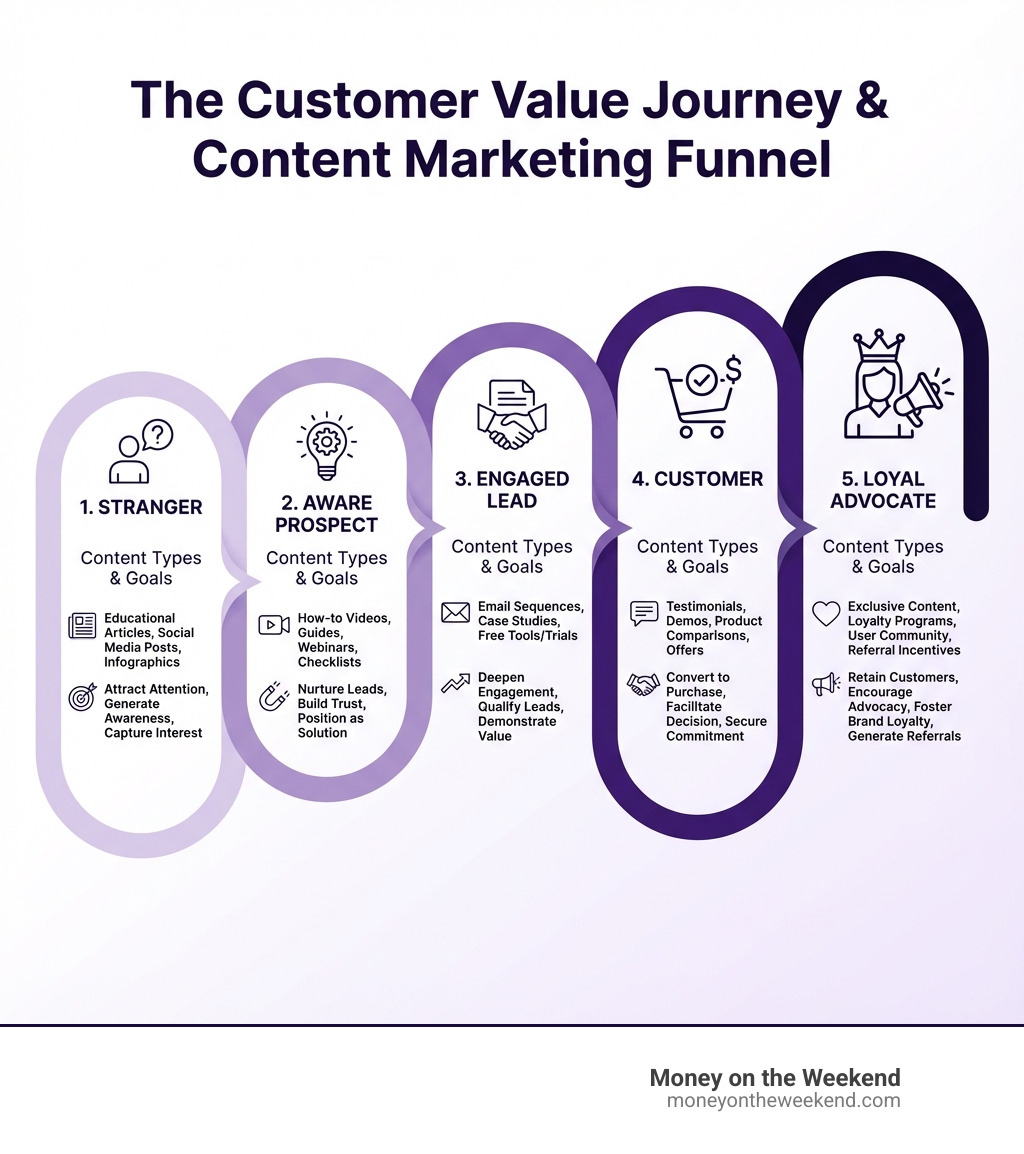
At its core, a content marketing funnel is a structured approach to guiding potential customers through their buying journey using relevant content at every step. Imagine a wide funnel: at the top, many people enter, curious about a topic. As they move down, the funnel narrows, and our content becomes more specific, helping them evaluate options, make a decision, and ultimately, become a loyal customer.
Why is this important for businesses focused on online income generation? Because in today’s crowded digital landscape, simply creating content isn’t enough. We need a strategy that ensures our content actively works to:
- Attract new prospects with broad, helpful content.
- Educate and engage by providing value that builds trust.
- Nurture leads by addressing their specific needs and concerns.
- Convert prospects into customers with clear paths to purchase.
- Retain and delight customers, turning them into brand advocates.
A well-designed funnel acts as a scalable lead engine, meeting your audience with personalized experiences. This isn’t just a bonus; it’s an expectation. According to Salesforce, 52% of customers expect personalized offers, and 66% expect companies to understand their unique needs. Delivering on this reduces sales friction and improves engagement, smoothing the path to purchase.
The beauty of this systematic approach is that it transforms your content from a scattershot effort into a cohesive, goal-driven strategy. It’s about being deliberate with every piece of content we create. This ensures our efforts are efficient and highly effective in driving leads and conversions, ultimately contributing to our financial freedom goals.
The Four Key Stages of a High-Converting Funnel
While the traditional marketing funnel has three stages (Awareness, Consideration, Conversion), we add a crucial fourth: Delight and Retention. This reflects the modern customer journey, which extends beyond the initial purchase. Think of it as a cyclical strategy where satisfied customers become advocates who help refill the top of your funnel.
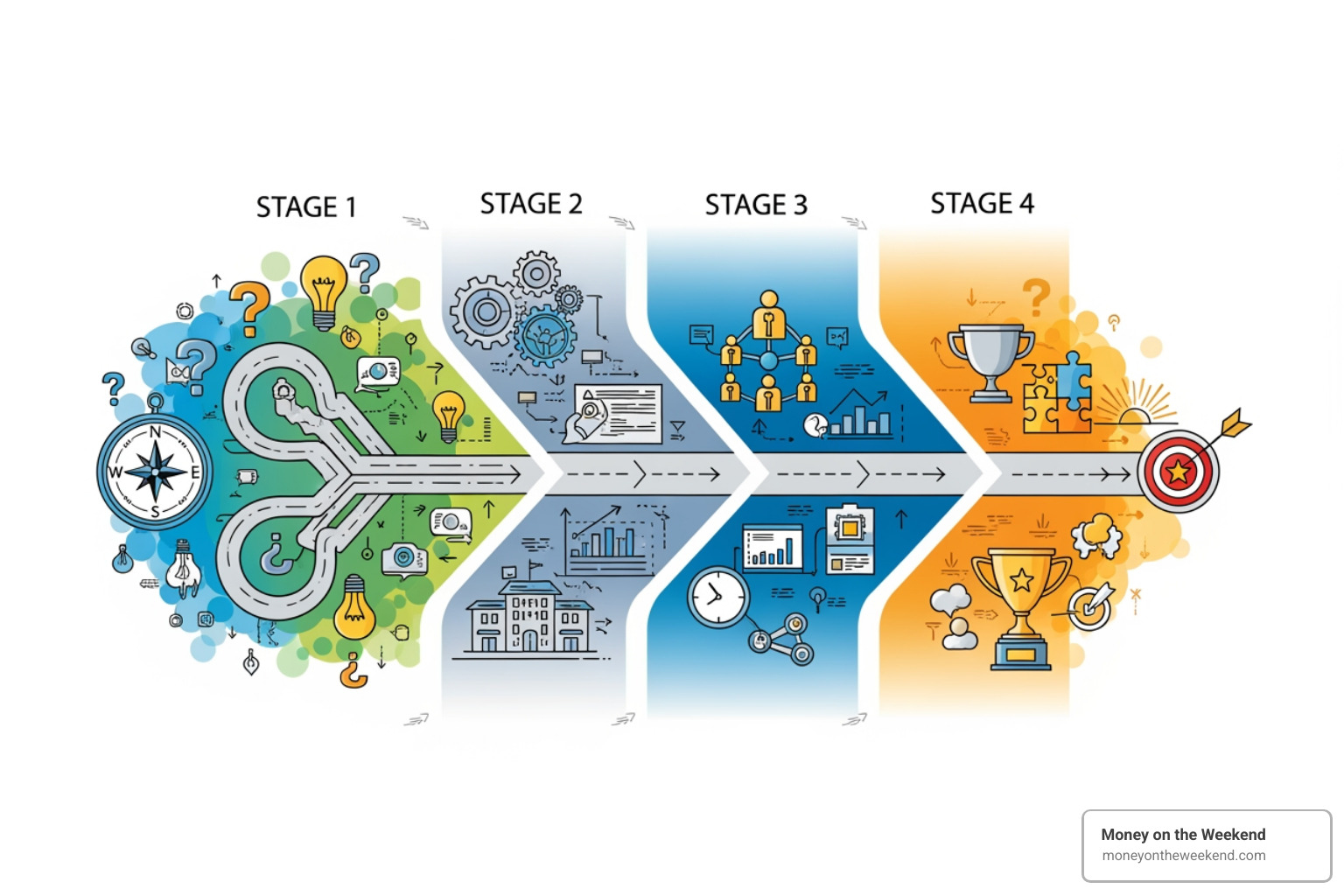
This model expands on the classic AIDA (Attention, Interest, Desire, Action) framework by adding the post-purchase phase. It accounts for different levels of customer awareness—from problem-aware to solution-aware—requiring a distinct content approach at each step to nurture prospects into loyal patrons.
Stage 1: Awareness (Top of the Funnel – TOFU)
At the top of the funnel (TOFU), your audience is “problem-aware.” They’re searching for general information, using broad questions like “what is” or “how to.” They aren’t looking for a product yet.
The goal is to attract, educate, and build trust—not to sell. Be a helpful resource that provides value and answers questions. This establishes your brand as a thought leader and improves SEO visibility for broad, informational keywords.
- Audience Mindset: They’re just starting their journey and seeking answers or solutions to general problems.
- Our Goal: Capture their attention, educate them, and make them aware of our brand as a helpful resource.
- Content Focus: Educational, entertaining, and easily digestible, addressing pain points without being overly promotional.
Stage 2: Consideration (Middle of the Funnel – MOFU)
In the Middle of the Funnel (MOFU), prospects are “solution-aware.” They understand their problem and are actively evaluating solutions, including yours. They have more specific questions and are comparing options, seeking expertise.
Here, you build deeper trust and demonstrate your unique value. Position your offerings as the best solution. Use lead magnets (like guides or checklists) to capture email addresses for further nurturing.
- Audience Mindset: They know they have a problem and are exploring different ways to solve it, looking for detailed information and comparisons.
- Our Goal: Build trust, demonstrate expertise, and differentiate our offerings. We want to generate and nurture leads.
- Content Focus: In-depth, solution-oriented, and persuasive, highlighting the benefits of our approach. This is an excellent stage to introduce concepts like affiliate marketing solutions.
Stage 3: Conversion (Bottom of the Funnel – BOFU)
At the Bottom of the Funnel (BOFU), prospects are “most aware” and ready to buy. They’ve done their research and just need a final nudge. Their questions are specific to pricing, features, and guarantees.
The goal is simple: convert leads into customers. Provide social proof, clear calls-to-action (CTAs), and a simple purchasing process.
- Audience Mindset: They are convinced they need a solution and are deciding who to buy from. They’re looking for reassurance and a seamless buying experience.
- Our Goal: Remove last-minute doubts and facilitate the purchase to close the deal.
- Content Focus: Product-specific, persuasive, and action-oriented. It should directly address objections and make it easy to buy.
Stage 4: Delight & Retention (The Profitable Loop)
The journey doesn’t end at conversion. The Delight & Retention stage turns buyers into repeat customers and brand evangelists, maximizing customer lifetime value (CLV). After all, a study found 91% of customers are more likely to purchase again after a great service experience.
Retaining customers is smart business, as acquiring new ones is far more expensive. Focusing on delight makes customers feel valued and connected, reducing churn and encouraging them to advocate for your brand.
- Audience Mindset: They are existing customers seeking support, additional value, and ways to maximize their investment.
- Our Goal: Ensure customer satisfaction, encourage repeat business, foster loyalty, and inspire advocacy.
- Content Focus: Support, value-added content, community building, and exclusive offers that reinforce their decision to choose us.
Mapping Content and Metrics to Your Funnel
To leverage your content marketing funnel, you need a strategic approach to creation and measurement. Each piece of content must have a purpose and trackable metrics. This comprehensive view is vital, as a full-funnel strategy can generate 52% more incremental sales than focusing on just one stage.
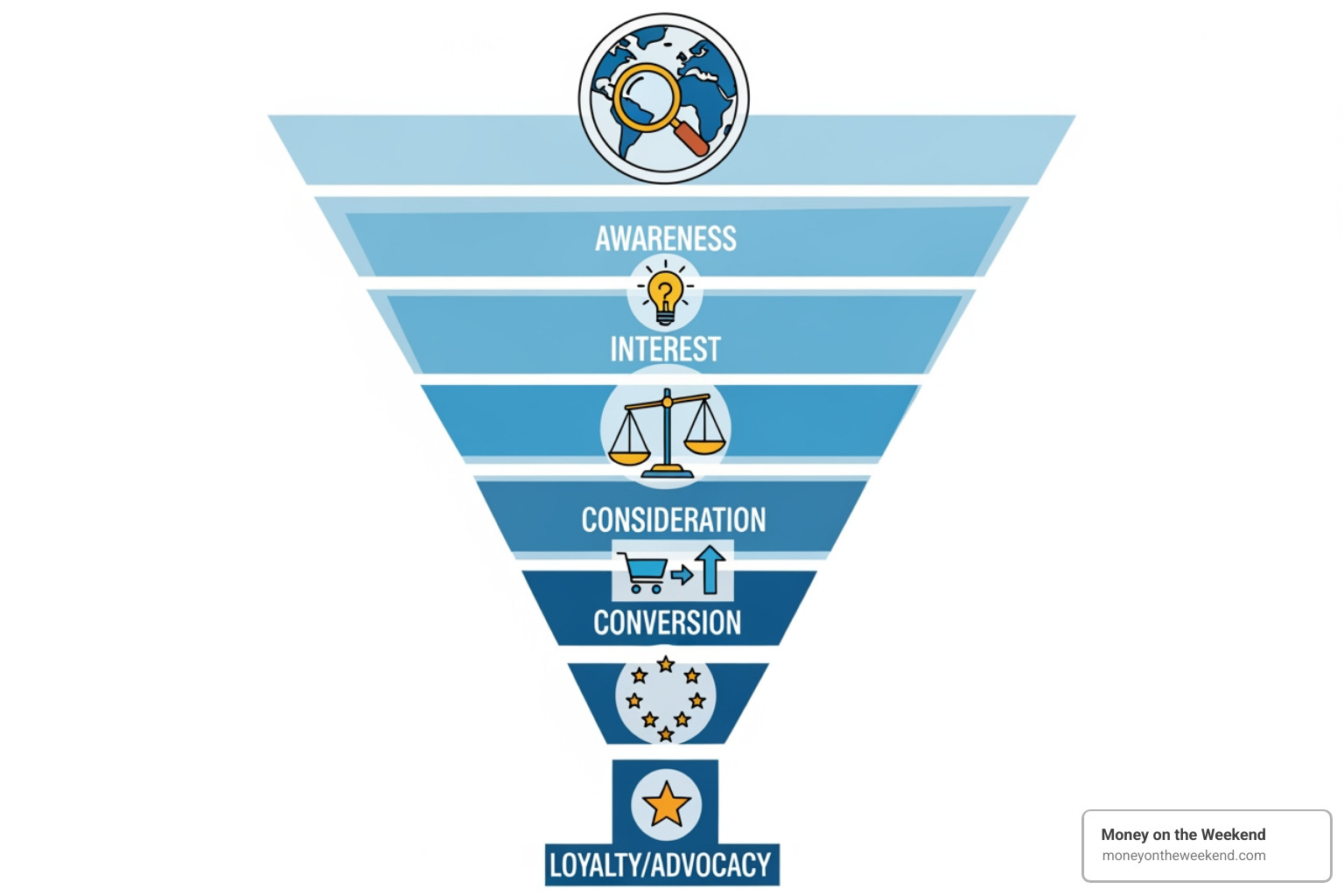
This strategy requires planning: consider audience needs, questions, and preferred formats for each stage. Then, pair content with key performance indicators (KPIs) to measure impact and optimize your return on investment (ROI).
Effective content types for your content marketing funnel
The types of content we create should directly address the mindset and needs of our audience at each stage:
-
TOFU (Awareness): Goal: Attract a wide audience with broad, educational content.
- Blog posts (e.g., “What is Passive Income?”)
- Infographics (e.g., “The Ultimate Guide to Online Income Streams”)
- Social media posts and updates
- Podcasts
- Videos (e.g., short explainer videos)
- Ebooks and whitepapers
- Checklists (e.g., “Your First 10 Steps to Content Creation Success”)
-
MOFU (Consideration): Goal: Build trust and differentiate with in-depth, solution-oriented content.
- Case studies (e.g., “How John Doubled His Affiliate Income in 6 Months”)
- Webinars and live Q&A sessions
- E-books and comprehensive guides
- Email sequences
- Comparison guides (e.g., “Affiliate Marketing vs. Dropshipping”)
- Templates and worksheets
- Product overviews
-
BOFU (Conversion): Goal: Convince and convert with highly specific, product-focused content.
- Testimonials and customer success stories
- Demos and free trials
- Product pages with detailed descriptions and FAQs
- Pricing pages
- Comparison guides (e.g., directly comparing our solution to competitors)
- Consultations or strategy calls
- Exclusive offers and discounts
-
Delight & Retention: Goal: Foster loyalty and advocacy with support, education, and community-building content.
- Exclusive content (e.g., members-only articles)
- Loyalty programs and special promotions
- Surveys and feedback forms
- Customer support resources (e.g., detailed FAQs)
- Email newsletters with product updates and insider tips
- Interactive content (e.g., quizzes, polls)
Measuring success: Key metrics for your content marketing funnel
To ensure our funnel is working, we must track key metrics at each stage.
-
TOFU Metrics (Awareness): Measures how well you attract attention and build awareness.
- Website Traffic: Total visitors, unique visitors.
- Impressions/Reach: How many people saw our content.
- Bounce Rate: Percentage of visitors who leave after viewing only one page.
- New Users: Number of first-time visitors.
- Social Media Engagement: Likes, shares, comments.
- Organic Search Rankings: Position in search results.
-
MOFU Metrics (Consideration): Indicates effectiveness in engaging prospects and generating leads.
- Lead Conversion Rate: Percentage of visitors who become leads.
- Time on Page/Average Session Duration: How long visitors spend consuming content.
- Email Open/Click-Through Rate: Engagement with nurturing emails.
- Download Rates: For lead magnets.
- Webinar Attendance/Completion Rates.
-
BOFU Metrics (Conversion): Shows how well you turn leads into customers.
- Sales Conversion Rate: Percentage of leads who make a purchase.
- Cost Per Acquisition (CPA): The cost to acquire a new customer.
- Cart Abandonment Rate: How many people start a purchase but don’t finish.
- Revenue Generated: Direct sales from BOFU content.
- Demo/Consultation Request Rate.
-
Delight Metrics (Retention & Advocacy): Measures customer satisfaction, loyalty, and advocacy.
- Customer Lifetime Value (CLV): Total expected revenue from a customer.
- Net Promoter Score (NPS): How likely customers are to recommend your brand.
- Repeat Purchase Rate: How often existing customers buy again.
- Churn Rate: The rate at which customers stop doing business with you.
- Referral Rate: New customers from existing customer recommendations.
- Customer Reviews/Testimonials.
Integrating SEO and Audience Insights into Your Strategy
To succeed, your content marketing funnel needs strong SEO and audience insights. SEO is about understanding user intent to deliver the right content at the right time. Combined with deep audience knowledge, you can create content that attracts and resonates with visitors throughout their journey.
Audience research is the bedrock. Understand your ideal customer’s pain points, questions, and information sources to craft guiding buyer personas. This ensures every piece of content speaks to a specific audience segment, which is fundamental for building sustainable Passive Income streams by serving a real need.
Aligning Keyword Intent with Funnel Stages
By mapping keyword intent to our funnel stages, we can create highly targeted content that meets users exactly where they are:
-
Informational Keywords (TOFU): Users are in the awareness stage, seeking general knowledge. Keywords: “what is,” “how to,” “guide.”
- Example: “What is affiliate marketing?” or “How to make money online?”
- Content: Blog posts, comprehensive guides, infographics, videos.
-
Commercial Investigation Keywords (MOFU): Users are in the consideration phase, comparing solutions. Keywords: “best,” “vs,” “review.”
- Example: “Best affiliate programs for beginners” or “Bluehost vs. SiteGround review.”
- Content: Comparison articles, detailed product reviews, case studies, expert guides.
-
Transactional Keywords (BOFU): Users show strong purchase intent. Keywords: “buy,” “price,” “discount,” “sign up.”
- Example: “Buy a domain name” or “Get a free trial of [product name].”
- Content: Product pages, pricing pages, landing pages for sign-ups, demo requests.
-
Navigational Keywords: Users are looking for a specific brand or website. Keyword: your brand name.
- Example: “Money on the Weekend blog”
- Content: Optimized homepages, “About Us” pages, branded content.
By understanding these distinctions, we can optimize our content for SEO, ensuring our relevant content appears and guides users smoothly through our funnel.
Tools and Tactics to Understand Your Audience Journey
To effectively build and optimize our funnel, we need reliable ways to understand our audience and track their journey.
| Tool/Tactic | How it Helps Understand Audience Journey | Funnel Stage Relevance |
|---|---|---|
| Audience Surveys | Directly ask customers about their pain points, information needs, and decision-making process. Great for qualitative insights. | All stages |
| Competitor Analysis | Examine what content competitors are producing, how it’s performing, and what keywords they rank for. Identify gaps and opportunities. | All stages |
| Analytics Platforms | Track website traffic, user behavior (pages visited, time on page, bounce rate), conversion paths. Essential for quantitative data. | All stages |
| Keyword Research Tools | Identify search volume, keyword difficulty, and user intent for various terms. Guides content creation for each funnel stage. | TOFU, MOFU, BOFU |
| Heatmap Tools | Visualize where users click, scroll, and spend time on your web pages. Reveals engagement patterns and friction points. | MOFU, BOFU |
| Session Recording Tools | Watch actual user sessions to understand how individuals interact with your content and steer your site. Pinpoints usability issues. | MOFU, BOFU |
| Social Media Listening | Monitor mentions of your brand, industry, and competitors. Understand sentiment, common questions, and trending topics. | TOFU, MOFU, Delight |
| Customer Feedback (Reviews, Comments) | Direct insights into what customers love, what they struggle with, and what improvements they desire. Fuels content for all stages. | MOFU, BOFU, Delight |
These accessible tools help you gather crucial data to refine buyer personas, find content gaps, and improve the user experience in your funnel. For more general Tools for your digital ventures, see our dedicated resources.
Frequently Asked Questions about the Content Marketing Funnel
How long does it take for a content marketing funnel to work?
Building an effective funnel is a long-term strategy. Results vary by industry, content quality, and consistency, but significant lead generation typically takes several months, though you may see initial traffic sooner.
The average blog post has a lifespan of about two years, so your content works for you long-term. This evergreen nature is key to passive income. Focus on consistent, high-quality creation and optimization to build momentum for sustainable success.
Can a content funnel work for a small business or solopreneur?
Yes, a content funnel is highly effective and scalable for solopreneurs. It’s crucial for competing with larger players by building trust and authority through valuable content.
For a small business or solopreneur, the strategy might involve:
- Focusing on a niche: Target a specific audience with highly relevant content.
- Prioritizing high-impact content: Focus on pieces that address core pain points or conversion drivers.
- Leveraging personal brand: Your unique voice and expertise can be a powerful differentiator.
For anyone looking to Start a Business in blogging or affiliate marketing, a content funnel is a roadmap to converting visitors into customers. It automates parts of the customer journey, freeing up your time while generating leads and sales.
What’s the biggest mistake to avoid when building a content funnel?
One of the biggest mistakes is focusing on only one stage or trying to sell too early.
Here is a breakdown of common pitfalls to avoid:
- Selling too early: Top-of-funnel content should educate, not pitch. Being too promotional drives away users who are just seeking information.
- Neglecting retention: Don’t stop at conversion. Ignoring the Delight stage misses out on repeat business, customer advocacy, and organic growth.
- No clear CTA: Every piece of content needs a clear next step, especially in the middle and bottom of the funnel. Guide your user.
- Ignoring audience needs: Content that doesn’t address specific questions and pain points at each stage will fail to engage. Do your audience research.
- Inconsistent content creation: A funnel needs a steady flow of content to stay active. Sporadic publishing leads to missed opportunities.
By understanding these common mistakes, we can proactively design a more robust and effective content marketing funnel that continuously attracts, engages, converts, and delights our audience.
Start Building Your Profitable Content Engine
We’ve explored the intricate yet powerful world of the content marketing funnel, from its foundational stages of Awareness, Consideration, Conversion, and Delight, to the specific content types and metrics that drive success at each step. We’ve seen how integrating SEO and deep audience insights can transform your content into a highly effective lead-generating machine.
For us, at Money on the Weekend, the content marketing funnel isn’t just a marketing theory; it’s a practical, actionable roadmap. It empowers digital entrepreneurs, affiliate marketers, and content creators to systematically grow their audience, build trust, and convert that trust into tangible income. It’s about working smarter, allowing your content to do the heavy lifting of guiding your audience, while you focus on what you do best.
This strategic approach to content ensures that every piece you create contributes to a larger goal, turning casual visitors into loyal customers and passionate advocates. It’s the key to achieving financial freedom through online income generation and digital entrepreneurship.
Ready to put this knowledge into action and transform your content efforts into a powerful, profitable engine? Start mastering your Content Creation strategy today and build the business you’ve always dreamed of.