Why Modern Marketers Must Master Two Worlds
The debate over social media vs. traditional marketing content might seem endless, but the reality is more practical than philosophical. Each channel demands a different content strategy, and mastering both can significantly boost your earning potential, especially if you’re building an online business in your spare time.
Quick Answer: Key Content Creation Differences
| Traditional Marketing | Social Media Marketing |
|---|---|
| One-way communication (broadcast) | Two-way dialogue (conversation) |
| Broad, mass-market messaging | Precise, targeted messaging |
| High production costs | Scalable, budget-friendly |
| Static, unchangeable once launched | Dynamic, adjustable in real-time |
| Interruption-based (push) | Permission-based (pull) |
| Difficult to measure ROI | Detailed analytics available |
| Focus on promotional content | Mix of educational, entertaining, and promotional |
Marketing has evolved far beyond billboards and TV commercials. Today, the average American is exposed to around 4,000 to 10,000 ads daily, so broadcasting a message is no longer enough. To stand out and actually make sales, you must create content people choose to engage with.
The shift to digital has not made old methods obsolete; it has created a new playing field where content is king in every format. Traditional marketing pushes messages onto consumers, while social media pulls audiences in with valuable information, storytelling, and ongoing interaction. Research consistently shows that content marketing generates about 3 times as many leads as traditional marketing while costing around 62% less.
For anyone building passive income streams or an online business in their spare time, understanding how to craft content for both worlds is essential. Knowing when to use each approach (and how to combine them) can be the difference between spinning your wheels and building a reliable income engine.
Key Marketing Terms:
Traditional vs. Social Media Marketing: The Core Differences
At its heart, marketing is about connecting with people. However, the methods, targeting capabilities, and success metrics differ vastly between traditional and social media. Understanding these distinctions is crucial for any business to thrive.
Communication Channels: Traditional marketing uses a one-way “push” model (TV, print), broadcasting a message without direct response. Social media marketing is a two-way “pull” strategy, using platforms like Facebook and Instagram for conversations, comments, and real-time interaction to draw audiences in.
Audience Targeting: Traditional marketing casts a wide, general net. While you can target viewers of a specific TV show, the precision is limited. Social media offers unparalleled precision, allowing you to define an audience by demographics, interests, behaviors, and even recent purchasing activity for hyper-targeted campaigns.
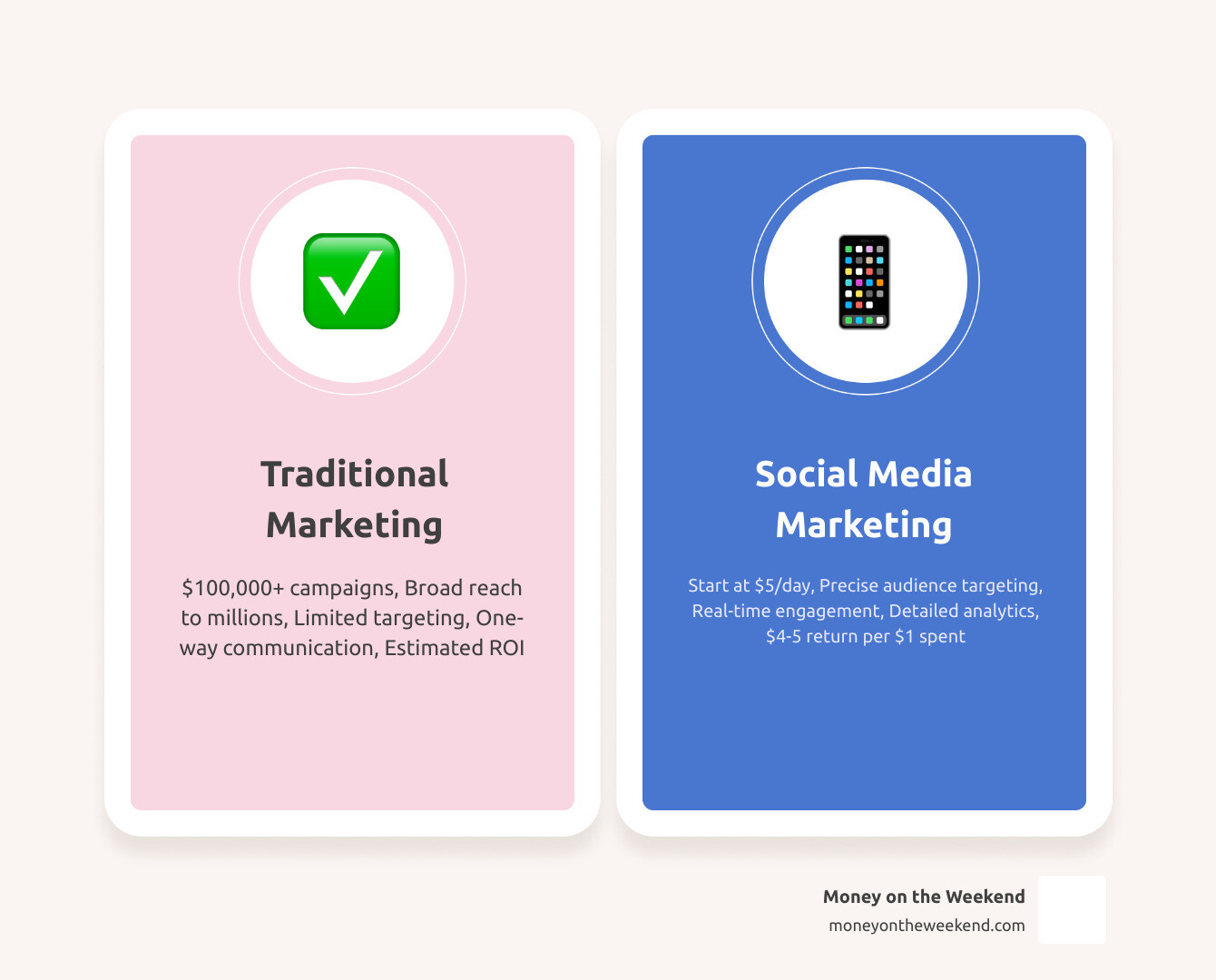
Cost-Effectiveness: Traditional marketing has a substantial initial cost. A prime-time TV ad can exceed $100,000, and a billboard can cost around $14,000 a month. Social media marketing is far more budget-friendly, with campaigns starting at just a few dollars a day, making it accessible to almost anyone.
ROI (Return on Investment): Measuring the ROI of traditional marketing is challenging and often relies on estimates like brand recall surveys. Social media provides comprehensive, real-time data, tracking impressions, engagement, clicks, and conversions with accuracy. Studies show businesses earn an average of $4 to $5 for every dollar spent on social media ads.
Engagement and Interaction: Traditional marketing offers limited direct engagement. Social media is built on it. Likes, comments, shares, and direct messages are integral, fostering community and a direct connection between brands and consumers.
Analytics and Performance Tracking: Social media platforms offer advanced tools to monitor campaign performance in real-time, allowing for on-the-fly adjustments. Traditional marketing lacks this immediate feedback, making mid-campaign optimization nearly impossible.
| Metric | Traditional Marketing | Social Media Marketing |
|---|---|---|
| Cost | High upfront, fixed | Flexible, scalable (starts low) |
| Reach | Broad, mass-market | Precise, targeted |
| Targeting | Limited, demographic | Highly granular (demographics, interests, behaviors) |
| Engagement | One-way, limited interaction | Two-way, real-time, community-driven |
| Measurement | Indirect, estimated ROI | Direct, real-time analytics, clear ROI |
Advantages and Disadvantages of Traditional Marketing
Traditional marketing still holds a significant place, having built many of the world’s biggest brands.
Advantages of Traditional Marketing:
- Broad Reach: Channels like TV, radio, and billboards can reach millions of people at once, making them ideal for mass-market campaigns.
- High Impact: A stunning print ad or a catchy radio jingle can leave a lasting, memorable impression on consumers.
- Credibility: For many, traditional media still carries an air of authority. An ad in a reputable newspaper can lend credibility to a brand.
- Tangible Content: Physical ads like direct mail or magazine inserts offer a tactile experience that digital ads cannot replicate.
Disadvantages of Traditional Marketing:
- High Costs: The expense of production and placement makes traditional campaigns inaccessible for many small businesses.
- Limited Interaction: As a one-way street, it’s difficult to build direct relationships or gather immediate feedback from the audience.
- Difficult to Measure ROI: Pinpointing the exact impact on sales is challenging, often relying on estimates rather than hard data.
- Lack of Flexibility: Once an ad is placed, changing the message or target audience is difficult and costly.
Advantages and Disadvantages of Social Media Marketing
Social media marketing is an indispensable tool for businesses of all sizes.
Advantages of Social Media Marketing:
- Precise Targeting: Sophisticated targeting options ensure your content is seen by those most likely to be interested in your products or services.
- Cost-Effective: Organic posting is free, and paid campaigns can be launched with small daily budgets, making it ideal for those looking to Make Money Online without a huge investment.
- Real-Time Engagement: Social media fosters direct interaction, allowing you to answer questions, run polls, and build a loyal community.
- Measurable Results: Every click and conversion can be tracked, allowing for continuous optimization to ensure your budget is spent effectively.
- Global Reach: Social media transcends geographical boundaries, enabling you to connect with audiences worldwide.
Disadvantages of Social Media Marketing:
- Time-Intensive: Maintaining a strong social media presence requires consistent effort in content creation and community engagement.
- Algorithm Dependence: Changes to platform algorithms can drastically impact reach, requiring constant strategy adaptation.
- Risk of Negative Feedback: The public nature of social media means negative comments can spread quickly, requiring vigilant reputation management.
- Ad Fatigue: Users can become tired of ads if content isn’t refreshed or targeted appropriately.
- Intense Competition: The low barrier to entry means the digital landscape is crowded, requiring creativity and consistency to stand out.
Crafting Your Message: Content Creation for Each Arena
Whether broadcasting to millions or engaging a niche community, your content’s format, tone, and purpose must be custom to the medium.

Content Versatility: Traditional marketing relies on static formats like a single billboard image or a short radio clip. Social media thrives on diverse and dynamic content: short-form videos, carousels, stories, live streams, and interactive polls, allowing for richer storytelling.
Ad Fatigue: With consumers seeing up to 10,000 ads daily, ad fatigue is a major issue. Traditional marketing fights this with memorable, high-quality ads (e.g., Coca-Cola’s “Share a Coke”). Social media combats it with refreshed content, diverse formats, and precise targeting to keep messages relevant.
One-Way Monologue vs. Two-Way Dialogue: Traditional marketing content is a monologue that speaks at the audience. Social media content is designed for dialogue, inviting interaction and feedback. This shift encourages a more conversational and responsive tone.
Branded vs. Educational Content: Traditional marketing often leans into promotional content. However, 70% of consumers prefer to learn about a company through articles rather than ads. This highlights the power of content marketing, which prioritizes valuable educational or entertaining content. Moz’s “Whiteboard Friday” series is a prime example, offering SEO insights that organically demonstrate expertise.
Content Tips for Traditional Marketing
Crafting content for traditional channels demands an impactful approach due to high costs and one-way communication.
- Focus on a Single, Powerful Message: With limited time or space, your content must convey one core idea instantly. Be simple, direct, and memorable.
- Strong Call-to-Action (CTA): Your content needs a clear, concise CTA. Tell people exactly what you want them to do: visit a store, go to a website, or call a number.
- High-Quality Visuals and Production: Traditional media demands top-tier production value. Crisp images, professional voiceovers, and compelling video are essential to capture attention and convey credibility.
- Writing for Print vs. Broadcast: Print ads require punchy headlines and concise copy. Broadcast (radio/TV) needs engaging scripts and memorable soundbites that hold attention.
- Creating Memorable Taglines: A catchy tagline like “Just Do It” or “I’m Lovin’ It” can stick with an audience long after they’ve seen your ad, defining your brand in just a few words.
Long-form content like blogs also plays a crucial role. Check out our guide: Is Blogging Still Useful in 2023?.
Content Tips for Social Media Marketing
Social media content is an art form focused on engagement, community, and value.
- Value-Driven Content: Prioritize content that educates, entertains, or inspires. Follow the 80/20 rule: 80% valuable content and 20% promotional.
- Interactivity (Polls, Q&As): Use social media’s two-way nature. Ask questions, run polls, and host Q&As to boost engagement and gain audience insights.
- User-Generated Content (UGC): Encourage your audience to create content featuring your products. UGC is authentic, builds trust, and provides a stream of content you don’t have to create.
- Platform-Specific Formats: Adapt your content to suit each platform’s unique style. Reels dominate Instagram, while LinkedIn favors professional articles. Don’t just cross-post identical content.
- Authenticity and Brand Voice: Develop a consistent, authentic brand voice. Be relatable, transparent, and show the human side of your business. As consultant Sarah Man suggests, “Don’t be afraid to test out-of-the-box ideas and be yourself.”
- Repurpose Existing Content: Maximize your efforts by changing blog posts into carousels, podcasts into video clips, or webinars into infographics. Colin and Samir, for example, regularly repurpose their video podcast into Instagram Reels.
Mastering these tips is key to successful Affiliate Marketing Content Ideas & Tips.
Strategic Synergy: When and How to Use Each Marketing Style
The most effective marketing strategies don’t choose between traditional and social media; they integrate them. By understanding the strengths of each, we can create campaigns that achieve broader reach and deeper engagement.

Integrating Campaigns: An integrated campaign amplifies your message by leveraging the strengths of both worlds. For example, a national TV ad (traditional) can create brand awareness and direct viewers to a social media hashtag, where they can engage more deeply with the brand (social media). Coca-Cola’s “Share a Coke” campaign successfully used TV ads to drive digital engagement and user-generated content.
Business Goals (Brand Awareness vs. Lead Generation): Your marketing choices should align with your business objectives.
- Brand Awareness: Traditional marketing excels at building mass brand awareness quickly. Social media can then reinforce this awareness through consistent messaging.
- Lead Generation & Direct Conversions: Social media is often more effective for direct sales, using precise targeting and measurable CTAs to drive traffic to product pages or lead forms.
Industry Effectiveness: Certain industries naturally lean towards one type of marketing. Luxury brands often use high-end magazine ads, local businesses may prefer local radio, and e-commerce or tech brands thrive on social media.
Future Trends (AI, AR/VR): Both marketing styles are evolving with technology. AI can optimize social media ad placements, while AR/VR can offer immersive experiences that blur the lines between digital and physical advertising.
For more examples, explore Money on the Weekend’s Content Marketing Examples.
When to Prioritize Traditional Marketing
There are specific scenarios where traditional marketing remains highly effective:
- Local Businesses: Local newspaper ads, radio, or direct mail can effectively reach a specific geographic audience for brick-and-mortar stores or local services.
- Reaching Older Demographics: Some older demographics may still be more easily reached through traditional channels like television, radio, or print media.
- Building Mass Brand Awareness: For introducing a new brand to a large, general audience, traditional media’s ability to achieve broad exposure quickly is unparalleled.
- High-Ticket Luxury Items: High-gloss magazines or curated TV spots can convey the desired brand image and exclusivity for expensive products.
- Industries Requiring High Trust: Sectors like healthcare or finance can benefit from the perceived credibility and authority of traditional advertising.
When to Prioritize Social Media Marketing
Social media is a powerhouse for many modern businesses, especially those online.
- E-commerce and Tech Industries: These digital-native sectors can showcase products, drive traffic, and engage tech-savvy consumers on their preferred platforms.
- Startups and Small Businesses: With low entry costs, social media allows smaller companies to compete with larger players and generate leads without a massive budget.
- Niche Audiences: Advanced targeting allows you to efficiently reach very specific groups that would be difficult to find with broad traditional advertising.
- Building Community: Social media is ideal for fostering direct relationships and building a loyal community, which is crucial for long-term customer retention.
- Driving Website Traffic and Direct Conversions: Social media excels at driving traffic to websites and facilitating direct sales through targeted ads and shoppable posts, which is valuable for Online Freelance Services.
A Deep Dive into Social Media Content Creation
Mastering content for social media is an ongoing journey that blends creativity with strategic thinking. It’s about creating content that resonates, engages, and converts.
Content Pillars vs. MP3 Framework: A common strategy is defining “content pillars” – 3-5 broad topics your brand consistently covers (e.g., Budgeting Tips, Investment Strategies). This provides focus. An alternative is Erica Schneider’s MP3 framework:
- Market the Problem: Address your audience’s pain points directly.
- Market the Process: Show how your product or service solves that problem.
- Market the Proof: Share testimonials and data that prove your solution works.
Repurposing Content: Maximize your efficiency by repurposing existing content. This “lowest-hanging fruit” strategy helps you reach different audiences on multiple platforms with the same core message. Turn a blog post into an infographic, a podcast into a video reel, or a webinar into social media graphics, like how Colin and Samir turn their podcast into Instagram Reels.
Content Batching: To ensure consistency and avoid burnout, dedicate blocks of time to create multiple pieces of content at once. For example, spend one day shooting videos, another editing, and a third writing and scheduling. This allows for a more efficient workflow.
Collaboration: Partnering with other creators or brands is a powerful way to expand your reach. Influencer partnerships or collaborative posts can introduce your brand to new, relevant communities.
Audience Feedback Loop: Pay attention to comments, DMs, and mentions. This feedback is gold, providing content ideas and insight into customer pain points. Skincare creator Aishwarya Kandpal, for example, used an Instagram Story to request improved packaging from a brand, demonstrating the power of this direct feedback.
For a comprehensive list of tools, check out our Content Creation Tools Ultimate Guide.
Key Content Creation Tips for Engagement
Engagement is the currency of social media. More interaction means more visibility.
- Understanding Platform Culture: Each platform has a unique “vibe.” TikTok is casual and trend-driven, while LinkedIn is professional. As Rachel Karten noted, “the culture of TikTok… is not as easy to transfer.” Create content that feels native to the platform.
- Creating Shareable Content: Design content that people want to share. This is often content that is highly relatable, educational, or entertaining, such as quizzes, memes, or actionable tips.
- The 80/20 Rule: Apply the 80/20 rule: 80% of your content should inform, educate, or entertain, while only 20% should be directly promotional. This builds trust and positions you as a valuable resource.
- Responding to Comments and DMs: Acknowledging comments and messages shows you value your audience and fosters community. Naba Ahmed of Prezi emphasizes that this makes you seem “more genuine and authentic.”
- Running Contests and Giveaways: These are excellent for boosting short-term engagement. Requiring likes, shares, or tags to enter can significantly increase your content’s reach.
To make your visuals pop, explore our 8 Best Graphic Design Tools for Content Creators.
Advanced Content Creation Tips for Growth
Refine your strategy for sustained growth with these advanced tips.
- Content Marketing vs. Social Media Marketing: Remember the distinction. Content marketing creates long-form assets (blogs, e-books) to attract an audience. Social media marketing distributes that content and engages with the community on social platforms.
- Using Social Listening for Ideas: Use social listening tools to monitor conversations and trends in your niche. This provides an endless stream of content ideas that directly address audience needs.
- A/B Testing Content: Don’t assume what will work. A/B test different headlines, visuals, and CTAs to see what resonates most with your audience. This data-driven approach allows for continuous optimization.
- Analyzing Metrics That Matter: Ignore “vanity metrics” like likes and follower counts. Focus on actionable metrics like click-through rates, conversions, and website traffic from social. As Sarah Man advises, “Create a solid strategy that talks to your audience.”
- Essential Content Scheduling Tools: To maintain consistency, scheduling tools are indispensable. They allow you to plan your content calendar and schedule posts across multiple platforms. Here are a few we recommend:
- Buffer
- Hootsuite
- Later
- Sprout Social
- CoSchedule
For a deeper dive, check out our guide on Content Scheduling Tools.
Frequently Asked Questions about Marketing Content
How does the cost of traditional marketing compare to social media marketing?
Traditional marketing requires high upfront costs (e.g., TV ads over $100,000, billboards ~$14,000/month), making it a major investment. In contrast, social media marketing is more cost-effective and scalable. Organic posting is free, and paid campaigns can start at just $5/day. With lower costs per click and precise targeting, businesses can optimize spending and often see a higher ROI, with studies showing an average return of $4-$5 for every $1 spent on social media ads.
How do you measure the success of a traditional marketing campaign?
Measuring traditional marketing is often indirect. Success is typically tracked using methods like:
- Customer Surveys: Asking customers “How did you hear about us?”
- Unique Codes/Offers: Using ad-specific coupon codes or URLs to track direct responses.
- Sales Lift Analysis: Monitoring sales figures in specific areas during the campaign’s run.
- Brand Recall Studies: Surveying brand awareness before and after a campaign.
While useful, these methods lack the real-time, granular data available through digital analytics.
What is the biggest mistake creators make when starting with social media content?
The biggest mistake is trying to be on every platform at once without a clear strategy. This “spray and pray” approach leads to burnout and low-quality content. It’s far more effective to start small. As consultant Emily Brungard advises, “It’s better to start small and focus on one platform.” Master one or two channels where your target audience is most active, build a community there, and then strategically expand.
Conclusion
The debate over social media vs. traditional marketing isn’t about declaring a winner. It’s about recognizing the unique strengths of each and strategically deploying them to achieve your business goals. At Money on the Weekend, we believe a hybrid approach is often most effective. Use the broad reach of traditional marketing to set the stage, and the precision of social media to drive deeper connections and conversions.
For digital entrepreneurs, freelancers, and anyone pursuing financial freedom through online income, mastering social media content is a non-negotiable skill. It’s the engine that drives passive income streams, builds affiliate marketing success, and fuels freelance work by connecting you directly with your audience, often with minimal upfront cost.
Whether you’re leveraging the power of a well-placed ad or the viral potential of a perfectly crafted reel, compelling content is at the heart of it all. It’s how you tell your story, solve problems, and ultimately, build a thriving online business.
Start your journey with our guide to Content Creation.