
Why Fresh Content Ideas Are Your Affiliate Marketing Superpower
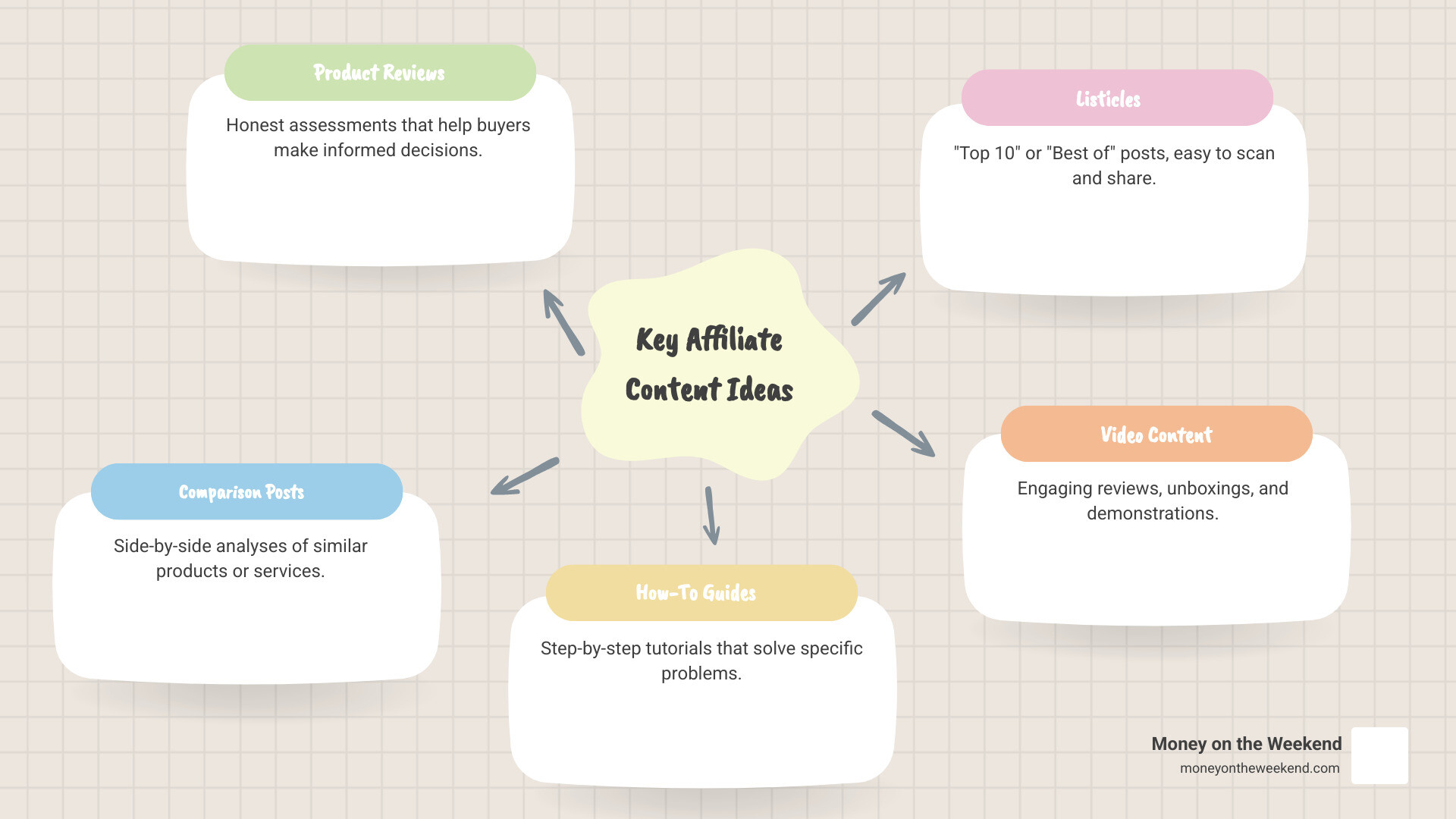
Affiliate marketing content ideas are the fuel that powers your online income engine. Here are the most effective types to start with:
- Product Reviews – Honest assessments that help buyers make informed decisions
- Comparison Posts – Side-by-side analyses of similar products or services
- How-To Guides – Step-by-step tutorials that solve specific problems
- Listicles – “Top 10” or “Best of” posts that are easy to scan and share
- Video Content – YouTube reviews, unboxings, and demonstrations
- Email Campaigns – Targeted messages that nurture leads over time
- Case Studies – Real-world success stories that build credibility
- Social Media Posts – Platform-specific content that builds community
- Infographics – Visual breakdowns of complex information
- Resource Pages – Comprehensive guides that become go-to references
Remember the old door-to-door salesmen? Affiliate marketing is the digital evolution of that model, but with one crucial difference: you build trust through valuable content before you ever ask for a sale.
The challenge most new affiliate marketers face isn’t finding products to promote. It’s knowing what to write about and how to present it in ways that actually help people. You need content that solves real problems, answers genuine questions, and makes your audience’s lives better.
Here’s the truth: creating content for affiliate marketing isn’t about tricking people into clicking links. It’s about becoming a trusted resource in your niche. When you consistently deliver value, your audience naturally turns to you when they’re ready to buy.
The beauty of affiliate marketing is that once you create great content, it can generate passive income for months or even years. A single well-written product review or tutorial can drive sales long after you hit publish.
Foundational Content: The Bedrock of Your Affiliate Strategy
To truly thrive in affiliate marketing, we need to lay a strong foundation of content that establishes our authority, provides immense value, and solves our audience’s problems. This isn’t just about selling; it’s about becoming a trusted guide. When people trust our expertise, knowledge, and opinion, they are far more likely to follow our recommendations. This initial content also serves as evergreen material, continuing to attract visitors and generate income long after it’s published.

If you’re just starting, consider launching a blog. As we dig into affiliate marketing, understanding its core principles is key. Find out more about What is Affiliate Marketing?.
In-Depth Product Reviews
What makes product reviews so incredibly effective for affiliate marketers? It boils down to trust and informed decision-making. Consumers today are savvy; they’re faced with countless choices, and they want to be 100% sure before buying items online. That’s why 9 out of 10 consumers read online reviews first before making a purchase.
Our product reviews should be thorough, honest, and helpful. This means not shying away from discussing drawbacks, because an honest review will provide both sides of the story. What might be a drawback for one customer could be a strong selling point for another. As the adage goes, honesty is always the best policy, even in affiliate marketing.
We should base our reviews on personal experience whenever possible, covering aspects like ease of use, price, support, and overall effectiveness. By doing so, we build credibility and establish ourselves as reliable sources of information. Don’t just describe the product; paint a vivid picture that lets readers imagine themselves using it. Remember to strategically embed affiliate links within these reviews, making it easy for interested readers to take the next step.

Detailed Comparison Posts
People often get confused when choosing between multiple options. Comparison articles and videos are a fantastic way to help them understand the differences and make an informed decision. These posts compare our affiliate product to similar offerings, highlighting key features, prices, usability, and ratings. The benefits here are twofold: we help our audience clarify their needs, and we position ourselves as an objective authority.
When we create comparison content, we’re attracting high-intent traffic – people who are actively researching a purchase. By providing a clear, objective analysis, we build trust. It’s not about pushing one product blindly; it’s about presenting the facts so the consumer can choose what’s best for them. This approach allows us to seamlessly integrate affiliate links for all compared products, maximizing our earning potential.
Here’s an example of how we might structure a generic comparison:
| Feature | Affiliate Tool A | Affiliate Tool B |
|---|---|---|
| Pricing | Tiered plans, starting at $29/month | Flat fee $49/month, annual discount available |
| Tracking | Real-time, pixel-level attribution | Daily sync, dashboard updates |
| Integrations | 50+ popular marketing platforms | Limited to 10 core platforms |
| Support | Email, live chat (24/7) | Email only (Mon-Fri 9-5 EST) |
| Ease of Use | Intuitive UI, beginner-friendly | Steep learning curve, powerful features |
| Best For | New affiliates, content creators | Experienced marketers, large teams |
| Pros | Excellent reporting, easy setup | Highly customizable, advanced automation |
| Cons | Less advanced features for power users | Can be overwhelming for beginners, higher initial cost |
How-To Guides and Tutorials
Got a product that needs some explaining? Break it down step-by-step in a how-to article or video tutorial. Tutorials and how-to guides are incredibly effective affiliate marketing content ideas because they solve a specific problem for our audience, demonstrating the value of the product in action. They are evergreen content, meaning they remain relevant and valuable over time.
We can showcase how a product or service addresses a user’s needs, walking them through the setup, usage, or problem-solving process. Make it so easy to follow that even our tech-challenged uncle could do it! Use clear, concise language, and don’t forget to sprinkle in some pro tips. Seamlessly integrating affiliate links at relevant points within these guides feels natural and helpful, rather than pushy.
For instance, if we’re promoting a web hosting service, a “How to Set Up Your First WordPress Website” tutorial could naturally include an affiliate link for that host. These guides build our authority and keep people longer on our website, increasing the chances of conversion. If you’re looking to launch your own affiliate site, our guide on How to Start and Launch an Affiliate Marketing Website in Just 7 Days offers practical steps.
Engaging Listicles (Top 10s, Best Ofs)
Who doesn’t love a good list? Listicles are the comfort food of the content world: easy to digest and oh-so-satisfying. They are one of the most popular affiliate marketing content ideas because they capture audience attention with easily digestible content. Whether we’re rounding up the “Top 10 POD Pet Products to Sell” or “5 Life-Changing Products You Never Knew You Needed,” listicles are designed for quick consumption and high shareability.
The key is to keep it snappy yet informative. Give enough detail to intrigue, but leave them wanting to click that affiliate link for more. Listicles convert more than reviews or how-to articles because they often target specific buyer keywords (e.g., “best headphones for travel”) and present a curated selection, reducing decision fatigue.
Gift guides are a special type of listicle that are truly unsung heroes and conversion machines. People searching for gift ideas are usually already in buying mode, making these guides highly effective for driving affiliate income. The more specific and niche our gift guide, the better! For those passionate about travel, our Affiliate Marketing Travel Ultimate Guide offers plenty of inspiration for listicle ideas.
Dynamic Formats: Engaging Affiliate Marketing Content Ideas
While text-based content forms the backbone, dynamic formats are crucial for capturing attention and engaging diverse audiences. These formats leverage visuals and audio to communicate information more effectively and can often be repurposed across multiple platforms, maximizing our content’s reach.
To explore more about getting started in this exciting field, check out our Affiliate Marketing Beginners Guide.
High-Impact Video Content for Affiliate Marketing
Show, don’t just tell! Video content is a powerhouse for affiliate marketing content ideas, especially on platforms like YouTube. With more than 2.7 billion monthly users, YouTube is not only the largest video platform but also a highly profitable channel for affiliate marketing. People spend 1 billion hours watching YouTube videos every single day!
Why are videos so effective? According to data, about 90% of the total information transmitted to our brain is visual, and visuals are processed 60,000 times faster in the brain than text. This means videos can convey complex information quickly and engage viewers on a deeper level.
We can leverage video in several ways:
- Unboxing Videos: Reveal new products and share first impressions. The Unbox Therapy YouTube channel is an excellent example, effectively incorporating affiliate links in video descriptions through product unboxings and reviews.
- Product Reviews: Demonstrate products in action, highlighting features and benefits. Your personality can really shine through in video format, helping you build a stronger connection with your audience.
- Tutorials/How-Tos: Visually guide viewers through using a product or solving a problem. Search engines love video content, and video tutorials are fantastic for demonstrating how products work.
- Social Media Clips: Short, engaging videos for platforms like TikTok or Instagram Reels can drive quick traffic to landing pages or product pages.
Just like written content, we use videos to direct traffic to relevant landing pages, product pages, and seller websites. For example, a popular fashion vlogger often includes affiliate links for “Items in this video” and “Shop my closet” embedded in the description for one of her YouTube videos.
Building Authority with Podcasts and Webinars
Podcasts and webinars offer unique ways to build authority and rapport with our audience. They cater to those who prefer consuming content in audio or live interactive formats, allowing us to connect on a more personal level.
Podcasts: These are a great way to establish rapport with potential customers, particularly those who prefer consuming content in an audio format. They are also an effective tool to build a presence as an industry authority, providing new perspectives and insights. We can discuss industry trends, interview experts, or dive deep into topics relevant to our niche. We can mention products from our affiliate program, but the focus should always be on providing value first, with affiliate links usually included in the show notes. For example, many top business podcasts integrate affiliate offers by mentioning relevant tools or services during an episode. These offers align with the topic being discussed and are often included with a special link in the show notes, providing value to the listener while generating income.
Webinars: A webinar is a good channel for any business to subtly convince a viewer to become a paying customer. These live, interactive sessions allow us to showcase expertise, build an audience organically, and generate high-quality leads. GoToWebinar mentioned that 60% of businesses design their webinars to convert prospects to loyal customers. We can use webinars to present products, demonstrate their value, and answer questions in real-time. For example, a webinar teaching a new software skill could include an affiliate link for a discount on that software in the description or as a follow-up email. This provides a direct, tangible benefit to attendees. Webinars can also be recorded and repurposed as evergreen content, continuing to attract viewers and generate leads long after the live event.
For those interested in exploring digital products, check out our insights on Ebook Affiliate Programs.
Visually Appealing Infographics
Infographics are a fantastic way to break down complex information into digestible, shareable bites. Remember to balance information with eye-catching design. Keep the text minimal and let the visuals do the talking – 90% of all the information zipping to our brain comes in visual form. Moreover, visuals are processed 60,000 times faster in the brain than text.
These highly shareable assets can condense data, statistics, or step-by-step processes related to our affiliate products. They’re excellent for social media and can also attract valuable backlinks to our site. Don’t forget to brand our infographics and include our affiliate website – they might get shared far and wide, increasing our reach and potential for conversions.
Strategic Content for Long-Term Growth and Trust
Building a successful affiliate marketing business isn’t a sprint; it’s a marathon. The content we create needs to be strategic, designed not just for immediate sales but for nurturing leads, building a loyal audience, and establishing long-term trust. This approach ensures sustainable growth and helps us achieve financial freedom.
Our goal is to build passive income streams, and affiliate marketing is a powerful way to achieve that. Learn more about Affiliate Marketing Passive Income.
Nurturing Leads with Email Marketing
Email is one of the ‘oldest’ digital marketing channels, but it is still a winner – if we know how to do it right. In 2020 alone, there were 3.9 billion daily email users, and this number has only increased. A staggering 87% of B2B marketers still say that email is one of their top free organic distribution channels.
The strategy behind using email campaigns for affiliate marketing is simple: build an email list by offering valuable content (like an e-book or exclusive tips), then use targeted campaigns to promote affiliate products to those who have expressed interest. This allows for personalization and direct communication, fostering a deeper connection and trust with our audience.
Good email deliverability is crucial for our affiliate marketing business because better email deliverability means more affiliate commission. We should segment our lists, mix promotional emails with value-packed content, and always provide a clear next step. Our Affiliate Marketing Ebook Complete Guide can be a fantastic lead magnet for building an email list.
Leveraging Social Proof: Case Studies & Success Stories
Nothing sells quite like success stories, and that’s exactly what case studies deliver. Case studies are incredibly powerful affiliate marketing content ideas, especially in B2B environments. They provide real-world examples of how a product or service solved a specific problem, offering tangible evidence of its benefits.
When creating case studies, we should identify a problem our audience commonly faces and walk through how our affiliate product solved it step-by-step. Use real-world examples, data, quotes, and specific outcomes to make it concrete and relatable. This helps overcome objections and builds significant credibility. Case studies are likely to convert more than regular blog posts because they offer proof of concept.
For B2C, success stories can take the form of customer testimonials or inspiring narratives about how a product changed someone’s life. These stories add a human element and resonate deeply with potential buyers.
Creative Affiliate Marketing Content Ideas for Social Media
With nearly 5 billion people worldwide on social media, affiliate marketers must leverage these platforms to build a presence, gain a following, and promote affiliate products and links. Social media offers immense reach and scalability, but the key is platform-specific content.
- Platform-Specific Content: What works on Instagram (visuals, Stories, Reels) might differ from TikTok (short, trending videos), X (quick updates, discussions), or LinkedIn (professional insights). We should adapt our content to each platform’s unique style and audience expectations.
- Building a Community: Social media isn’t just for broadcasting; it’s for interaction. Engaging with comments, running polls, and answering questions builds a loyal community around our brand.
- Influencer Collaborations: Partnering with influencers is a highly effective social media strategy. Influencers have established trust and engaged audiences. We can choose partners whose values align with ours for co-created content or sponsored posts that naturally feature our affiliate products.
- User-Generated Content (UGC): Encourage our audience to create content featuring our affiliate products (reviews, photos, videos, testimonials). Sharing UGC adds authenticity and social proof, making our promotions feel more organic and trustworthy.
- Behind-the-Scenes: Share glimpses into our process, product testing, or daily life. This humanizes our brand and builds a more personal connection with our followers.
- Memes and Trends: Don’t be afraid to use humor! Creating or adapting memes that resonate with our audience and subtly relate to our products can make our brand more approachable and increase shareability.
Frequently Asked Questions about Affiliate Content
What are the key elements of successful affiliate marketing content?
Successful affiliate marketing content isn’t just about throwing links at our audience. It’s about a strategic approach that prioritizes value and trust. The key elements include:
- Value First: Our content should always aim to solve a problem, answer a question, or provide genuine utility to the reader, before promoting a product.
- Authenticity and Honesty: Be transparent about our affiliate relationships and provide unbiased opinions, including both pros and cons.
- Audience Understanding: We must deeply understand our audience’s interests, pain points, and buying behavior to create content that truly resonates.
- Clear Call-to-Action (CTA): Once value is established, guide users clearly and explicitly to the next step, whether it’s clicking an affiliate link, signing up for an email list, or learning more.
- High-Quality Visuals: Use compelling images, videos, and infographics to make content engaging and easier to digest. 90% of information zipping to our brain comes in visual form.
- SEO Optimization: Research and incorporate relevant keywords to ensure our content ranks high in search engines, attracting organic traffic. An SEO-optimized web page, peppered with affiliate partner links, can perform exceptionally well.
How can I ensure my content is authentic and builds trust?
Authenticity and trust are the cornerstones of successful affiliate marketing. Here’s how we can cultivate them:
- Honest Reviews: Don’t just praise products. Discuss the drawbacks or situations where a product might not be ideal. This builds credibility.
- Disclose Partnerships: Always be transparent about our affiliate relationships. A simple disclosure statement is often enough and legally required in many places.
- Share Personal Experiences: If we’ve used the product ourselves, share our genuine experience. This makes our recommendations relatable and trustworthy.
- Focus on Helping, Not Selling: Our primary goal should be to educate and assist our audience. When we genuinely help them, sales become a natural byproduct.
- Engage with Your Audience: Respond to comments, answer questions, and participate in discussions. This shows we care about their needs and are a real person behind the content.
- Don’t Over-Promote: Balance promotional content with informational and entertaining content. We should aim for a healthy affiliate content ratio, where informational content outweighs commercial pitches.
How much money can you make with affiliate marketing?
The earning potential in affiliate marketing is vast, and truly, there’s no limit to how much one can earn. It’s one of the most attractive aspects of pursuing financial freedom through online income. However, it’s not a get-rich-quick scheme.
How much money we can make with affiliate marketing depends on several factors:
- Niche Selection: Some niches are more lucrative than others, often due to higher-priced products or recurring commissions.
- Traffic Volume: More traffic to our content generally means more potential clicks on affiliate links.
- Conversion Rates: The effectiveness of our content in convincing visitors to click and purchase directly impacts earnings.
- Commission Rates: Different affiliate programs offer varying commission percentages.
While beginners might start by earning $500-$1000 per month, reaching five-figure or even six-figure incomes is entirely possible with consistent effort, smart strategies, and a diverse range of affiliate marketing content ideas. The key is to focus on long-term value, continuously optimize our content, and build a loyal audience.
For a deeper dive into this topic, explore our article on How Much Money Can You Make With Affiliate Marketing?.
Conclusion
We’ve explored a vast landscape of affiliate marketing content ideas, from foundational blog posts like in-depth reviews and comparison articles to dynamic formats like videos, podcasts, and infographics, and strategic approaches like email campaigns and case studies. The overarching theme is clear: success in affiliate marketing isn’t about magic formulas or quick schemes; it’s about creating content that truly resonates with our audience.
A diverse content strategy, combining different formats and approaches, is essential for reaching various segments of our audience and building a robust affiliate business. By consistently providing genuine value, maintaining authenticity, and understanding our audience’s needs, we can establish ourselves as trusted authorities in our niches.
At Money on the Weekend, our mission is to empower individuals to find financial freedom in their spare time. Creating valuable content is a cornerstone of this journey, especially through passive income streams like affiliate marketing. So, let’s get creative, experiment with these ideas, and start on the path to building a thriving online business.
Ready to put these content ideas into action and start your journey towards financial independence? Start building your passive income stream with blogging today!