From Idea to Income: The Digital Product Creation Journey
Why Digital Product Creation Is One of the Smartest Ways to Earn Online

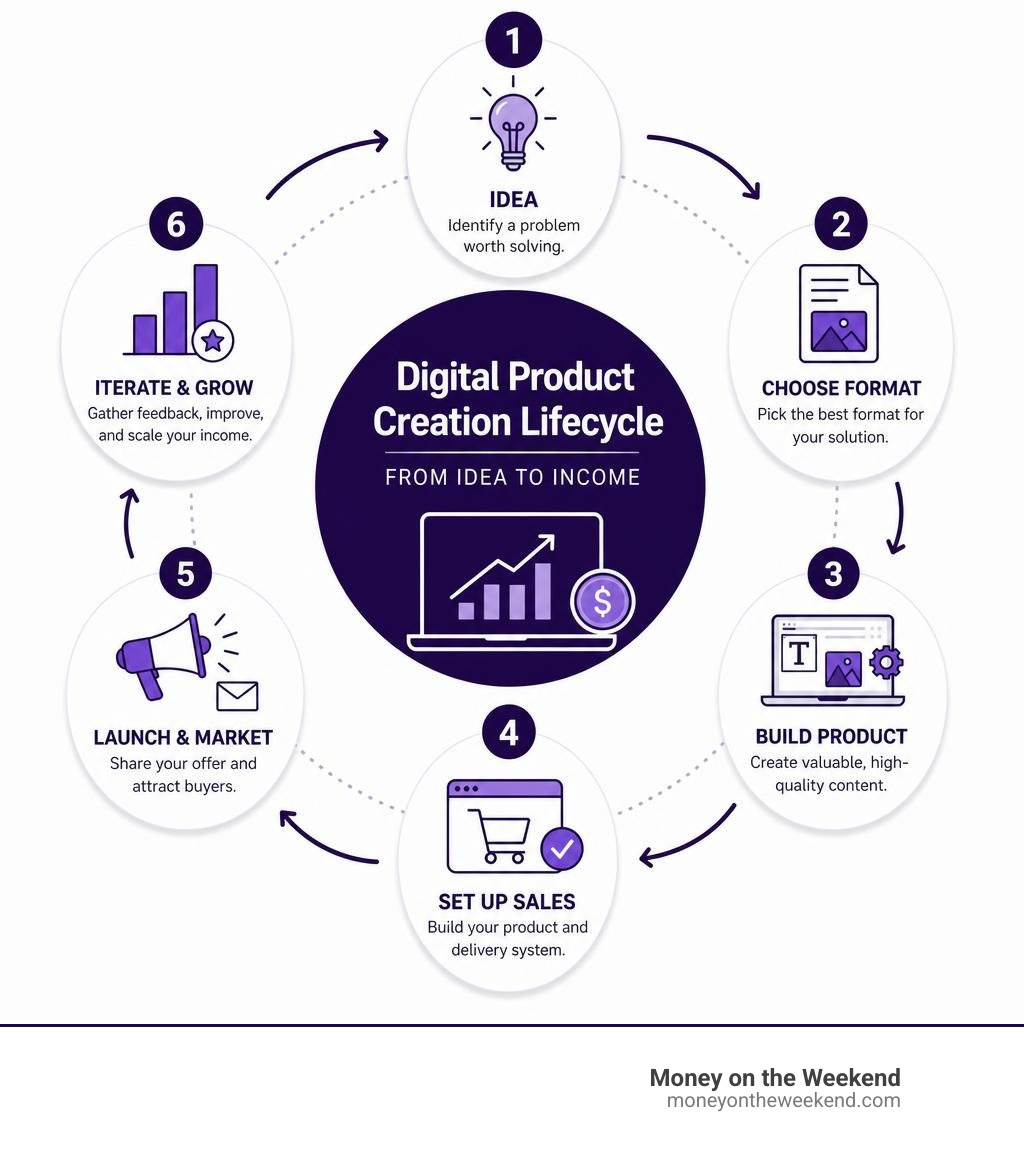
Digital product creation is the process of building and selling intangible goods — like online courses, templates, ebooks, and workbooks — that can be delivered automatically and sold repeatedly without restocking.
Here’s the quick version of how it works:
- Identify a problem your audience has and wants to solve
- Choose a format (course, template, spreadsheet, printable, etc.)
- Build the product using tools like Canva, Google Docs, or AI platforms
- Set up a sales system on a platform like Gumroad, Kajabi, or Sellfy
- Launch with a plan — pre-launch hype, email sequences, and a clear offer
- Iterate based on buyer feedback and keep improving
The numbers tell a compelling story. The global e-learning market alone is projected to reach $404.8 billion by 2025. Creators who sell digital products report an average revenue increase of 3.2x compared to those offering only services. And the average digital product creator earns between $1,000 and $5,000 per month — with top creators clearing over $50,000 monthly.
But the real appeal isn’t just the income potential. It’s the leverage. You build something once. Then it sells while you sleep, travel, or work your day job.
The challenge most people hit? They don’t know where to start — or they spend months building something nobody wants.
This guide walks you through the full journey: from spotting a real problem worth solving, to designing a product people actually buy, to launching it with confidence.
Explore more about Digital product creation:
The Blueprint of Digital Product Creation

We have all been there. You get a sudden burst of inspiration, spend three weeks locked in your room drinking too much coffee, build what you think is a masterpiece, and launch it to the sound of absolute silence. It is a classic rite of passage, but it is one we want to help you avoid.
Successful Digital product creation is not about building what you think is cool. It is about understanding the digital product lifecycle and building what your audience is already begging for. When you shift your focus from “What can I make?” to “What problem can I solve?”, you open up a highly reliable path to Make Money Online.
To build a product that actually sells, we need to treat the creation process as a structured journey. According to the framework outlined by How to Start Selling Digital Products in 7 Steps – Salesforce, a successful launch relies on clear market research, targeted validation, and structured delivery. By mapping out your product lifecycle before you create a single page or slide, you ensure that every hour you spend building translates directly into value for your future customers.
Validating Demand and Solving Real Problems
If you want to Start A Business that generates reliable passive income, validation is your safety net. You do not need a massive following to validate an idea, but you do need to listen to real human struggles.
The most effective way to start is by looking at the questions your audience asks repeatedly. Are you constantly getting the same questions in your email inbox, social media comments, or online forums? Those recurring questions are goldmines. As noted in Create and Sell Digital Products: A Starter’s Guide | beehiiv Blog, identifying these precise audience struggles is the foundation of any successful digital offer.
To validate your idea before building, we recommend a simple three-step framework:
- Ask a Single-Question Survey: Reach out to your email list or social media community and ask: “What is the single biggest problem you are currently struggling with when it comes to [your niche]?”
- Analyze the Vocabulary: Do not just look at the topics—look at the exact words they use. These responses serve as your product roadmap and your copywriting cheat sheet. If they say they feel “overwhelmed and stuck in a rut,” use those exact words in your sales copy.
- Scan Existing Marketplaces: Go to Amazon, Udemy, Pinterest, or Etsy. Are people already paying for solutions to this problem? The presence of competitors is not a warning sign; it is proof of an active, buying market.
Choosing the Right Digital Product Formats
Not all digital products are created equal. Some require months of video editing, while others can be built in a single weekend. The best format is the one that solves your customer’s problem in the fastest, most digestible way possible.
Here are the most popular formats working exceptionally well in 2026:
- Online Courses: Great for comprehensive transformations, but they require the highest effort to build.
- Templates: Highly profitable and incredibly popular. People love shortcuts. Think Notion setups, Canva graphics, or website themes.
- Workbooks & Journals: Perfect for step-by-step guidance, reflection, and structured learning.
- Masterclasses & Workshops: A pre-recorded or live 90-minute deep dive into a highly specific topic.
- Spreadsheets: Financial planners, habit trackers, and business calculators built in Google Sheets are incredibly high-value and low-effort to create.
To help you decide which path to take, we have put together a quick comparison table:
| Product Format | Creation Effort | Profit Potential | Best For |
|---|---|---|---|
| Checklists & Printables | Very Low | Moderate | Quick wins, lead magnets, low-ticket offers |
| Spreadsheets & Calculators | Low | High | Systems, organization, financial tracking |
| Canva/Notion Templates | Moderate | High | Saving time, design shortcuts, daily workflow |
| Workbooks & Guides | Moderate | Moderate | Self-paced learning, structured reflection |
| Masterclasses (1-2 hours) | Moderate | High | Fast specialized training, teaching + tools |
| Full Online Courses | High | Very High | Complete skill transformations, high-ticket |
If you are looking for the 10 Best Passive Income Ideas, we often recommend starting with templates or a short masterclass. Why? Because they offer a fantastic balance of quick creation time and high perceived value. You can easily bundle a 2-hour masterclass with a practical template to create a premium offer that solves a problem instantly.
Designing and Prototyping for Maximum Perceived Value

Let’s be completely honest: people buy with their eyes. Even if your digital product contains life-changing information, a sloppy presentation will kill your sales. To build a sustainable source of Online Income From Home, your digital asset must look professional, polished, and premium.
Perceived value is the psychological worth a customer places on your product based on its visual presentation, branding, and ease of use. If your product looks like a thrown-together Word document, people will struggle to justify spending $20 on it. But if that same information is packaged in a beautiful, interactive PDF with custom mockups and a cohesive brand style, they will happily pay $97 or more.
Accelerating Digital Product Creation with AI and Canva
The good news is that you do not need a degree in graphic design or a massive budget to create gorgeous products. In 2026, the intersection of user-friendly design platforms and artificial intelligence has made rapid prototyping incredibly fast.
When it comes to modern Content Creation, a few key tools can do the heavy lifting for you:
- Canva: The ultimate playground for creators. You can use Canva’s extensive template library to build workbooks, slide decks, and ebook covers in hours.
- Figma Make: If you are building digital tools, interactive guides, or software mockups, using an AI Product Prototype Generator: Design Faster | Figma allows you to turn plain-language ideas into interactive prototypes without writing a single line of code.
- Mowgli: For web and mobile app concepts, Mowgli: AI design tool for mobile, web & desktop apps is a game-changer. It helps you quickly map out entire visual screens and user flows on a single canvas, keeping your design context perfectly preserved.
- UXMagic: If you need to generate clean, Figma-ready UI designs instantly from a simple text prompt, sketch, or screenshot, AI UI Generator — Figma-Ready Designs in Seconds | UXMagic is an incredible asset. It even allows you to export your designs directly into clean HTML or React code.
By leveraging these tools, you can prototype your digital products 10x faster, allowing you to test your ideas in the real world before committing to weeks of manual design work.
Branding and Visual Presentation Best Practices
To make your digital product stand out, you need consistent branding. This doesn’t mean you need to spend thousands of dollars on a professional branding agency. It simply means choosing a clean, cohesive look and sticking to it.
Here are our top rules for visual presentation:
- Keep Your Colors Simple: Choose a palette of 2 to 3 colors that align with your topic. Use one dominant color, one supporting tone, and one accent color for callouts and buttons.
- Prioritize Readability: Stick to highly legible, modern typography. Use clean sans-serif fonts like Inter, Montserrat, or Roboto for body text.
- Use 3D Mockups: Since digital products are invisible, mockups make them feel “real.” Use Canva’s laptop and tablet frames to show your ebook, template, or course playing on a physical screen.
- Design for “Quick Wins”: Structure your layout so the user can get a result within the first 15 minutes. Use checkboxes, callout boxes, and progress trackers to keep them engaged.
If you are developing more technical tools, platforms like ProductOS — AI Product Development Platform | Customer Signal to Shipped Product can help you coordinate your research, design, and code agents in one unified workflow. For simple, one-sentence product generation, you can explore the AI Product Generator | One Sentence to a Complete Product tool by Hydite. And if you are building full-stack, cloud-based applications, Firebase Studio offers an incredible browser-based workspace to prototype and deploy your ideas quickly.
Pricing, Launching, and Scaling Your Offer
Once your product is designed and ready, it is time for the most exciting phase: putting it out into the world and making your first sales. This is where strategic pricing and a structured launch plan turn your hard work into real, repeatable Passive Income Ideas Ultimate Guide.
Too many creators simply upload their product to a platform, post about it once on social media, and wonder why the sales aren’t rolling in. To get a step-by-step video walkthrough of how to set up your store and start selling successfully this year, we highly recommend watching How to Start Selling Digital Products in 2026 (STEP BY … – YouTube. It breaks down the exact mechanics of launching a high-converting digital storefront.
Strategic Pricing and Iterative Testing
Pricing is highly psychological. If you price your product too low, people will assume it is low-quality. If you price it too high, you might price out beginners.
When searching for the Best Passive Ways To Make Money, we recommend a value-based pricing strategy combined with iterative testing:
- The “Feels Good” Starting Point: Start with a price that feels accessible but still respects your time. For a comprehensive workbook or template, $27 to $47 is a sweet spot.
- Psychological Pricing: Always end your prices in .95, .97, or .99. Pricing a product at $29.97 instead of $30 has a statistically proven positive impact on conversion rates.
- The Iterative Ramp-Up: Start low for your initial launch (you can call this an “introductory price” or “founding member pricing”). As you collect positive feedback, testimonials, and improve the product, gradually increase the price.
- Establish a Clear Refund Policy: Having a clear, fair refund policy (e.g., a 14-day money-back guarantee) reduces the risk for the buyer and increases conversion rates.
Executing a High-Converting Launch Campaign
A successful launch is not an event; it is a campaign. To build anticipation, you should start warming up your audience at least 2 to 4 weeks before your product officially goes on sale. This is where your Content Marketing Funnel becomes your most powerful asset.
Here is a simple, high-converting launch sequence you can adapt:
- The Tease Phase (2 Weeks Out): Share behind-the-scenes clips of you building the product. Talk about the specific problem you are trying to solve and ask your audience for their input on design options.
- The Value Phase (1 Week Out): Publish free content (blog posts, short videos, or social media updates) that solves a small, related part of the main problem. This proves your expertise and builds trust.
- The Open Cart Phase (Launch Week): Send a series of structured emails to your list. A standard launch sequence should include at least 10 emails over 5 to 7 days, highlighting different angles of the product:
- Day 1: The announcement (introducing the product and the “why” behind it).
- Day 3: The deep dive (explaining exactly what is inside and showing a video walkthrough).
- Day 5: Social proof & FAQ (sharing testimonials or answering common objections).
- Day 7: Last call (reminding them that the introductory pricing or limited-time bonuses are expiring).
- Scarcity and Urgency: Human beings are natural procrastinators. To get them to take action, you need a deadline. Offer a special launch discount or a set of high-value bonuses that disappear when the launch window closes.
Overcoming Mindset Pitfalls in Digital Product Creation
Before we move on, let’s address the elephant in the room: the mental hurdles. Creating your first digital product can be emotionally draining. You might deal with intense imposter syndrome (“Who am I to teach this?”) or paralyzing perfectionism (“It’s not ready yet, I need to add ten more modules!”).
Here is our advice to help you get out of your own way:
- Embrace the Minimum Viable Product (MVP): Your first version does not need to be perfect. In fact, it shouldn’t be. It is far better to launch a clean, helpful, 10-page guide that solves one problem than to spend a year building a 200-page encyclopedia that nobody buys.
- Focus on digestible content over massive scope: People do not pay for volume; they pay for outcomes. If you can help someone save 10 hours of work with a simple 2-page template, that is infinitely more valuable than a 20-hour video course they will never finish.
- You only need to be one step ahead: You do not need a PhD to help someone. If you have figured out a system that works for you, you are qualified to share it with those who are still struggling at step one.
Frequently Asked Questions about Digital Products
What is the easiest digital product to create for beginners?
The easiest digital product to create is a resource that provides a “quick win” with minimal technical setup. We highly recommend starting with a Canva template, a Google Sheets calculator, or a structured PDF checklist. These formats can be built in a single weekend using free tools, require zero hosting fees, and can be easily delivered via a simple Gumroad or Sellfy link.
How do I protect my digital products from being stolen?
While it is impossible to prevent 100% of digital piracy, you can easily protect your assets by:
- Adding subtle watermarks to your templates and PDFs.
- Including a clear licensing agreement on the first page of your product.
- Hosting your files on secure platforms like Gumroad, Kajabi, or Teachable.
- Remembering that the vast majority of online buyers are honest people who want to support creators. Focus your energy on serving them rather than worrying about bad actors.
Do I need a large audience to launch a digital product?
Absolutely not. You do not need millions of followers; you just need a small, highly engaged group of people who trust you. Many creators successfully launch their first product to email lists of fewer than 100 subscribers. By focusing on solving a highly specific, painful problem for a targeted niche, your conversion rates will be significantly higher than a generic offer sent to a massive, cold audience.
Conclusion
At Money on the Weekend, our mission is to empower you to find financial freedom and build sustainable passive income in your spare time. Digital product creation is, without a doubt, one of the most leveraged and rewarding ways to achieve that goal.
You don’t need a massive team, thousands of dollars in investment, or decades of experience. You just need to find a real problem, package the solution beautifully, and put it out into the world.
So, what are you waiting for? Pick one simple idea, draft your outline, and take your first step toward building your digital asset today.
To take your content and creation skills to the next level, dive into our comprehensive guides on Content Creation and start turning your spare hours into a thriving online business.