
The Short-Form Gold Rush: What 2026 Holds for Your YouTube Earnings
YouTube short monetization 2026 is shaping up to be less about instant riches and more about strategic audience building. If you’re wondering whether your Shorts will still pay next year, here’s what you need to know right now:
Quick Answer: Yes, but differently than you might expect.
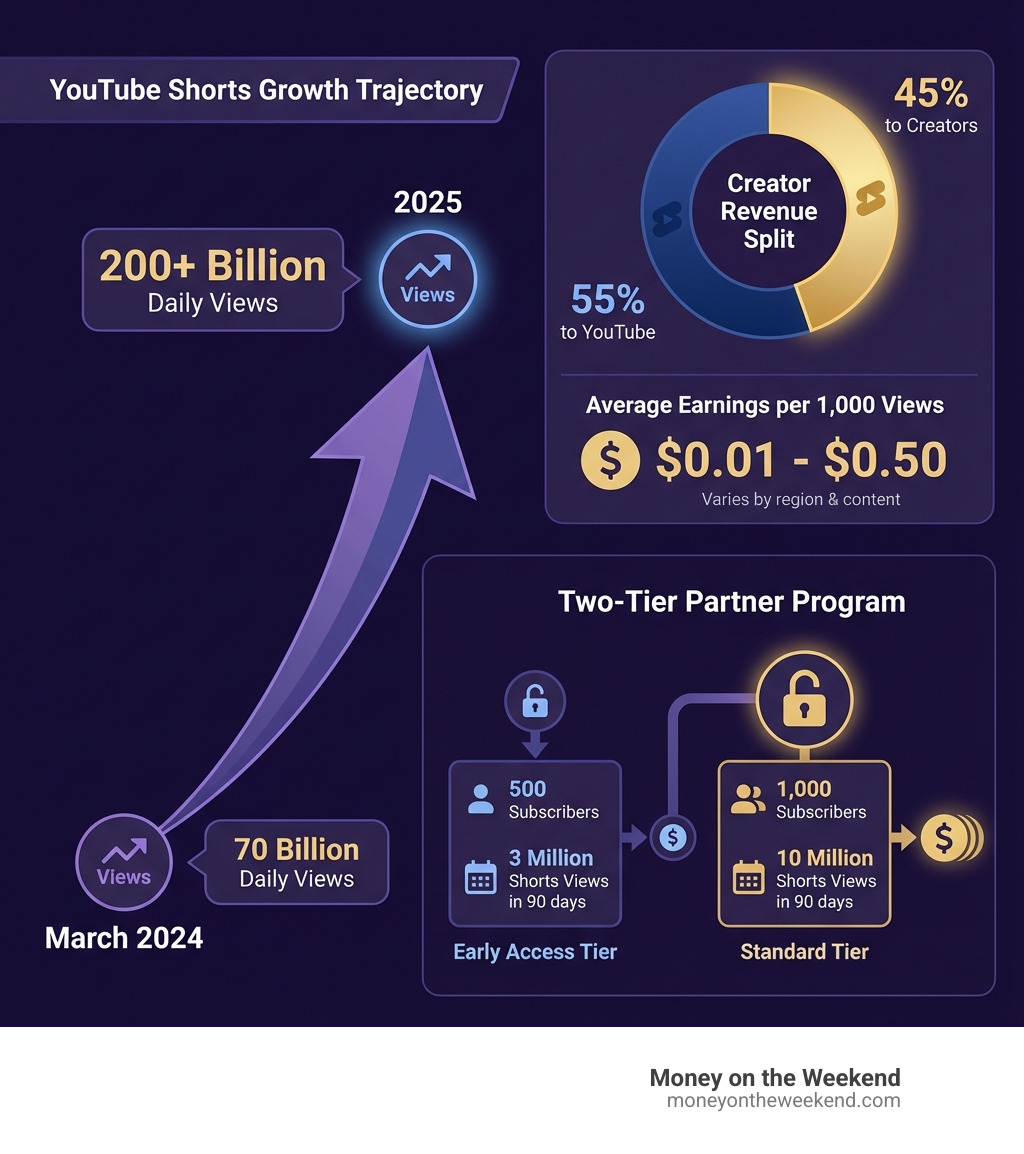
- Two-tier system: Early access tier (500 subs, 3M Shorts views) or Standard tier (1,000 subs, 10M Shorts views)
- Revenue split: Creators keep 45% of allocated Shorts revenue (vs. 55% for long-form)
- Realistic earnings: $0.01-$0.50 per 1,000 views on average
- Best strategy: Use Shorts as a traffic funnel to higher-paying revenue streams
The numbers tell a compelling story. YouTube Shorts now generates over 200 billion views every day—nearly triple the 70 billion daily views from March 2024. An estimated 175 million Americans use Shorts in 2025, with projections hitting 192 million by 2027. Short-form content has become the format of choice for 96% of consumers.
But here’s the reality check: while Shorts are exploding in popularity, they’re not a passive income miracle. Most creators report earning just pennies per thousand views. The platform’s revenue-sharing model pools ad revenue, deducts music licensing costs, then splits what’s left 45/55 in favor of YouTube.
Yet creators are still rushing in. Why? Because Shorts offer something more valuable than immediate ad revenue: rapid audience growth. Channels are jumping from 10,000 to 200,000 subscribers in months by posting consistently. Those subscribers then become customers for higher-margin income streams like brand deals, courses, and memberships.
The question isn’t whether Shorts will pay in 2026. It’s whether you’re building a strategy that makes them worth your time.
The 2026 YouTube Partner Program: A Two-Tiered System
Navigating YouTube short monetization 2026 starts with understanding the gateway to all earnings: the YouTube Partner Program (YPP). For 2026, YouTube continues to evolve its requirements, offering a more flexible, two-tiered system designed to bring creators into the monetization fold sooner. This means that even if you’re just starting your journey towards financial freedom through online income, YouTube is providing clearer paths to start earning.
Standard vs. Early-Access Tiers
The biggest change, and indeed a significant opportunity for creators, is the introduction of an early-access tier within the YPP. This allows creators to begin monetizing certain aspects of their channel even before reaching the traditional, higher thresholds.
To qualify for the Standard Tier of the YouTube Partner Program, which open ups full ad revenue sharing for both long-form videos and Shorts, creators will need to meet the following criteria:
- 1,000 subscribers: A foundational milestone for any YouTube channel. If you’re wondering What happens when you get 1000 subscribers on YouTube?, it’s often the first step towards realizing your monetization goals.
- Either 10 million valid public Shorts views in the last 90 days OR 4,000 valid public watch hours from long-form videos in the last 12 months: This dual pathway is crucial. It acknowledges the massive growth of short-form content, allowing creators who excel in Shorts to monetize without necessarily accumulating extensive watch hours from longer videos. It’s important to note that watch hours from Shorts themselves do not count towards the 4,000-hour requirement for long-form content; instead, they have their own specific view count target.
For those looking to get a head start, the Early-Access Tier provides a pathway to fan-funding features without requiring the full subscriber and view/watch hour counts. This tier requires:
- 500 subscribers.
- Either 3 million valid public Shorts views in the last 90 days OR 3,000 valid public watch hours from long-form videos in the last 12 months.
- Three valid public uploads in the past 90 days.
This early-access tier is a fantastic opportunity for emerging creators to begin building a stable income through fan support, offering features like channel memberships, Super Chat, Super Stickers, and Super Thanks. While it doesn’t immediately grant ad revenue sharing for YouTube short monetization 2026, it allows creators to start earning and engage their audience in meaningful ways, building momentum towards full YPP eligibility.
Core Compliance and Technical Setup
Regardless of which tier you’re aiming for, adherence to YouTube’s policies is non-negotiable. To ensure your channel remains eligible for YouTube short monetization 2026 and beyond, you must:
- Follow all YouTube channel monetization policies: This includes a broad spectrum of rules covering everything from content appropriateness to intellectual property.
- Adhere to YouTube’s Community Guidelines, Terms of Service, Copyright, and Google AdSense program policies: These are the bedrock of a healthy, monetized channel. Violations can lead to demonetization or even channel termination.
- Be located in a country where the program is available: YouTube’s Partner Program has geographical restrictions, so ensure your region is supported.
- Have no active Community Guidelines strikes against your channel: A clean record is essential.
- Have two-step verification turned on for your Google account and advanced features enabled: Security is paramount.
- Link an active Google AdSense account: This is how you get paid!
For new creators, these requirements might seem daunting, but they are crucial for building a sustainable online business. If you need Help Starting a YouTube Channel, we’ve got resources to guide you through the process, ensuring you set up your channel for long-term success and monetization.
Decoding the Shorts Ad Revenue Model: How the Money Flows
Understanding how money flows from ads in the Shorts Feed is key to grasping YouTube short monetization 2026. Unlike long-form videos where ads are placed directly within or around your content, Shorts operate on a unique, pooled revenue system. This model is designed to fairly distribute earnings across a vast ecosystem of short-form content, accounting for factors like music licensing and the rapid-fire nature of Shorts consumption.

Here’s the breakdown of how the YouTube Shorts ad revenue sharing model works:
- Ad Placement: Ads are shown between videos in the Shorts Feed as viewers swipe from one Short to the next. These can be skippable video or image ads.
- Revenue Pool: All revenue generated from these ads is collected into a single pool.
- Music Licensing Deduction: Before any money reaches creators, a portion of this overall revenue pool is allocated to cover the costs of music licensing. This is a critical step, as music is a huge part of the Shorts experience. The amount deducted depends on whether copyrighted music is used in a Short and, if so, how many tracks. For instance, if a Short uses one music track, half of the revenue associated with its views is allocated to the Creator Pool, and the other half covers music licensing. If two tracks are used, it’s one-third for the Creator Pool and two-thirds for licensing.
- Creator Pool Calculation: The remaining funds after music licensing deductions form the “Creator Pool.”
- Allocation to Creators: This Creator Pool is then distributed to monetizing creators based on their share of total eligible, engaged Shorts views from their content. “Engaged views” are legitimate views from real users that adhere to YouTube’s policies, excluding bot views, policy violations, or artificial traffic.
- Revenue Split: Once a creator’s share of the Creator Pool is determined, they keep 45% of that allocated revenue, while YouTube retains the remaining 55%. This 45/55 split applies regardless of whether music was used in the Short.
This system means that creators get paid from a shared fund, not per ad shown directly on their specific Short. It’s a fundamental difference from long-form content, and it’s why the earnings per view can vary significantly. For those pursuing Passive Income, understanding this unique model is vital for setting realistic expectations.
YouTube Premium Revenue: It’s also worth noting how YouTube Premium plays into YouTube short monetization 2026. For views from YouTube Premium subscribers, creators also receive 45% of the net revenue allocated to their Shorts. This revenue is separate from ad revenue but operates on the same 45% creator share model, contributing another potential income stream for creators.
Projecting Earnings: A Realistic Look at YouTube Short Monetization 2026
One of the most frequently asked questions is, “How much can I actually earn from YouTube short monetization 2026?” The answer, while not as straightforward as for long-form content, gives us a clear picture. Most creators report making anywhere from $0.01 to $0.50 per 1,000 views on Shorts. This means that for one million views on YouTube Shorts, creators can expect to earn between $10 to $120+. Some sources even indicate earnings as low as $10-$50 for a million views.
Why such a wide range? Several factors influence your RPM (Revenue Per Mille, or revenue per 1,000 views) for Shorts:
- Audience Location: Viewers from countries with higher advertising demand (like the U.S., Canada, UK) generally lead to higher RPMs.
- Niche: Certain niches attract higher-paying advertisers. Finance, business, and tech content often see better rates.
- Engagement Quality: The overall engagement on your Shorts can signal value to advertisers, potentially impacting your share of the Creator Pool.
- Music Usage: While your 45% share from the Creator Pool remains constant, the initial music licensing deductions from the overall revenue pool can affect the size of that pool, indirectly influencing earnings.
To put it in perspective, if you have a Short with 1,000 views, you might only make a few cents. This highlights why Shorts are often considered a volume game for direct ad revenue. While the potential earnings per view are lower than long-form content, the sheer virality and findability of Shorts can lead to massive view counts, which can eventually add up.
Shorts vs. Long-Form Monetization: A Comparison
To truly appreciate the nuances of YouTube short monetization 2026, compare it with the long-form video monetization model. This table highlights the key differences that every creator should be aware of when planning their content strategy.
| Feature | YouTube Shorts | Long-Form Videos |
|---|---|---|
| Revenue Split | 45% to Creator, 55% to YouTube | 55% to Creator, 45% to YouTube |
| Ad Placement | Between videos in Shorts Feed | Pre-roll, mid-roll, post-roll, display, overlay |
| Average RPM | $0.01 – $0.50 | $2.00 – $10.00+ |
| Primary Goal | Audience Growth & Findability | Direct Ad Revenue & Audience Retention |
| Monetization Path | 10M views in 90 days (or 4k watch hours) | 4,000 watch hours in 12 months (or 10M Shorts views) |
As “Dungeons & Dragons” creator Zachery “ZachTheBold” Renauldo aptly put it, “Long-form monetization is 100 percent better; it’s more consistent… With Shorts, you get a peak, and then it falls off.” This underscores the difference in reliability and consistency of income. While Shorts can offer explosive growth, their ad revenue is often seen as less stable compared to long-form content. Therefore, a balanced approach is often the most lucrative strategy for creators.
Beyond the Feed: Diversifying Your Shorts Income in 2026
While direct ad revenue from YouTube short monetization 2026 might not make you an overnight millionaire, the true power of Shorts lies in their ability to act as a powerful funnel for diversified income streams. For Money on the Weekend, our mission is to guide individuals to financial freedom through online income generation. Shorts fit perfectly into this philosophy, serving as a dynamic tool for audience acquisition that can then be leveraged for higher-value monetization methods.
Think of Shorts as your channel’s free marketing machine. They bring in new viewers and subscribers at an incredible rate (more than 6.5 million creators upload at least one Short every month!), and it’s your job to convert those viewers into customers for other offerings. This is where the magic of Content Creation truly shines, as you strategize how each Short contributes to your overall financial goals.
Leveraging Shorts for Brand Deals and Affiliate Marketing
Brand partnerships and affiliate marketing represent significant opportunities for YouTube short monetization 2026. Their viral potential and high engagement make them attractive to brands looking to reach new audiences.
- Brand Deals and Sponsored Content: Brands are increasingly recognizing the value of Shorts. Seventy-five percent of Dentsu Creative UK’s creator-led campaigns in 2025 included Shorts, marking a significant year-over-year increase. YouTube is actively working to expand its internal brand partnership tools, such as the BrandConnect program (currently in beta testing and available to invited creators, initially those with at least 25,000 subscribers), and collaborating with third-party creator monetization vendors. This means more opportunities for sponsored content, product placements, and integrated campaigns within your Shorts.
- Affiliate Marketing: Shorts are perfect for quick product demonstrations, comparisons, or “get the look” clips. You can showcase a product or service in action and then direct viewers to an affiliate link in your description or pinned comment. For example, if you create content around digital entrepreneurship, you could promote tools or services. The Shopify Affiliate Program is a great example for creators who educate their audience about entrepreneurship, where Shorts could visually highlight the benefits of starting an online store. This is a subtle yet effective way to generate revenue, especially since consumers prefer learning about products through short videos (78% of consumers, according to Wyzowl’s 2025 video marketing data).
The key here is authenticity. While the rise in branded content opportunities could tempt some creators to prioritize quantity over quality, as “Magic: The Gathering” YouTuber MaldHound noted, this could decrease the overall perception of the format. Instead, focus on genuine recommendations that resonate with your audience. Understanding How much do sponsors pay YouTubers? can help you negotiate fair rates for your valuable Shorts content.
Alternative Income Streams for YouTube Short Monetization 2026
Beyond direct ad revenue and brand collaborations, several other avenues can significantly boost your earnings through YouTube short monetization 2026:
- Fan Funding Features: These allow your most loyal viewers to directly support your channel. The Early-Access YPP tier grants access to these, making them an excellent starting point for new creators.
- Super Thanks: Viewers can purchase a “Super Thanks” to show appreciation for a Short, which highlights their comment.
- Channel Memberships: Offer exclusive perks, content, or badges to members who pay a recurring monthly fee.
- Super Chat & Super Stickers: While primarily for live streams, Shorts can promote your live sessions where these features are active.
- Selling Your Own Products and Merchandise: Shorts are fantastic for showcasing your own line of merchandise or digital products. A quick, engaging Short demonstrating your product or highlighting its benefits can drive traffic directly to your online store. Whether it’s branded apparel, e-books, presets, or online courses, Shorts provide a visual storefront.
- Digital Products and Services: If you offer services like coaching, consultations, or sell digital products like templates or stock footage, Shorts can be used to provide quick value or teasers, leading viewers to your offerings.
These alternative streams emphasize the strategic role of Shorts in building a comprehensive Monetization strategy. They allow you to convert the massive reach of Shorts into more stable and often higher-margin income.
Strategies and Challenges for YouTube Short Monetization 2026
Success with YouTube short monetization 2026 isn’t just about meeting eligibility requirements; it’s about smart content strategy and overcoming unique challenges. Shorts are a different beast from long-form content, demanding a specific approach to maximize their potential for audience building and revenue generation. For us at Money on the Weekend, we believe in empowering creators with the knowledge to steer these waters effectively.
Best Practices for Monetized Shorts
To truly make your Shorts pay off, whether through direct ad revenue or by funneling viewers to other income streams, consider these best practices:
- Hook Viewers in the First 3 Seconds: The Shorts Feed is a rapid-fire consumption experience. You have mere milliseconds to grab attention. Start with a question, a surprising visual, or an intriguing statement. A strong hook is non-negotiable for virality and watch time.
- Use Trending Sounds and Topics with a Unique Spin: YouTube’s algorithm, much like other short-form platforms, favors content that leverages trending audio and themes. However, simply copying trends isn’t enough. Infuse your unique personality, niche, or educational value to stand out. This is where your creativity as a creator truly pays off.
- Post Consistently to Signal Activity to the Algorithm: Creators who post frequently (some successful channels even aim for 3-5 Shorts daily) tend to see faster growth. Consistency tells YouTube that you’re an active contributor, encouraging the algorithm to push your content. While this can lead to creator burnout if not managed well, batch creation and repurposing content can help maintain momentum.
- Create Original, Transformative Content to Comply with YouTube’s reused content policy: This is crucial for monetization. YouTube is strict about originality. Simply re-uploading unedited clips from movies, TV shows, or other creators, or creating compilations without significant original commentary or creative input, will likely render your Shorts ineligible for monetization. Reaction Shorts, for example, need to be transformative and add substantial value beyond just showing another video.
- Use Shorts to Funnel Viewers to Long-Form Videos and Other Revenue Sources: This is arguably the most powerful strategy. Treat your Shorts as appetizers for your main course. Use engaging teasers, quick tips, or behind-the-scenes glimpses to entice viewers to your longer, more in-depth videos (which typically have higher RPMs), your website, or your product pages. This is how you convert rapid audience growth into sustainable income.
For more insights into optimizing your channel, check out our YouTube Tips section.
Overcoming the Challenges: Low RPMs and Content Originality
The journey to successful YouTube short monetization 2026 isn’t without its problems. Creators often face two primary challenges: the notoriously low RPMs (revenue per 1,000 views) and YouTube’s stringent policies on content originality.
-
Low RPMs: As we’ve discussed, the direct ad revenue from Shorts is significantly lower than long-form content. This can be disheartening for creators who pour effort into viral Shorts only to see minimal payouts. “Long-form monetization is 100 percent better; it’s more consistent,” echoed Zachery “ZachTheBold” Renauldo, a Dungeons & Dragons creator, highlighting the common sentiment. The solution isn’t to abandon Shorts but to reframe their purpose.
- Focus on Volume: If direct ad revenue is a goal, you need immense volume. Batch-producing content and posting consistently can help accumulate views.
- Niche Down for Higher Value: While not guaranteed, some niches attract higher-paying advertisers, potentially leading to slightly better RPMs.
- Treat Shorts as a Top-of-Funnel Tool: This is the most effective approach. Accept that Shorts’ primary value is audience acquisition. Leverage their viral potential to grow your subscriber base, then direct those subscribers to your long-form videos (which earn more), your affiliate links, your merchandise, or your courses. Shorts become a powerful lead-generation tool.
-
Content Originality: YouTube’s stance on reused or non-original content is clear: it won’t be monetized. This means:
- Avoid Simple Re-uploads: Don’t just take content from other platforms or creators and re-upload it to Shorts without significant change.
- Add Significant Commentary or Educational Value: If you’re using third-party content (e.g., reaction videos, clips from movies), you must add substantial value in the form of commentary, critique, educational insight, or creative input. The content needs to be “transformative,” meaning it adds new meaning or message.
- Be Mindful of Music Licensing: While YouTube handles much of the music licensing for Shorts, using copyrighted music without proper rights can still lead to issues or deductions from the Creator Pool.
The opacity of the YouTube Shorts algorithm can also be a challenge, making it difficult for creators to predict which Shorts will go viral. As creator Beret noted, the desire for guaranteed payment for a particular short is strong. This unpredictability, combined with lower ad revenue, means that creators cannot invest days into scripting and shooting for a potentially low-paying partnership. Therefore, efficiency in content creation and a focus on the broader strategic goals are paramount.
Conclusion
As we look ahead to YouTube short monetization 2026, it’s clear that Shorts are not just a fleeting trend but a fundamental shift in how content is consumed and monetized on the platform. While the direct ad revenue from Shorts might not be the primary driver of income for most creators, their immense power for rapid audience growth and findability makes them an indispensable tool in any digital entrepreneur’s arsenal.
We’ve explored the updated, two-tiered YouTube Partner Program, making monetization accessible to more creators sooner. We’ve demystified the unique Shorts ad revenue sharing model, understanding how the Creator Pool and music licensing impact earnings. And crucially, we’ve emphasized that the real financial freedom open uped by Shorts comes from diversifying income streams—through brand deals, affiliate marketing, selling your own products, and leveraging fan funding.
For us at Money on the Weekend, the message is clear: YouTube short monetization 2026 is about strategic integration. It’s about treating Shorts as a powerful lead generator, a way to build a passionate community, and a gateway to higher-value monetization opportunities. It’s not a get-rich-quick scheme, but a vital component of building a sustainable, diversified online business. By understanding these dynamics and implementing smart strategies, you can transform Shorts from a simple content format into a cornerstone of your financial freedom journey.
Ready to take control of your online earnings and build a sustainable income stream? Start your YouTube passive income journey with our expert guidance today.