
Why Content Writing Tips Are Your Secret Weapon for Online Success
Content writing tips are the building blocks for anyone who wants to turn their words into income. If you’re looking to master content writing quickly, here are the essentials:
Quick Answer: Top Content Writing Tips
- Craft compelling headlines (14-17 words work best)
- Write for one specific person, not everyone
- Use simple language – grade 8 level or below
- Make it actionable with step-by-step instructions
- Back it up with data and credible sources
- Edit ruthlessly – remove fluff, keep value
- Optimize for search with keywords and clear structure
Why does this matter? In a digital-first world, high-quality content is the engine behind brand authority, search visibility, and converting readers into customers. For anyone looking to make money online, content writing is one of the most sought-after skills you can develop.
The challenge? Attention spans are shrinking every day. You have about 15 seconds to hook your reader before they scroll away. That’s why 98% of marketing teams use written content, yet only 41% say their content actually generates a return on investment.
Here’s the good news: you don’t need to be a professional writer to create content that works. You need a system. You need to understand what makes people stop scrolling, what makes them trust you, and what makes them take action.
As one successful content creator puts it: “Content writing clears my head, it makes me see the world and my business in new ways. Content writing also helps me to earn a good living on the web.”
Whether you’re building a blog for passive income or offering online freelance services, mastering these content writing tips will help you stand out in a crowded digital landscape.
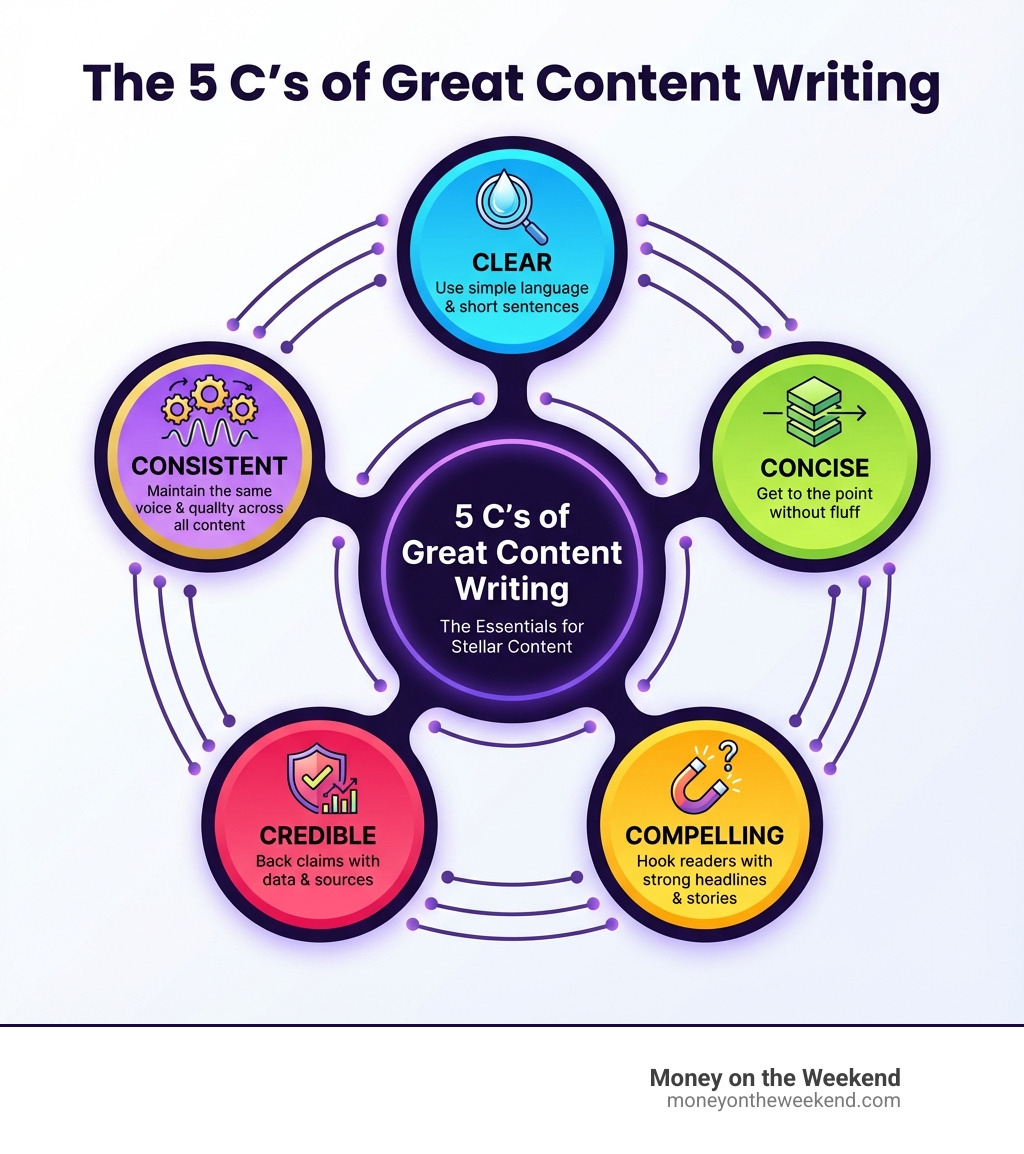
Easy Content writing tips glossary:
The Foundation: Core Principles of Stellar Content

Just like building a sturdy house, great content needs a strong foundation. This foundation isn’t about fancy jargon or complex theories; it’s about mastering the core principles that make your words resonate. We believe that anyone can become a stellar content writer with the right approach and dedication.
At its heart, content writing is about planning, writing, and publishing written material for online consumption, aiming to inform, educate, or persuade readers. This can range from blog posts and articles to product descriptions and marketing copy. What skills do we need to cultivate? Strong writing abilities, creativity, a good grasp of SEO, a dash of marketing savvy, and excellent research skills are essential. We need to be able to take complicated facts and break them down into digestible pieces.
But it’s not just about getting the words on the page; it’s about making them count. Our content needs to be readable and trustworthy. Why? Because most visitors spend only about 15 seconds on an article before leaving. If they don’t trust us or find our content easy to consume, they’re gone. For our content marketing to truly work, it needs to be incredibly useful and actionable, guiding our audience toward solutions and insights they can immediately apply.
Develop a Unique Voice and Style
Imagine trying to talk to everyone at once – it’s impossible to make a genuine connection. The same goes for our writing. To truly engage our audience, we need to develop a unique voice and style that speaks directly to them. This starts with understanding our brand persona and maintaining a consistent tone. As Wheaton College wisely advises, “the overall tone or attitude of a piece of writing should be appropriate to the audience and purpose.” We should imagine ourselves speaking to our audience directly.
A consistent voice isn’t just about sounding professional; it’s about building recognition and trust. When our audience knows what to expect from us, they’re more likely to return. This is why developing buyer personas is so crucial – it helps us understand who we’re talking to, what their needs are, and how they prefer to be addressed. Then, we can write in a way that feels natural and authentic, almost as if we’re having a conversation with a friend. We can even write as we talk, as long as it aligns with our brand’s personality and goals.
For more insights into building a strong brand identity through our writing, check out our guide on More info about building a brand.
Write with Clarity, Conciseness, and Credibility
In a world overflowing with information, clarity, conciseness, and credibility are our superpowers. Our goal is to make our content super easy to read and share. This means embracing simple language, short sentences, and concise paragraphs. We want to take complex ideas and break them down into easily understandable chunks. As the research shows, readers prefer simpler headlines and content over complex ones, and they pay more attention to it.
We should aim to use common English words. Instead of writing “famished,” we use “hungry.” Forget “ubiquitous” – just use “everywhere.” This approach ensures our message is accessible to a wider audience, not just academics. Keeping paragraphs short and sprinkling in visuals also makes our content more scannable and less daunting.
To build credibility, we must back up our claims with solid data and thorough research. Stats and links to credible sources help establish trust with our readers. We do our homework, reference reputable sources, and show that we know what we’re talking about. Tools like the Hemingway Editor can be invaluable here, helping us simplify complex sentences, reduce passive voice, and improve overall readability, ensuring our writing is as clear as possible.
Build Trust and Make Your Content Actionable
Trust is the currency of the digital world. For people to share and link to our content, they need to trust us first. One of the most powerful ways to build this trust is by sharing our first-hand experiences. When we write content that showcases our actual experience, it becomes much easier for a random visitor to trust us. This kind of authentic, experience-driven content is rare and incredibly valuable.
Beyond personal experience, we should link out to authoritative sources to further bolster our credibility. These references show our audience that our insights are well-researched and supported.
But trust isn’t enough; our content also needs to be actionable. Our audience is seeking information that will help them in their lives, solve their problems, or guide them towards a goal. This means providing step-by-step instructions, offering practical tips, and clearly outlining solutions. When we develop content to address questions, we add big-time value to our customers’ lives, which in turn helps our audience pay attention because our content writing skills solve their problems. This is what greases the wheel of our sales and promotions systems once we are ready to sell.
For those looking to turn their writing into a consistent income stream, mastering actionable content is key to a successful Passive Income: Blogging journey.
The Writing Blueprint: From Idea to Polished Piece

Even the most brilliant ideas need a blueprint to become a masterpiece. Our writing process, from initial concept to final publication, should be structured yet flexible. This involves using content templates, creating detailed outlines, and dedicating ample time to editing and proofreading. It’s how we ensure our writing is not only creative but also clear, coherent, and impactful.
Master the Art of Headlines and Introductions
The headline is our content’s first impression, and often its only chance to grab attention. Catchy headlines are the difference between people reading our content and simply scrolling past it. They are the powerhouse of our content writing, determining whether audiences will read the rest of our work. With only 15 seconds to hook a reader, our headlines have a lot of heavy lifting to do.
Research from a 2024 study published in Science Advance found that readers prefer simpler, more readable headlines over complex ones. They also pay more attention to and process these simpler headlines more deeply. We should aim for headlines that are between 14-17 words for optimal shares, and consider adding emotional appeal. We can even use free tools that give us an “Emotional Marketing Value” score to benchmark the emotional impact of our copy.
Once we’ve hooked them with a compelling headline, our introduction needs to seal the deal. We should use short introductions, approximately 4-8 sentences, that get straight to the point. We want to avoid rambling on like some recipe sites; instead, we offer a quick preview of what the reader will gain.
Here are 5 headline formulas that consistently work well for us:
- How-to [Achieve Benefit] in [Number] Easy Steps: (e.g., “How to Boost Your Blog Traffic in 5 Easy Steps”)
- [Number] Ways to [Solve Problem]: (e.g., “10 Ways to Overcome Writer’s Block”)
- The Ultimate Guide to [Complex Topic]: (e.g., “The Ultimate Guide to Passive Income Strategies”)
- Why You Should [Action/Believe Something Counter-Intuitive]: (e.g., “Why You Should Stop Chasing Every Trend in Content Marketing”)
- [Controversial Statement] About [Common Belief]: (e.g., “Content is NOT King: What Truly Drives Online Success”)
The Power of Research, Outlines, and Storytelling
Before we even begin writing, we need to understand what our audience truly wants. This is where listening to audience questions becomes more valuable than anything else. Harvesting these questions and creating content from them adds big-time value to our customers’ lives. Tools like AnswerThePublic are fantastic for finding what people are asking about any given topic.
Once we know what to write about, keyword research helps us understand how people are searching for that information. Learning SEO fundamentals is the backbone of effective content writing, guiding us to find winning keywords that resonate with our audience’s search intent.
With our topic and keywords in hand, we create an outline. Outlines are a great first step in the content writing process; they speed up writing by forcing organized thought and provide a high-level view for better structure. We can use templates, previous successful pieces, or even analyze top-performing content (using tools like BuzzSumo) to build our outline.
Finally, we infuse our content with the power of storytelling and personal experiences. Our best copywriting will come from our own stories, observations, and unique perspectives. Sharing anecdotes makes our content more relatable, memorable, and human. We can learn from brands like WooCommerce, which regularly features stories from brands serving niche markets, turning practical advice into inspiring narratives. This blend of structured information and engaging stories makes our content stand out, whether we’re building a personal brand or offering Online Freelance Services.
The Crucial Role of Editing and Proofreading
We’ve all been there: convinced our first draft is a masterpiece, only to reread it later and find a dozen mistakes. That’s why editing and proofreading are not just important; they are absolutely crucial. They are the final polish that transforms our writing from good to stellar.
After completing our first draft, we step away for a bit, then return with fresh eyes. We read over the text multiple times to ensure it’s easy for readers to comprehend. We look for clarity, conciseness, and flow. A great tip is to read our content aloud; this helps us catch awkward phrasing, grammatical errors, and clunky sentences that we might miss when reading silently.
Fortunately, we have fantastic tools at our disposal. Grammarly for writers is an advanced grammar checker that catches typos, spelling errors, and offers detailed explanations of grammar rules. The Hemingway Editor helps improve readability by highlighting complex sentences, passive voice, and unnecessary adverbs. Using these tools diligently ensures our work is polished, professional, and free of distracting errors. A good editor can turn a piece of writing into a masterpiece, but a great content writer minimizes the editor’s job by self-editing thoroughly.
Essential Content Writing Tips for SEO and Audience Engagement
In today’s digital landscape, writing compelling content is only half the battle. Our words also need to be findable by search engines and appealing to our target audience. This means integrating fundamental SEO best practices, adapting to the rise of AI in search, and leveraging visual content and audience feedback to maximize engagement.
Fundamental SEO Content Writing Tips
Optimizing our content for search engines isn’t just a suggestion; it’s crucial for getting our words seen. SEO basics are the backbone of content writing. We need to strategically place keywords, use clear header tags, craft compelling meta descriptions, and build internal links to guide both users and search engine crawlers.
The process starts with finding a winning keyword and understanding what searchers truly want. This means matching search intent – are they looking for information, a product, or a solution? Our content should then aim to cover everything searchers want to know about that topic.
When writing, we use keywords naturally within our content, especially in the title, introduction, and subheadings. Header tags (H1, H2, H3, etc.) not only structure our article for readability but also signal to search engines the most important topics. We also craft compelling title tags (ideally under 70 characters) and meta descriptions (under 160 characters) that accurately describe our content and entice clicks from the search results page. Finally, adding internal links to other relevant pages on our site helps search engines understand the structure of our website and pass authority between pages.
For a deeper dive into tools that can help us with keyword research and content optimization, explore our More on content tools guide.
Adapting to AI and Generative Engine Optimization (GEO)
The digital landscape is constantly evolving, and AI is playing an increasingly significant role. As more users turn to AI for search, the demand for clear, optimized content has never been greater. This introduces a new layer of optimization: Generative Engine Optimization (GEO).
While AI tools can assist with drafting and generating variations, we believe that AI cannot replicate the process of developing an idea over time or providing unique perspectives. Google’s Helpful Content guidelines emphasize the importance of original, insightful, or interesting information. This means our content needs to go beyond what AI can easily aggregate; it needs to demonstrate true Experience, Expertise, Authoritativeness, and Trustworthiness (E-E-A-T).
We focus on bringing new information to the table, challenging truisms, and sharing first-hand experiences that AI cannot replicate. If our content feels too easy to write, chances are others can easily replicate it, including AI. The real value lies in the deep thinking, unique angles, and authentic voice that only human writers can provide. This commitment to originality helps us stand out in an increasingly AI-saturated content world.
To improve our content and make it more appealing, even to AI, we can leverage visual elements. Learning about Using graphic design tools can help us create engaging visuals that complement our unique insights.
Advanced Content Writing Tips for Engagement
Beyond SEO, we constantly seek ways to make our content more engaging and impactful for our human audience.
One of the most powerful strategies is the effective use of visuals. We know that 94% of the information transmitted to the human brain is visual, and the brain processes visual information 60,000 times faster than plain text. This is why incorporating images, videos, and especially infographics can dramatically increase our content’s perceived value and engagement. Publishers who use infographics, for example, grow their traffic an average of 12% more than those who don’t. Visuals break up text, illustrate complex points, and make our content more shareable.
We also accept storytelling and personal experiences. Whether it’s a personal anecdote, a case study, or a narrative that illustrates a point, stories make our content relatable and memorable. They connect with our audience on an emotional level, fostering a deeper connection.
Finally, we actively leverage audience feedback and questions from our community. User feedback shows us our audience’s reactions, suggestions, and worldviews. When we develop content to address these questions, we add immense value to our customers’ lives. This kind of give and take is essential for building a strong relationship with our audience and ensures our content is always relevant and helpful.
Here’s a quick comparison of B2B and B2C content writing styles:
| Feature | B2B Content Writing | B2C Content Writing |
|---|---|---|
| Target Audience | Businesses, decision-makers, professionals | Individual consumers, general public |
| Tone of Voice | Formal, authoritative, data-driven, educational, problem-solving | Informal, emotional, entertaining, aspirational, relatable |
| Content Goals | Lead generation, thought leadership, industry authority, sales support | Brand awareness, engagement, direct sales, customer loyalty |
| Sales Cycle | Longer, more complex, multiple stakeholders | Shorter, often impulse-driven, individual decision-makers |
| Content Formats | Whitepapers, case studies, reports, webinars, detailed guides | Blog posts, social media updates, product descriptions, reviews |
Frequently Asked Questions about Content Writing
We often hear common questions from aspiring content writers and digital entrepreneurs. Let’s address some of these head-on.
How do you measure the success of content writing?
Measuring the success of our content writing is crucial to understanding what works and what doesn’t. We don’t just throw words out into the void; we track their impact. Key metrics we look at include:
- Search Rankings: Are our articles appearing higher in Google search results for target keywords? Tools like Google Analytics and SEO platforms help us track this.
- Organic Traffic: How many visitors are coming to our site directly from search engines due to our content?
- Engagement Rates: Are people reading our content? We look at metrics like bounce rate, time on page (dwell time), social shares, and comments. A high time on page suggests our content is engaging.
- Conversion Tracking: Is our content leading to desired actions, such as signing up for a newsletter, downloading a lead magnet, or making a purchase? This is especially important for financial freedom goals.
- Backlinks: Are other reputable websites linking back to our content? This indicates authority and trust, which boosts our own SEO.
By regularly analyzing these metrics, we can refine our content writing tips and strategies to ensure our efforts are yielding tangible results.
What are content pillars and why are they important?
Content pillars are the foundational themes or broad topics that support our overall content strategy. Think of them as the main categories under which all our specific content pieces fall. For example, if our mission is to guide individuals to financial freedom, our content pillars might be “Passive Income,” “Affiliate Marketing,” and “Freelance Work.”
These pillars are incredibly important because they:
- Provide Structure: They ensure consistency throughout our content and keep us aligned with our business goals.
- Build Authority: By consistently producing high-quality content around a few core themes, we establish ourselves as experts in those areas.
- Improve SEO: Content pillars often lead to topic clusters, where we create a main “pillar page” that broadly covers a topic and then link to many supporting articles that dive into specific subtopics. This interconnectedness signals to search engines that we are a comprehensive resource.
- Prevent Writer’s Block: Once we have our pillars, our “bank of ideas becomes expansive,” and we never feel like we have nothing to say. We always have a direction for new content.
What’s the difference between B2B and B2C content writing?
While the core principles of good writing apply to both, B2B (Business-to-Business) and B2C (Business-to-Consumer) content writing have distinct differences due to their target audiences and objectives.
- Target Audience: B2B content targets other businesses and professionals, often decision-makers within organizations. B2C content targets individual consumers.
- Tone of Voice: B2B content is typically more formal, authoritative, and data-driven, focusing on logic, ROI, and problem-solving. B2C content tends to be more emotional, informal, relatable, and entertaining, appealing to personal desires and immediate needs.
- Content Goals: B2B aims for lead generation, thought leadership, building industry authority, and supporting long sales cycles. B2C focuses on brand awareness, direct sales, customer loyalty, and driving quick purchasing decisions.
- Sales Cycle Length: B2B sales cycles are often long and complex, involving multiple stakeholders. B2C sales cycles are generally shorter, sometimes impulsive.
- Content Formats: B2B content often includes detailed whitepapers, case studies, industry reports, webinars, and in-depth guides. B2C content frequently uses blog posts, social media updates, product descriptions, reviews, and interactive quizzes.
Understanding these differences helps us tailor our content to maximize its effectiveness for the specific audience we are trying to reach.
Conclusion: Turn Your Words into a Weekend Income
We’ve explored a wealth of content writing tips, from crafting magnetic headlines to leveraging audience feedback and adapting to the age of AI. The journey to becoming a stellar content writer, and in turn, achieving financial freedom through online income generation, is a continuous one.
Remember the core principles: clarity, conciseness, credibility, and consistency. Develop a unique voice that resonates with your audience. Master the art of the headline and introduction, as these are your crucial gateways to engagement. Always research thoroughly, outline carefully, and tell compelling stories. And never underestimate the power of rigorous editing and proofreading.
The digital landscape is dynamic, and the best content writers are those who listen, learn, and adapt. By consistently applying these content writing tips, you’re not just writing; you’re building a valuable skill set that can open up opportunities for passive income, successful affiliate marketing, and thriving freelance work.
Your words have power. It’s time to release them. If you’re ready to transform your writing into a source of income, we invite you to Start your content creation journey with Money on the Weekend.