
Why YouTube Shorts Earn Matters for Aspiring Creators
YouTube Shorts earn has become one of the hottest topics for creators looking to turn their short-form videos into real income. If you’re wondering how much you can actually make and how to get started, here’s what you need to know:
Quick Answer: How Much Can You Earn from YouTube Shorts?
- Ad Revenue Range: $0.01 – $0.07 per 1,000 views (RPM)
- Earnings for 1 Million Views: $10 – $120+
- Creator Revenue Share: 45% of allocated ad revenue
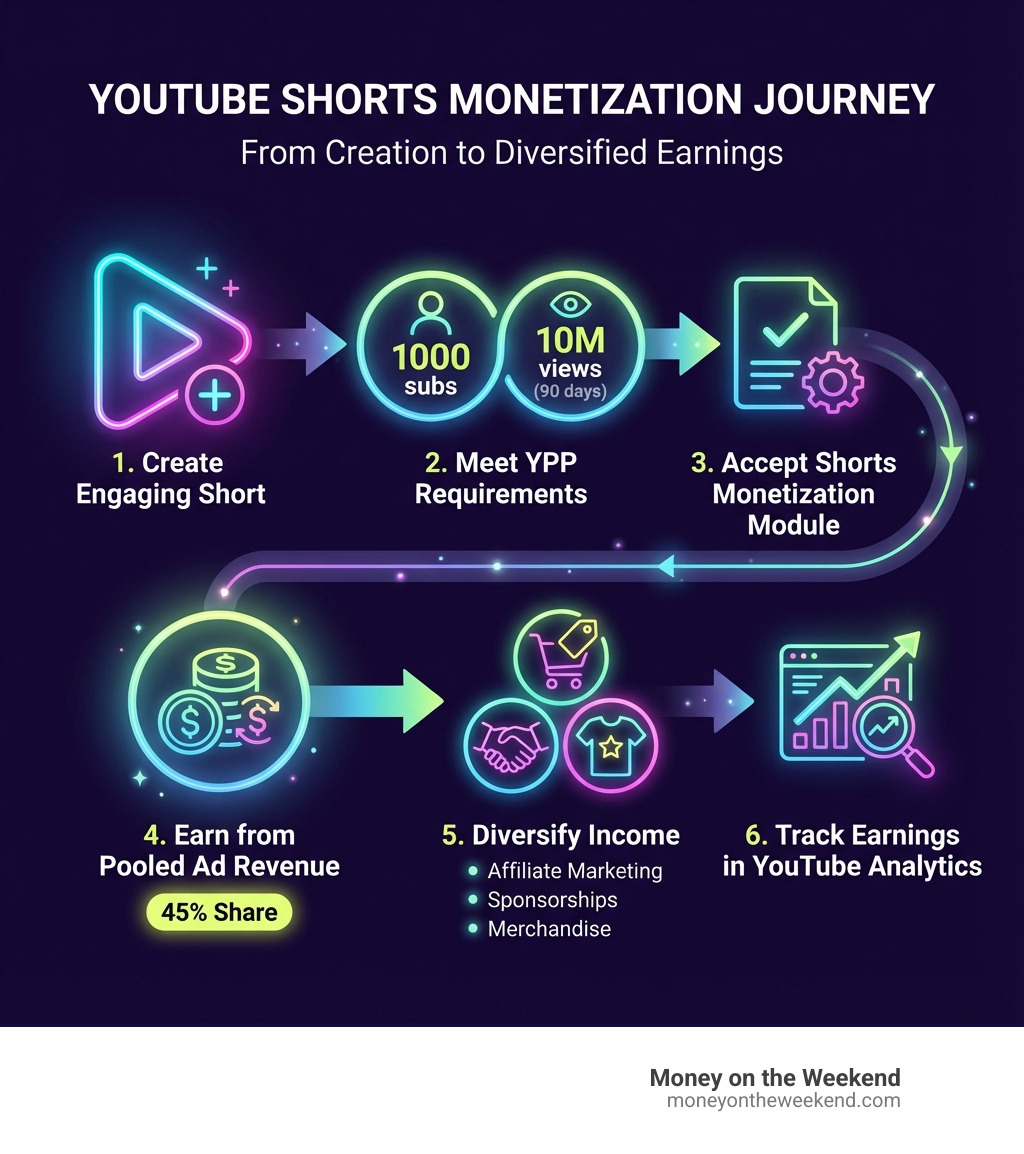
- Eligibility: 1,000 subscribers + 10 million Shorts views in 90 days
- Beyond Ads: Affiliate marketing, brand deals, merchandise, and fan funding can earn significantly more
YouTube Shorts has exploded to over 50 billion daily views, making it impossible to ignore if you’re serious about earning online. But here’s the reality check: while ad revenue from Shorts is relatively low compared to long-form videos, the platform offers something more valuable—rapid audience growth and multiple income streams.
Since YouTube launched its ad-revenue sharing model for Shorts in February 2023, more than 25% of channels in the YouTube Partner Program now earn through this revenue stream. Even better, over 80% of creators who joined through Shorts eligibility are also earning through other YouTube monetization features.
The truth is, Shorts shouldn’t be viewed as your primary income source from ad revenue alone. Instead, they’re a powerful gateway to building an audience quickly, securing brand partnerships, and driving traffic to your other products or services. Think of Shorts as your front door—they get people interested, but your house has many rooms where the real money is made.
Whether you’re creating content in your spare time or building toward full-time creator income, understanding how to monetize Shorts effectively can accelerate your journey to financial freedom.
Youtube shorts earn further reading:
How Does the YouTube Shorts Earn Model Actually Work?
The YouTube Shorts monetization model is a unique beast, distinct from its long-form video counterpart. It’s designed to reward creators for their short, engaging content while also accounting for the complexities of short-form advertising and music licensing.
At its core, the YouTube Shorts earn model operates through an ad-revenue sharing system that replaced the previous YouTube Shorts Fund in February 2023. This means that instead of a fixed fund, creators now earn a share of the actual ad revenue generated in the Shorts Feed. This shift was a big deal, moving Shorts from a bonus program to a fully integrated monetization pathway within the YouTube Partner Program (YPP).
Here’s the gist: ads are shown between videos in the Shorts Feed. The revenue from these ads is then pooled together. From this pooled revenue, YouTube first covers the costs of music licensing (if music is used in the Shorts). The remaining amount then goes into what’s called the “Creator Pool.” Finally, monetizing creators receive a 45% share of their allocated portion from this Creator Pool.
It’s a simplified approach that aims to streamline earnings for creators, making it easier to understand how your efforts translate into income. You can find more details on the official YouTube Shorts monetization policies.
How Ad Revenue is Shared: A 4-Step Breakdown
Understanding the journey from an ad view to your bank account can feel a bit like watching a magic trick. But fear not, we’re here to pull back the curtain! The Shorts ad revenue sharing works in four main steps:

- Pool Ad Revenue: First, all revenue from ads that run between Shorts in the Shorts Feed is gathered. This isn’t tied to a specific ad running on your Short, but rather ads viewed in between Shorts in the overall feed. This system ensures that all eligible Shorts contribute to the overall revenue pool, regardless of whether an ad was directly placed on them.
- Calculate the Creator Pool: Next, YouTube takes a portion of this pooled ad revenue to cover the costs of music licensing. The amount that remains after these music costs are deducted is what forms the “Creator Pool.” The size of this pool depends on the overall ad revenue and how much music is used across all Shorts.
- Allocate the Creator Pool: Now comes your slice of the pie! The Creator Pool is then distributed to monetizing creators based on their share of total engaged views from eligible Shorts. For example, if your eligible Shorts collectively account for 1% of all eligible Shorts views in a given country during a specific period, you’ll receive 1% of the Creator Pool for that country.
- Apply Revenue Share: Finally, you keep 45% of the revenue allocated to you from the Creator Pool. YouTube retains the remaining 55%. This 45% share applies consistently, whether your Short used music or not, as the music costs were already factored in when calculating the Creator Pool.
The Impact of Music and Third-Party Content
Music is a massive part of what makes Shorts so engaging, but it also adds a layer of complexity to monetization. As we mentioned, music licensing costs are deducted before the Creator Pool is formed. This means that while using popular tracks can boost your views, it indirectly affects the total amount available for creators.
Here’s how music usage specifically impacts the Creator Pool calculation:
- No Music: If your Short doesn’t use any music from YouTube’s licensed library, 100% of the revenue associated with its engaged views goes directly into the Creator Pool.
- One Music Track: If you use one music track, half (50%) of the revenue associated with its engaged views is allocated to the Creator Pool, and the other half covers music licensing costs.
- Two or More Music Tracks: If your Short features two or more music tracks, one-third (33.3%) of the revenue associated with its engaged views is allocated to the Creator Pool, with the remaining two-thirds covering music licensing.
This model is YouTube’s way of simplifying things for creators, so you don’t have to worry about individual music rights negotiations. However, it’s crucial to remember the importance of original content. Shorts that violate intellectual property rules or use unoriginal content (like unedited clips from TV shows, movies, or re-uploads from other creators) won’t earn money. Your content needs to be original or “sufficiently transformed” to be eligible. We have a great guide on What is considered reused content to help you steer these waters.
Qualifying to Monetize Your Shorts
Before you can start seeing those dollars roll in from your short-form masterpieces, you need to meet YouTube’s eligibility criteria and join the YouTube Partner Program (YPP). This is your golden ticket to earning, not just from Shorts ads, but from a host of other monetization features.
Joining the YPP means you’ve agreed to YouTube’s terms and policies, including their Community Guidelines, Terms of Service, and Copyright policies. You also need an active AdSense account to receive payments. Once you’re in the YPP, you’ll need to accept the “Shorts Monetization Module” to specifically enable earning from Shorts ad revenue and YouTube Premium views on your Shorts.
We know it sounds like a lot, but meeting these requirements is a clear path to financial freedom through your content. If you’re curious about the broader impact of reaching a key milestone, check out What happens when you get 1000 subscribers on YouTube?.
What are the Eligibility Requirements to YouTube Shorts Earn?
YouTube has two tiers of eligibility for the YouTube Partner Program, offering more flexibility for creators to start monetizing.
-
Tier 1: Fan Funding Access
This tier allows you to open up fan funding features like Super Chat, Super Stickers, Super Thanks, and Channel Memberships. You can also promote your own products through YouTube Shopping. To qualify for this tier, you need:- At least 500 subscribers.
- 3 valid public uploads in the last 90 days.
- Either 3,000 valid public watch hours on long-form videos in the past 12 months OR 3 million valid public Shorts views in the past 90 days.
-
Tier 2: Full Ad Revenue & Fan Funding Access
This is the tier that open ups ad revenue sharing for both long-form videos and YouTube Shorts. To qualify for this tier, you need:- At least 1,000 subscribers.
- Either 4,000 valid public watch hours on long-form videos in the past 12 months OR 10 million valid public Shorts views in the past 90 days.
In addition to these subscriber and view/watch hour metrics, your channel must also:
- Follow all YouTube channel monetization policies.
- Be in a country where the program is available.
- Not have any active Community Guidelines strikes.
- Have two-step verification turned on.
- Have advanced features enabled.
- Have an AdSense account linked to your channel.
How to Apply and Get Approved
Once you meet the eligibility criteria, applying for the YouTube Partner Program is straightforward.
- Sign in to YouTube Studio: You can do this on a computer or through the YouTube Studio app.
- Steer to the “Earn” Section: In the left-hand menu, click on “Earn.”
- Review Eligibility: YouTube Studio will show you your progress towards the YPP requirements. If you meet them, you’ll see an “Apply” button.
- Start Your Application: Click “Start” to review and accept the base terms of the YouTube Partner Program.
- Set Up AdSense: Click “Start” to either link an existing AdSense account or create a new one. This is crucial for receiving payments.
- Channel Review: After completing these steps, your channel will be placed in a queue for review by YouTube. This process ensures your channel complies with all their policies.

The review process can take a few weeks. If your application is initially rejected, don’t despair! YouTube will usually tell you why, and you can reapply after 30 or 90 days, depending on the reason for rejection. Just make sure to address the issues before reapplying.
How Much Can You Realistically Earn from YouTube Shorts?
This is the million-dollar question, or perhaps more accurately, the few-cents-per-thousand-views question! When we talk about how much you can earn, we often refer to RPM (Revenue Per Mille), which stands for revenue per thousand views. It’s how much you, the creator, earn for every 1,000 monetized views after YouTube takes its cut.
For YouTube Shorts earn potential, the RPM is significantly lower than for long-form videos. Creators typically report an average RPM for Shorts ranging from $0.01 to $0.07. This means that for 1 million Shorts views, you might earn anywhere from $10 to $120+. For instance, one creator shared earning $99.87 for 3.1 million Shorts views, which breaks down to about $32 per million views. Another creator, CaffeinatedBlogger, revealed earning $31.70 for 1.2 million views.
Several factors influence your actual earnings:
- Viewer Geography: Ads from viewers in certain countries pay more than others.
- Niche: Some niches attract higher-paying advertisers.
- Ad Engagement: How often viewers actually watch or click on ads.
- Music Usage: As discussed, using music indirectly reduces the Creator Pool, affecting everyone’s share.
While these numbers might seem low, Shorts have a viral nature, often accumulating views much faster than long-form content. If you’re interested in crunching your own numbers, Use our YouTube Views to Money Calculator.
Shorts vs. Long-Form Videos: A Revenue Comparison
To truly understand the earning landscape, it’s helpful to compare Shorts with long-form YouTube videos. They serve different purposes and offer distinct monetization paths.
| Metric | YouTube Shorts | Long-Form Videos |
|---|---|---|
| Average RPM | $0.01 – $0.07 | $1.61 – $29.30 (average $1.25 – $2.5) |
| Creator Revenue Share | 45% of allocated Creator Pool revenue | 55% of ad revenue on your video |
| Monetization Model | Pooled ad revenue from Shorts Feed (post-music deduction) | Ads directly on your video (pre-roll, mid-roll, post-roll) |
| Primary Value | Rapid subscriber growth, audience building, virality | Direct ad revenue, in-depth content, community engagement |
| Best For | Top-of-funnel marketing, brand exposure, quick content consumption | Deep dives, educational content, consistent passive income |
As you can see, the average RPM for long-form videos is significantly higher. This is why many creators use Shorts as a powerful tool for growth, driving viewers to their long-form content where the “real” ad revenue often lies.
How to Find and Track Your YouTube Shorts Earn Revenue
Transparency is key, and YouTube provides tools to help you keep tabs on your YouTube Shorts earn revenue.
Your primary source for tracking earnings will be YouTube Analytics within YouTube Studio. From the moment you accept the Shorts Monetization Module, you’ll start seeing estimated daily Shorts Feed ad revenue displayed here. This gives you a real-time (or near real-time) look at how your Shorts are performing.
It’s important to differentiate between estimated daily revenue in YouTube Analytics and your finalized earnings in AdSense. The numbers in Analytics are estimates and can fluctuate. Your final, confirmed earnings are processed and displayed in your linked AdSense account, typically around the middle of the following month.
When analyzing your Shorts’ performance, pay attention to metrics like “viewed vs. swiped away.” This can give you insights into how engaging your content is and whether viewers are sticking around, which directly impacts your “engaged views” count and, consequently, your share of the Creator Pool. For creators using Studio Content Manager, downloadable reports are available to provide even more detailed revenue specifics.
Beyond Ads: 6 Ways to Maximize Your Shorts Income
While YouTube Shorts earn from ad revenue might not make you an overnight millionaire, they are an incredibly powerful tool for audience growth and income diversification. We always emphasize that relying solely on ad revenue is like trying to build a house with just one type of brick. The real magic happens when you leverage your Shorts to drive other income streams and build a robust brand.
Think of your Shorts as magnetic snippets that draw people in. Once they’re hooked, you can guide them to more lucrative opportunities. This strategy is all about using Shorts as a marketing funnel to showcase your expertise, personality, and offerings. For more general advice on building your content game, check out our Content Creation strategies!
1. Drive Sales with Affiliate Marketing
Affiliate marketing is a fantastic way to monetize your Shorts, often with a much higher return than ad revenue per view. If you review products, recommend services, or create tutorials, you can include affiliate links in your Shorts’ comments section or description.
For example, if you review a new gadget, you can drop an Amazon affiliate link to that product. When viewers click your link and make a purchase, you earn a commission. It’s crucial to always disclose your affiliate relationships to maintain trust with your audience and comply with regulations. Learn more in our comprehensive guide: What is Affiliate Marketing?.
2. Secure Brand Partnerships and Sponsorships
With the influencer marketing industry expected to hit $22.3 billion in 2024, brand partnerships are a golden opportunity. Brands are actively seeking creators to promote their products and services, especially through engaging short-form videos.
Your Shorts, with their potential for viral reach, can be a compelling pitch to brands. You can create sponsored content, integrating a brand’s message naturally into your Shorts. To secure these deals, build a strong portfolio, understand your audience, and proactively pitch to brands that align with your content. Curious about the potential? Read How Much Do Sponsors Pay YouTubers?.
3. Sell Your Own Products or Merchandise
This is where you truly take control of your income. Whether you have a physical product line, digital products like e-books or online courses, or even branded merchandise, Shorts are a perfect promotional tool.
You can create Shorts that subtly (or not so subtly!) showcase your products, tease new releases, or offer quick tips related to your digital offerings. Then, link directly to your e-commerce store (e.g., Shopify, Spring) in the comments or description. This turns your Shorts into direct sales funnels. This is a fantastic way to build Passive Income ideas.
4. Activate Fan Funding Features
For creators in the YouTube Partner Program, fan funding offers direct support from your most loyal viewers. Even if you’re in the lower YPP tier (500 subscribers), you can access some of these features:
- Super Thanks: Viewers can buy a fun animation that appears on your video, along with a colorful, customizable comment. It’s a direct way for fans to show appreciation.
- Super Chat and Super Stickers: During live streams and Premieres, viewers can pay to highlight their messages or send animated stickers, making them stand out in the chat.
- Channel Memberships: Offer exclusive content, perks, and badges to subscribers who pay a monthly fee. This could include exclusive Shorts, early access to videos, or members-only live streams.
5. Promote Your Long-Form Content
We’ve established that long-form videos often have higher RPMs. So, one of the smartest ways to use Shorts is as a gateway to your longer content.
Create engaging, bite-sized “trailers” or highlights from your longer videos and post them as Shorts. This hooks viewers and encourages them to click through to your main channel to watch the full video. This strategy can significantly increase your overall channel watch time and boost the ad revenue generated by your long-form videos. It’s a win-win, using the virality of Shorts to fuel the higher earning potential of long-form. If you’re new to this, learn How to Enable Long Videos on YouTube.
6. Offer Your Skills as a Content Creator
Your ability to create engaging Shorts is a valuable skill in itself! You can offer your services to brands or businesses who want to leverage short-form video but don’t have the in-house expertise. This could involve:
- Creating User-Generated Content (UGC) for Brands: Many brands seek authentic, creator-style content for their own social media. You can create these videos for them, often without needing a massive following yourself.
- Freelance Video Editing: Your proficiency in editing Shorts (perhaps with tools like CapCut) can be offered as a freelance service.
- Managing Social Media: Businesses might hire you to manage their short-form video strategy across platforms, including YouTube Shorts.
This is a direct service-based income stream that leverages your creative talents. For more ways to leverage your skills and earn, explore More info about making money online.
Frequently Asked Questions about Earning with YouTube Shorts
We get it, online monetization can be confusing. Let’s clear up some common questions about how to YouTube Shorts earn.
Can I get monetized on YouTube with only Shorts?
Yes, absolutely! You can meet the eligibility requirements for the YouTube Partner Program (YPP) exclusively through your Shorts views. To qualify for full ad revenue sharing, you need to reach 1,000 subscribers and accumulate 10 million valid public Shorts views within a 90-day period.
Many creators have successfully joined the YPP and started earning by focusing solely on Shorts. However, as we’ve discussed, diversifying your content and income streams is often the most profitable long-term strategy.
What content is NOT eligible for Shorts monetization?
To ensure your Shorts are eligible for monetization, they must adhere to YouTube’s strict guidelines. Content that is generally NOT eligible includes:
- Non-original content: This means unedited clips from movies, TV shows, or other creators’ content. While reaction videos can be monetized, they must add significant original commentary or creative value.
- Re-uploads: Simply taking another creator’s video (even from other platforms like TikTok or Instagram) and re-uploading it to YouTube Shorts is not allowed.
- Artificial views: Any views generated by bots, click farms, or other deceptive means are not counted and can lead to demonetization or channel termination.
- Content violating advertiser-friendly guidelines: Shorts must be suitable for advertisers. This means avoiding inappropriate language, violence, adult content, dangerous acts, and other sensitive themes that would deter advertisers. You can review the full advertiser-friendly guidelines for more details.
- Shorts over one minute with claimed content: While Shorts can be up to 60 seconds, YouTube has introduced 3-minute Shorts. However, Shorts over one minute containing claimed third-party content (like music) may be blocked from monetization or have their revenue split differently.
Do I need 1,000 subscribers to make money from Shorts?
Not necessarily for all forms of income, but yes, for ad revenue sharing, you will need 1,000 subscribers (along with 10 million Shorts views or 4,000 watch hours).
However, you can start earning from Shorts even with fewer subscribers through other methods:
- Fan Funding: If you meet the lower YPP tier requirements (500 subscribers, 3 public uploads, and either 3 million Shorts views or 3,000 watch hours), you can activate Super Thanks and Channel Memberships.
- External Monetization: Affiliate marketing, brand partnerships, and selling your own products don’t typically have subscriber requirements set by YouTube. You can start pursuing these avenues at any channel size, using your Shorts to drive traffic and sales.
So, while 1,000 subscribers is the gateway to ad revenue, it’s not the only path to earning from your Shorts.
Turn Your Passion into Profit
The world of YouTube Shorts earn is dynamic and full of potential for creators like us. We’ve seen that while direct ad revenue from Shorts might be modest, their power lies in their ability to rapidly grow an audience and serve as a launchpad for multiple, more lucrative income streams.
YouTube Shorts are more than just short videos; they are a powerful tool for audience acquisition, brand building, and income diversification. By understanding the monetization model, meeting eligibility requirements, and strategically leveraging external income sources, you can transform your creative passion into tangible profit.
At Money on the Weekend, our philosophy is about empowering you to find financial freedom, often in your spare time. YouTube Shorts perfectly align with this, offering an accessible entry point into content creation and online earning. Don’t let the small ad revenue numbers deter you; instead, see Shorts as your fast pass to a larger, more sustainable creator business.
Ready to dive deeper and explore how your content can generate real income? Start your journey to earning on YouTube today.