
Why Alternative Income Streams Are Your Path to Financial Freedom
Alternative income streams are ways to earn money beyond your primary job, offering financial security and flexibility in an increasingly unpredictable economy. Whether you’re looking to supplement your paycheck, build wealth, or eventually replace your 9-to-5, these income sources work alongside—or even without—your active participation.
Quick Answer: Types of Alternative Income Streams
- Investment-Based: Dividend stocks, real estate, bonds, high-yield savings accounts
- Skill-Based: Digital products (ebooks, courses), content creation (blogs, YouTube), affiliate marketing
- Asset Rental: Renting cars, equipment, storage space, or creative work (stock photos, music)
- Business Ventures: Online courses, subscription services, automated businesses
The gig economy is booming, and more people are finding that traditional employment isn’t the only path to financial success. In 2012, one investment banker walked away from his corporate job with roughly $80,000 per year in passive income—money that kept flowing whether he worked or not.
But here’s the truth: alternative income streams require upfront effort. They’re not get-rich-quick schemes. Whether you’re investing money into dividend stocks or investing time into building a YouTube channel, you’ll need to put in work before the rewards start flowing.
The good news? You have more options than ever before. With platforms democratizing access to investing, content creation, and digital entrepreneurship, you don’t need massive capital or special connections to get started. You just need the right strategy and the willingness to begin.
This guide breaks down both investment-based strategies (where your money works for you) and skill-based opportunities (where your time and talents create income). By the end, you’ll have a clear roadmap for building income that fits your budget, interests, and available time.
What Are Alternative Income Streams (And Why You Need Them)
At Money on the Weekend, we believe in empowering you to achieve financial freedom. A crucial step on this journey is understanding the difference between active and passive income, and why diversifying into alternative income streams is so vital.
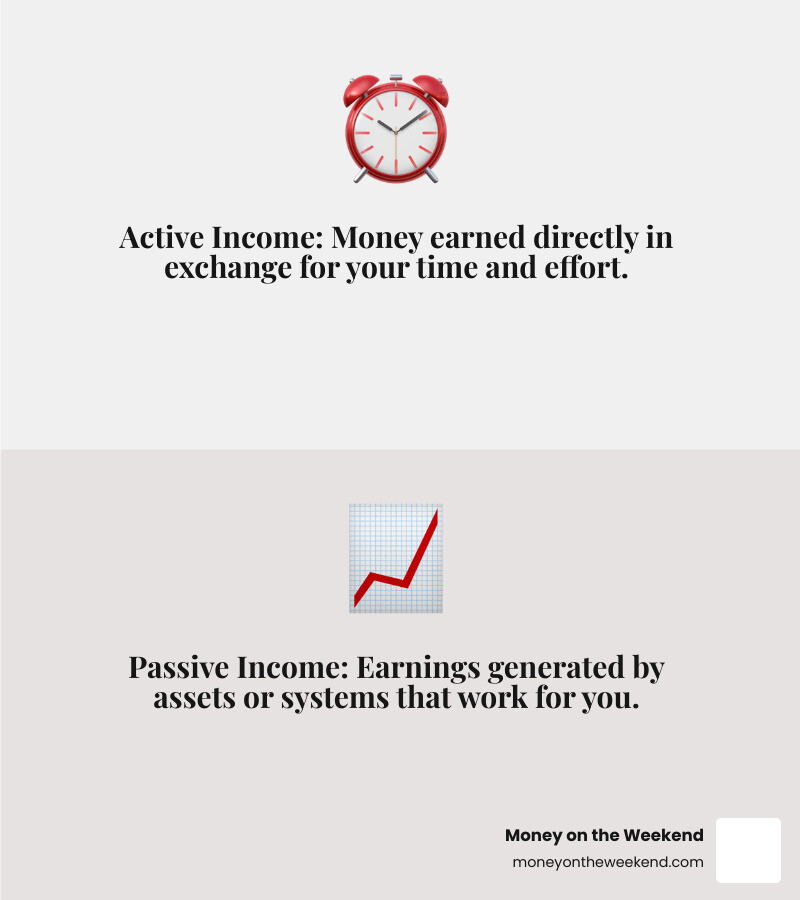
Active income is what most of us are familiar with: it’s the money you earn directly in exchange for your time and effort. Think of your salary, hourly wages, or payments for freelance work. If you stop working, the active income stops. It’s a direct trade of your time for money.
Passive income, on the other hand, is income that requires an upfront investment of time, money, or effort, but then continues to generate revenue with minimal ongoing involvement. As the IRS defines it, passive income can come from sources like rental property or a business in which you don’t actively participate, such as book royalties or stock dividends. You can read more about how the IRS classifies passive income in IRS Publication 925. However, it’s important to understand that “passive” doesn’t mean “zero effort.” As one financial literacy evangelist wisely notes, “All passive income projects involve some form of time, energy, or financial commitment on the onset… Sometimes people will give up before it has a chance to truly take root and grow.”
So, why bother with these alternative income streams?
- Financial Freedom: The goal for many of us is to have our passive income exceed our expenses. This is when true financial freedom kicks in, giving us the choice and flexibility to pursue what truly matters, whether that’s early retirement, travel, or spending more time with family.
- Beating Inflation: In today’s economy, the cost of living is always on the rise. Relying solely on active income can make it hard to keep pace. Passive income acts as an extra layer of financial protection, helping your money work harder for you.
- Diversification: Putting all your financial eggs in one basket (your main job) can be risky. If your primary income source is disrupted, having alternative income streams can provide a crucial safety net.
- Leveraging Your Time and Skills: Many passive income opportunities allow you to turn existing skills or unused assets into cash flow, making your efforts more efficient.
It’s crucial to remember that building these streams isn’t a get-rich-quick scheme. It takes patience, strategic planning, and often, significant upfront work. But the payoff—long-term financial stability and freedom—is well worth the effort. For a deeper dive into the concept, check out our guide on Passive Income.
Investment-Based Ideas: Making Your Money Work for You

When we talk about alternative income streams, often the first thing that comes to mind is making your money work for you. This category focuses on leveraging your capital to generate returns, changing your savings into a steady income flow. While some of these strategies require a larger upfront investment, others are accessible with smaller amounts, making them viable options for almost everyone.
We’ll explore how you can build a diversified investment portfolio that includes dividend stocks, real estate, bonds, and high-yield savings accounts. These avenues offer distinct risk-reward profiles and can be custom to your financial goals and comfort level. Even if you’re starting with a budget, there are options to get your money growing. Explore how you can begin building wealth with our insights on 10 Businesses You Can Start on a Budget in 2024.
Dividend Investing
Imagine owning a piece of a company that regularly pays you a slice of its profits, just for being a shareholder. That’s the beauty of dividend investing. Companies that consistently pay and even increase their dividends, often called “dividend aristocrats,” offer a reliable income stream.
While the S&P 500 dividend yield is currently under 1.3%, requiring over $700,000 invested to generate $10,000 a year, focusing on individual dividend stocks or exchange-traded funds (ETFs) dedicated to dividends can yield more. For example, a $10,000 investment in a stock with a 4% yield could pay you $400 per year. Over time, reinvesting these dividends can lead to powerful compounding growth.
Consider a well-known beverage company like Coca-Cola (KO). In 2024, it paid a quarterly dividend of $0.48 per share, totaling $1.92 per share annually. To generate $12,000 in dividends from Coca-Cola alone, you would need to own nearly $375,000 worth of stock. This illustrates that while dividend investing is a fantastic passive income source, significant capital is often needed for substantial returns. However, starting small and consistently adding to your positions can build a formidable dividend portfolio over decades.
Real Estate Ventures
Real estate has long been a cornerstone of wealth generation, and it remains a powerful source of alternative income streams. While owning physical rental properties can be hands-on, there are ways to make it more passive.
Traditional rental properties, where you own and rent out homes or apartments, can provide a steady monthly income. The average landlord made just over $16,000 from leased property in 2024, demonstrating the potential. However, this often involves property management, tenant screening, and maintenance—which can be active work. To make it more passive, we can hire a property manager, though this will reduce your net income.
For those seeking real estate exposure without the landlord headaches, consider real estate investment funds (REITs). These are companies that own and operate income-producing real estate, and they’re required to distribute most of their income to shareholders as dividends. REITs offer liquidity and diversification, allowing you to invest in commercial properties like shopping malls, apartments, and warehouses with smaller amounts of capital.
Another modern approach is crowdfunded real estate. Platforms allow you to invest in specific real estate projects, often with lower minimums than direct ownership. These private real estate platforms typically target returns between 7% to 12%, offering a hands-off way to participate in larger real estate deals.
Lastly, don’t overlook short-term rentals. Platforms allow you to rent out your spare room or entire home for short periods. A host on a short-term rental platform in Los Angeles, for example, could earn over $2,000 from a week-long stay in a two-bedroom residence. Even renting out unused space, like a driveway, can generate around $200 a month. For more detailed strategies on leveraging property, explore our Real Estate Income Ideas.
Fixed-Income and Lending
Beyond stocks and direct property, several fixed-income and lending options can provide reliable alternative income streams. These are generally considered lower-risk ways to earn returns on your money.
High-yield savings accounts and Certificates of Deposit (CDs) are among the safest options. With current yields around 4-5%, CDs offer guaranteed returns and are FDIC-insured up to $250,000 per depositor, per bank. This makes them excellent for short-term goals or emergency funds where capital preservation is key. Money market accounts also offer higher APYs than traditional checking accounts while maintaining liquidity, provided you meet minimum balance requirements.
U.S. Treasury bonds and high-grade corporate bonds represent another solid fixed-income choice. With interest rates still liftd, these bonds currently offer yields between 4% and 5%. This translates to $400 to $500 per year for every $10,000 invested, providing a stable income stream that is often less volatile than stocks.
Finally, peer-to-peer (P2P) lending platforms allow you to lend money to individuals or small businesses, earning interest on your loans. While carrying more risk than traditional bank accounts or government bonds, P2P lending platforms can offer higher returns. Historically, some platforms have seen average returns of around 5.3%. Diversifying your loans across multiple borrowers is key to mitigating risk here. To learn more about maximizing these types of returns, read our guide on How to Earn More with Fixed-Income Investments.
Skill-Based Alternative Income Streams: Turn Your Time into Treasure

Not all alternative income streams require a substantial financial investment. In fact, many of the most popular and accessible options today hinge on leveraging your existing skills, knowledge, or creative talents. This is where digital entrepreneurship shines, allowing you to turn your expertise into products or content that can generate income around the clock.
The beauty of skill-based income is that it often starts with very little capital, substituting time and effort for money. If you’ve ever thought about starting a side project or wondered how to monetize your passions, this section is for you. We’ll explore how you can create digital products, build content platforms, master affiliate marketing, and even monetize your physical assets or creative works. These are truly low-cost business ideas that can grow into significant revenue streams. Ready to turn your weekends into moneymaking opportunities? Dive into our comprehensive guide on how to Make Money Online.
Creating digital products as one of your alternative income streams
Your knowledge and creativity can become powerful alternative income streams. Digital products are assets you create once and can sell repeatedly, making them incredibly scalable and truly passive after the initial effort.
Think about what you’re good at or what problems you can solve for others.
- Ebooks: If you have expertise in a niche, writing an ebook is a fantastic way to share your knowledge and earn royalties. For example, a former educator could leverage their teaching skills to create and sell ebooks, newsletters, and other digital assets, proving that existing skills can be directly translated into digital products.
- Online Courses: Online learning is surging, with millions of course enrollments reported on platforms. If you have a skill you can teach, creating an online course can be highly lucrative. For example, a marketer reported earning $3,000/month after six months of promoting their “Freelance Writing 101” course.
- Templates & Printables: The demand for digital planners, educational resources, and templates is rising on digital marketplaces. A teacher selling lesson plan templates on a platform for educators can earn over $1,000/month with consistent uploads, simply by sharing resources they’ve already created for their work.
The key here is to identify a need, create a high-quality solution, and then market it effectively. While the creation process demands significant upfront time and effort, once launched, these products can generate income for years to come. To sharpen your skills in this area, explore our resources on Content Creation and consider developing your own Courses.
Building content platforms as alternative income streams
If you enjoy sharing your thoughts, expertise, or experiences, building a content platform can be a rewarding way to create alternative income streams. The upfront effort involves consistently creating valuable content, but the long-term payoff can be substantial through various monetization methods.
- Blogging: Despite popular belief, blogging is far from dead. Niche blogs monetized through ads, affiliate links, or direct product sales remain highly viable. Ad networks pay anywhere from $10–$50 per 1,000 pageviews for niche sites. Imagine a blogger focusing on “best budgeting apps” earning $500/month with just 1,000 monthly visitors—that’s the power of targeted content! A travel blog with 20,000 monthly visitors, for instance, could generate $1,500/month from ads and affiliate links. The key is consistent, high-quality, SEO-optimized content that attracts and retains an audience.
- YouTube: Video content continues to dominate, and YouTube’s ad revenue and sponsorships remain lucrative. Creators can earn $3–$5 per 1,000 views via AdSense, and sponsorships can add significantly more. A “how to budget” channel with 10,000 subscribers can earn $1,000/month from ads and affiliates after a year of consistent effort. While it requires ongoing content creation, once a video is live, it can continue to generate income indefinitely.
Both blogging and YouTube require passion and dedication to build an audience. But once established, they offer diverse monetization avenues, allowing your content to work for you long after you’ve hit “publish.” Learn how to get started on YouTube with our guide: How to Start Making Money on YouTube Fast, and dive deeper into writing for profit with Passive Income: Blogging.
Mastering Affiliate Marketing
Affiliate marketing is a popular and accessible way to generate alternative income streams by promoting products or services you genuinely believe in. Essentially, you earn a commission for referring customers to a business.
Here’s how it works: You create content (a blog post, a YouTube video, a social media review) discussing a product. You then include a unique affiliate link. When someone clicks your link and makes a purchase, you earn a percentage of the sale. Commissions can range from 3% to 20% or even higher, depending on the program and product.
The gig economy has seen affiliate marketing thrive, especially with influencers leveraging platforms to monetize their content. Programs like Amazon Associates are widely used, but many businesses offer their own affiliate opportunities.
Success in affiliate marketing hinges on building trust with your audience. If you consistently recommend valuable products, your followers are more likely to convert. For example, a blogger focusing on “best budgeting apps” could earn $500/month with just 1,000 monthly visitors by strategically placing affiliate links for financial tools. While it requires significant traffic to your site or channel to generate serious income, the initial setup can be relatively low-cost, making it an attractive option for many. For a deeper dive into this powerful strategy, check out our Affiliate Marketing Complete Guide.
Monetizing Your Assets and Creative Work
One of the most innovative ways to build alternative income streams is by monetizing assets you already own or creative work you’ve produced. The sharing economy has made it easier than ever to turn underused possessions into cash flow.
- Renting Your Car or Equipment: Do you have a spare car that sits unused most days? Platforms allow you to rent it out to others, earning income with minimal maintenance time. A host in a tourist-heavy city, for example, might earn $800/month renting out a spare car. The same goes for equipment like cameras, tools, or even storage space. You can easily monetize these assets through peer-to-peer rental platforms.
- Stock Photography & Royalties: If you have a knack for photography or graphic design, your visuals are in high demand. Platforms pay royalties for photos, videos, or illustrations used in ads or social media. A photographer uploading 100 images/month could earn $300–$500 after six months as downloads accumulate. Similarly, musicians, authors, and inventors can earn royalties when their creative works or intellectual property are used or sold. These streams are truly passive once the initial creative work is done.
These methods require some upfront setup and occasional management, but they excel at generating income from resources that might otherwise be idle. It’s about looking at what you have and seeing its potential for revenue. To understand more about how your creative outputs can generate wealth, explore What are the Different Types of Digital Content Creators?.
Frequently Asked Questions About Building Wealth
We know that diving into alternative income streams can bring up a lot of questions. Here, we address some of the most common concerns we hear from individuals looking to build wealth and achieve financial independence.
How much money do I need to start?
This is a fantastic question, and the good news is that the answer varies widely. You don’t always need a lot of capital to begin generating alternative income streams.
- Time vs. Money: Many passive income strategies involve a trade-off between upfront financial investment and upfront time/effort investment. If you have little to no money, you can substitute your time and skills. For example, starting a blog or a YouTube channel can begin with minimal financial outlay, primarily requiring your dedication to content creation.
- Low-Cost Options: Creating digital products, affiliate marketing, or even monetizing existing assets (like renting out a spare room or equipment) can often be started with very low costs. For instance, you could start an affiliate blog with just the cost of web hosting.
- Investment-Based: For strategies like dividend investing or real estate, a larger initial investment typically leads to more substantial passive income sooner. However, even here, you can start small. Many brokerage accounts allow you to invest with small amounts, or you can explore crowdfunded real estate platforms with lower minimums.
The best approach is to start with what fits your budget, interests, and risk tolerance. We encourage you to explore our Low Cost Business Ideas for inspiration on how to get started without breaking the bank.
Can passive income replace my full-time job?
Absolutely! While it takes time, strategic planning, and consistent effort, replacing your full-time job with alternative income streams is a long-term goal that many aspire to and achieve.
Remember the investment banker we mentioned earlier? He retired at 34 with a significant net worth and roughly $80,000 per year in passive income. This income was enough to cover his basic living expenses in a major city, giving him the freedom to pursue his passions, like writing about personal finance. His story is a powerful testament to what’s possible when you strategically build your passive income.
The key to reaching this level of financial independence lies in:
- Diversification: Don’t rely on just one passive income stream. Spreading your investments and efforts across various sources creates a more robust and resilient financial foundation.
- Scaling: Many of the strategies we’ve discussed, from digital products to content platforms, have the potential to scale significantly over time.
- Patience and Persistence: It won’t happen overnight. Building substantial passive income requires consistent effort, learning from setbacks, and continually optimizing your strategies.
For us, the journey to financial freedom is about empowering you to make choices. When your passive income eventually covers your living expenses, you gain the ultimate freedom to decide how you spend your time.
What are the tax implications of these income streams?
Understanding the tax implications of your alternative income streams is crucial for effective financial planning. While the idea of passive income is exciting, the IRS still wants its share!
- Taxable Income: Passive income is generally taxable, just like active income. However, the rules and rates can vary depending on the source. For example, rental property income, stock dividends, and business income where you don’t actively participate all have specific tax treatments.
- IRS Definition: The IRS defines passive income as earnings from rental property or a business in which one does not actively participate. This distinction is important because it affects how losses from passive activities can be used.
- Record-Keeping is Key: Maintaining meticulous records of all income and expenses related to your passive income streams is essential. This will simplify tax preparation and ensure you’re claiming all eligible deductions.
- Deductible Expenses: Many costs associated with generating passive income can be tax-deductible. For instance, if you’re running an affiliate marketing business, expenses like website hosting, software subscriptions, or advertising costs might be deductible. For rental properties, maintenance, property taxes, and insurance are typically deductible.
- Consult a Professional: Given the complexities of tax law, especially when dealing with multiple income streams, we strongly advise consulting a qualified tax professional. They can help you understand your specific obligations, identify potential deductions, and strategize to minimize your tax burden. This proactive approach ensures you keep more of the money you’ve worked hard to generate passively.
Conclusion: Your Journey to Financial Independence Starts Now
We’ve explored a wide array of alternative income streams, from making your money work for you through investments to leveraging your skills and assets for digital entrepreneurship. What’s clear is that whether you have significant capital to invest or are starting with just your time and creativity, there’s a path for you to build a more secure and flexible financial future.
The journey to financial independence isn’t a sprint; it’s a marathon. It requires patience, continuous learning, and the willingness to put in the upfront work. But as we’ve seen, the rewards—the freedom to pursue your passions, the security of diversified income, and the ability to beat inflation—are truly life-changing.
At Money on the Weekend, our mission is to guide you through this journey. We empower you to find financial freedom in your spare time, whether through passive income, affiliate marketing, or other digital ventures. So, take that first step today. Choose an alternative income stream that excites you, aligns with your resources, and start building the future you deserve.
Explore our complete guide to Passive Income and open up your full earning potential.