Why Digital Marketing for Beginners is Your Gateway to Online Income
Digital marketing for beginners is the process of using online channels—like search engines, social media, email, and websites—to promote products or reach customers. Here’s what you need to know to get started:
Quick Start Guide:
- What it is: Marketing through digital channels (search, social media, email, content, affiliate programs)
- Why it matters: Reaches billions of people, costs less than traditional marketing, delivers measurable results
- Where to start: Pick 1-2 channels (content marketing and social media are easiest for beginners)
- What you’ll need: Basic computer skills, willingness to learn, and time to practice
- Timeline: Expect to see initial results in 90 days with consistent effort
As a digital marketing training academy aptly notes, “Nobody starts at the deep end, nobody has all the answers before they begin and, even better, getting going is probably cheaper and quicker than you might think.”
The numbers tell a compelling story. According to Statista, ad spending in the digital advertising market is projected to reach $740 billion in 2024, with social media platforms like Facebook reaching 3.07 billion users and Instagram connecting with 2 billion people monthly. Email marketing delivers an average ROI of $36 for every $1 spent—making it one of the most cost-effective ways to build income online.
For someone looking to earn extra income in their spare time, digital marketing offers a unique advantage: you can start with minimal budget and scale as you learn. Unlike traditional marketing that requires hefty upfront costs, digital channels let you test, measure, and adjust in real-time.
The beauty of digital marketing is its accessibility. Whether you’re interested in affiliate marketing to earn commissions on products you recommend, creating content that generates passive income, or building a side business, these skills form the foundation of online success.
Must-know digital marketing for beginners terms:
- affiliate marketing content ideas
- affiliate marketing landing page
- affiliate marketing traffic sources
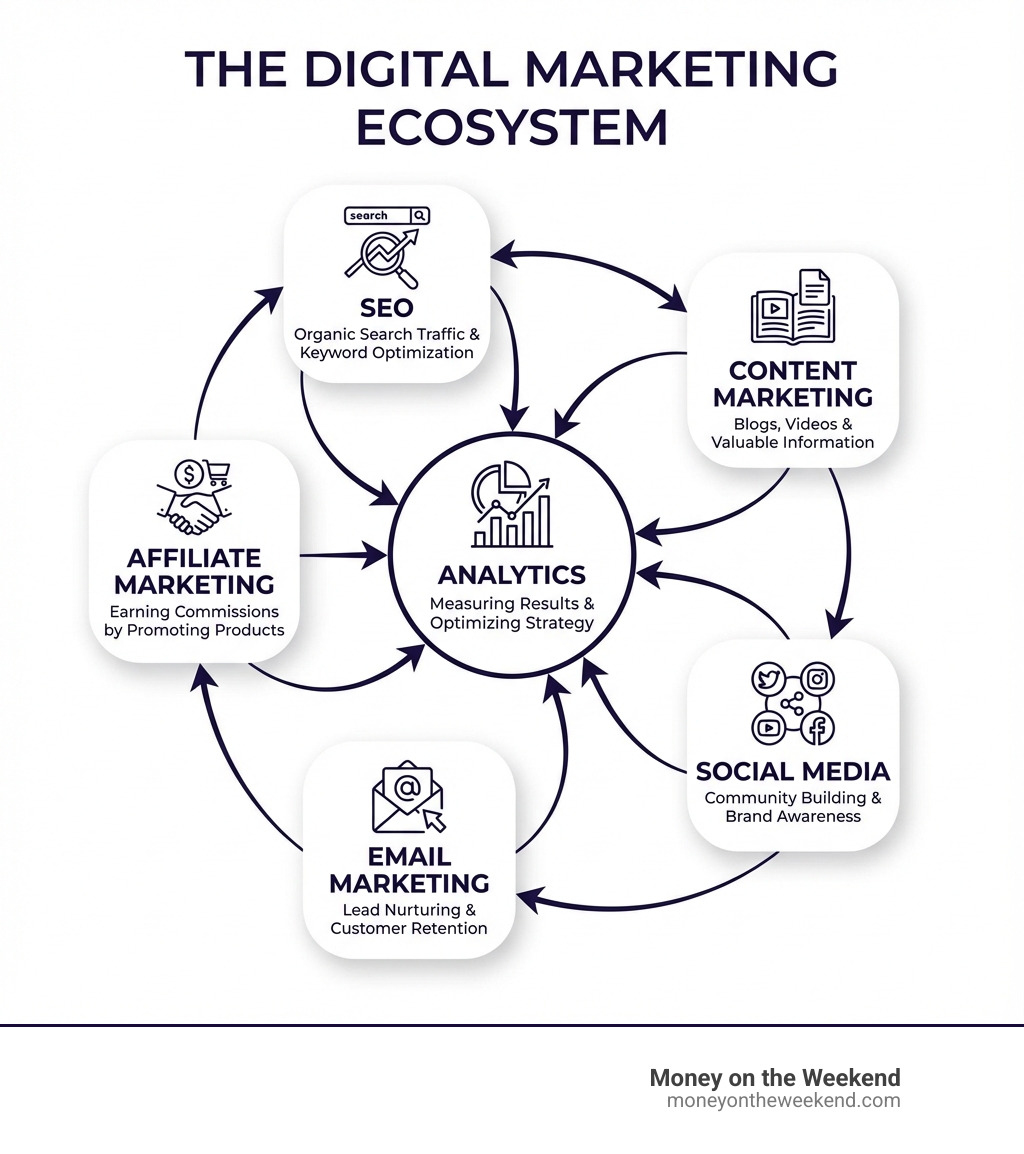
The Core Channels of Digital Marketing
Think of digital marketing as a magnificent, multi-lane highway leading directly to your customers. Each lane represents a different channel, and understanding how to steer them is key to online success. For digital marketing for beginners, getting to grips with these core components is your first big step.

Search Engine Optimization (SEO)
Imagine your website as a hidden gem in a vast digital ocean. Search Engine Optimization, or SEO, is like creating a lighthouse that guides people directly to your shore. It’s all about improving your website’s visibility in search engine results pages (SERPs) without paying for ad space. This is often referred to as “organic traffic,” and it’s gold for anyone looking to build a sustainable online presence.
SEO has several vital sub-processes:
- On-page SEO: This involves optimizing elements directly on your website, such as keywords, content quality, meta descriptions, and image alt text. We want to make it easy for search engines to understand what your page is about and how relevant it is to a user’s query.
- Off-page SEO: This focuses on actions taken outside of your website to impact your rankings. The most common off-page SEO tactic is building high-quality backlinks from other reputable sites, which acts as a vote of confidence for your content.
- Technical SEO: This ensures your website’s infrastructure is optimized for search engine crawling and indexing. Think site speed, mobile-friendliness, site architecture, and secure connections (HTTPS).
At its heart, SEO relies heavily on keyword research – finding the exact words and phrases your potential customers are typing into search engines. By understanding these, we can tailor our content to meet their needs. Check out our Beginner’s Guide to SEO on Money on the Weekend.
Content Marketing
Content marketing is the art of attracting and retaining a clearly defined audience by creating and distributing valuable, relevant, and consistent content. It’s not about directly selling; it’s about building trust and establishing your authority in your niche. When we provide useful information, entertainment, or solutions, we become a go-to resource for our audience.
There are many forms of content we can create:
- Blogs: Publishing articles on a company blog helps us demonstrate expertise and generates organic search traffic. This can lead to more opportunities to convert website visitors into leads. You might be wondering, Is Blogging Still Useful in 2023? (Spoiler: Yes!).
- Videos: From tutorials to vlogs, video content is highly engaging and shareable. Platforms like YouTube offer immense reach.
- Ebooks & Guides: These longer-form pieces allow us to dig deep into a topic, offering comprehensive value in exchange for an email address, which is great for lead generation.
- Infographics: These highly shareable images present complex information in an easy-to-understand visual format, making them perfect for social media and increasing brand visibility.
The goal of content marketing is to answer questions, solve problems, and entertain our audience, ultimately nurturing them towards becoming loyal customers. Explore more with our Content Creation resources.
Social Media Marketing
Social media marketing is about promoting our brand and content on social media platforms to increase brand awareness, drive traffic, and generate leads. It’s where we meet our audience where they’re already spending a significant amount of their time – online!
Consider the sheer scale: Facebook boasts 3.07 billion monthly users, Instagram has 2 billion, TikTok 1.6 billion, LinkedIn 950 million, and X (formerly Twitter) 586 million. Each platform offers unique opportunities to connect with different target audiences.
For digital marketing for beginners, social media is a fantastic place to start because it allows for direct engagement and community building. We can share valuable content, respond to comments, and participate in conversations. User-generated content, where our customers create and share content about our brand, is also incredibly powerful for building authenticity and trust.
If you’re new to social platforms, tools like HubSpot can connect channels like LinkedIn and Facebook in one place, simplifying management. To get started effectively, dive into our Social Media Tips for Beginners.
Email Marketing
Email marketing is one of the oldest forms of digital marketing, and it remains incredibly effective. It’s all about communicating directly with our audience through email to nurture leads, promote products, and build lasting customer relationships.
The statistics speak for themselves: email marketing remains incredibly cost-effective, with an average ROI of $36 for every $1 spent. This makes it a powerhouse for anyone focused on online income generation. Today’s email marketing strategies go beyond simple newsletters; they leverage consumer data to incorporate personalization, making each email feel custom to the recipient. This personalization is crucial, as personalized email campaigns can generate 40% more revenue than non-personalized ones.
We use email for:
- Lead nurturing: Guiding potential customers through the sales funnel with targeted content.
- Personalization: Tailoring messages based on user behavior and preferences.
- Automation: Setting up automated email sequences (e.g., welcome series, abandoned cart reminders).
- Customer retention: Keeping existing customers engaged and encouraging repeat purchases.
For a deeper dive into this high-ROI channel, explore our Email Marketing for Beginners guide.
Affiliate Marketing
For those focused on earning Passive Income, affiliate marketing is a cornerstone. It’s a performance-based marketing strategy where we earn a commission by promoting other companies’ products or services. Essentially, we act as a referrer, driving traffic or sales to a merchant, and in return, we get a cut of the revenue.
Affiliate marketing is a domain of digital marketing where merchants pay commissions to other third parties to advertise their products. This can be done through various channels:
- Blogs: Writing reviews or recommendation articles with affiliate links.
- Social Media: Sharing product recommendations with our followers.
- YouTube: Creating video reviews or tutorials featuring products.
- Email Lists: Recommending products to our subscribers.
The beauty of affiliate marketing is that we don’t need to create our own products, handle inventory, or manage customer service. Our role is to connect potential buyers with suitable products. To maximize earnings, many focus on High Ticket Affiliate Programs which offer higher commission rates. To learn more about this exciting opportunity, check out What is Affiliate Marketing?.
The Essential Guide to Digital Marketing for Beginners
Now that we understand the core channels, let’s put it all together. For digital marketing for beginners, creating a strategic roadmap is crucial. This isn’t just about throwing things at the wall and seeing what sticks; it’s about thoughtful planning, execution, and continuous improvement.

Step 1: Define Your Goals and Audience
Before we even think about which buttons to click, we need to know where we’re going and who we’re trying to reach. This is the bedrock of any successful digital marketing effort.
- Set SMART Goals: Our goals should be Specific, Measurable, Achievable, Relevant, and Time-bound. Instead of saying, “We want more sales,” we might say, “We want to increase sales of our digital ebook by 15% within the next three months.” This provides a clear target and a way to track progress.
- Identify Your Target Audience: Who are we trying to reach? What are their demographics, interests, pain points, and online behaviors? This leads us to create buyer personas—fictionalized, general descriptions of our ideal customers. For example, if we sell online courses, one persona might be “Sarah, a 35-year-old stay-at-home parent looking for flexible online income opportunities.” By understanding Sarah’s goals and challenges, we can tailor our marketing messages directly to her.
- Conduct Market Research: We need to understand the landscape we’re operating in. Who are our competitors? What are they doing well? Where are the gaps we can fill? This helps us carve out our unique value proposition.
Defining these elements upfront ensures our efforts are focused and effective.
Step 2: Choose Your Channels and Budget
With our goals and audience clearly defined, it’s time to select the right lanes on our digital highway. We don’t need to be everywhere at once, especially as digital marketing for beginners.
- Channel Selection: We choose channels based on where our target audience spends their time and which channels best support our goals. For instance, if our audience is primarily professionals, LinkedIn might be more effective than TikTok. If we’re selling visual products, Instagram could be key. We want to meet them where they’re at.
- Budget Allocation: Digital marketing can be incredibly cost-effective, but it’s rarely free. We need to establish a budget for each channel. Small businesses can start with $500-$1,000 monthly for organic efforts like content creation and SEO. For those looking to dive into paid advertising, a competitive budget might be $2,000-$5,000 monthly. While Google Ads might require $1,000-$2,000 monthly for sufficient data, Facebook and Instagram ads can start at $500-$1,000 monthly.
- Free vs. Paid Strategies: It’s crucial to strike a balance. Organic strategies like SEO and content marketing build long-term authority and traffic, often with just an investment of our time. Paid strategies like PPC (Pay-Per-Click) can deliver immediate results and traffic. For those exploring Low Cost Business Ideas, starting with organic efforts and reinvesting profits into paid channels is a smart approach.
Step 3: Create and Launch Your Campaign
This is where our ideas come to life! Once we have our strategy and channels, we move into execution.
- Content Calendar: Consistency is king in content marketing. A content calendar helps us plan, organize, and schedule our content across all chosen channels. This ensures a steady stream of valuable information for our audience.
- Ad Creation: For paid channels, this involves crafting compelling ad copy and selecting eye-catching visuals. Whether it’s a search ad or a social media ad, our goal is to grab attention and drive action.
- Landing Pages: These are dedicated web pages designed to capture leads or drive a specific conversion (like a purchase or sign-up). They should be optimized for clarity and a strong call-to-action.
- A/B Testing: This is our secret weapon for optimization. We create two versions of a piece of content (e.g., an ad, an email subject line, a landing page) and test them against each other to see which performs better. This data-driven approach helps us continuously refine our campaigns.
The goal is to create engaging content that resonates with our audience. Our Content Creation Tools Ultimate Guide can provide valuable resources to help you get started.
Step 4: Measure Your Success with Analytics
What gets measured, gets managed. One of the biggest advantages of digital marketing over traditional methods is the ability to track and measure results in real-time. This allows us to make informed decisions and quickly adjust our strategies. Companies that use data to make decisions see a 25% increase in their revenue.
- Key Performance Indicators (KPIs): These are the metrics we track to determine if we’re meeting our goals. For example, if our goal is to increase website traffic, our KPI might be “unique visitors per month.” If our goal is sales, our KPI would be “conversion rate.”
- Website Traffic: Tools like Google Analytics 4 (GA4) are essential here. GA4 is used by 86% of websites as their preferred analytics platform and offers advanced features for understanding user behavior. We can see how many people visit our site, where they come from, and what they do once they’re there.
- Conversion Rates: This measures the percentage of visitors who complete a desired action (e.g., making a purchase, signing up for a newsletter). Improving conversion rates means turning more leads into customers.
- ROI (Return on Investment): This tells us how much profit we’re making for every dollar we spend on our marketing efforts. A positive ROI is the ultimate sign of a successful campaign.
Effectively analyzing and acting on data has become a core competency in digital marketing. Our Beginner’s Guide to Analytics will help you get started with understanding and interpreting this crucial data.
Building Your Skillset and Toolbox
When digital marketing for beginners, it’s important to recognize that it’s a dynamic field. Continuous learning and adapting to new technologies and trends are essential. Building a strong skillset and familiarizing ourselves with essential tools will set us up for long-term success, whether we’re pursuing Online Freelance Services or building our own ventures.
Key Skills for Digital Marketing for Beginners
While digital marketing encompasses a wide range of specialties, certain core skills will serve us well across all channels:
- Analytical Skills: The ability to interpret data, understand trends, and make data-driven decisions is paramount. We need to be able to look at numbers and understand what they mean for our campaigns.
- Copywriting: Crafting compelling, persuasive, and clear written content is vital for everything from ad headlines to blog posts and email subject lines.
- SEO Fundamentals: A basic understanding of how search engines work and how to optimize content for visibility is a foundational skill.
- Social Media Management: Knowing how to engage with an audience, create platform-specific content, and manage a brand’s presence on social media is increasingly important.
- Adaptability: The digital landscape is constantly evolving. Being open to learning new tools, strategies, and trends is a must.
Essential Tools and Platforms
We don’t need a massive budget to access powerful digital marketing tools. Many offer free tiers or trials, making them accessible for digital marketing for beginners:
- Web Analytics:
- Google Analytics 4 (GA4): This is a must-have for tracking website traffic and understanding user behavior. It offers advanced features such as cross-platform tracking and AI-powered insights.
- SEO Tools:
- Semrush: Ideal for SEO and PPC analysis, keyword research, competitive analysis, and tracking rankings. There are often free tools available for basic research.
- Google Search Console: Essential for monitoring your site’s performance in Google Search results, identifying technical issues, and submitting sitemaps.
- Email Marketing:
- Mailchimp: A popular platform for email marketing automation, list management, and tracking performance metrics. It offers a generous free plan for beginners.
- Social Media Management:
- Hootsuite: Lets us schedule and manage social media posts across multiple platforms from a single dashboard, saving time and ensuring consistent presence.
- Buffer: Another excellent option for scheduling and analyzing social media posts.
Staying Ahead: Future Trends
The digital marketing world never stands still. Keeping an eye on emerging trends ensures our strategies remain effective and future-proof.
- Artificial Intelligence (AI): AI is here to stay and is rapidly changing digital marketing. Future trends point towards leveraging AI to create increased personalization in direct email campaigns, assist with content creation, learning, and data analysis. In fact, 1 in 2 marketers (50.17%) see AI working in conjunction with marketers, assisting them in performing most of their job duties. We should view AI as a powerful tool to simplify and quicken our work, not replace it.
- Video Marketing: The popularity of video content, including live streams and tutorials, continues to soar. Platforms like TikTok and YouTube are dominant, and incorporating video into our content strategy is crucial for engagement.
- Voice Search: With the rise of smart speakers and voice assistants, optimizing content for voice search queries is becoming increasingly important. People search differently when speaking versus typing.
- Data Privacy: Data privacy changes, such as GDPR and Google’s decision to phase out third-party cookies, have significantly impacted marketing strategies. 88% of marketers say these changes affected their approach in 2024. We need to focus on first-party data strategies and building trust with our audience by being transparent about data collection. Stay informed with our insights on The future of digital marketing and privacy.
Frequently Asked Questions about Digital Marketing
We often hear similar questions from those just starting their journey in digital marketing for beginners. Let’s tackle some of the most common ones.
How long does it take to see results from digital marketing?
This is a common question, and the answer varies depending on the channel and strategy. Think of it like planting a garden – some seeds sprout quickly, others take time to grow deep roots.
- PPC (Pay-Per-Click) and Paid Social Campaigns: These can generate immediate traffic and conversions, often within 24 to 48 hours of launch. They’re great for quick visibility.
- Email Marketing: If you have an existing list, you can see results from campaigns within days. Building a list, however, takes time.
- Social Media Marketing: Building momentum and a engaged community on social media typically takes 1 to 3 months.
- SEO (Search Engine Optimization): This is a long-term play. You might see meaningful organic traffic increases within 3 to 6 months, but achieving top rankings for competitive keywords can take 6 to 12 months or even longer. The good news is, SEO results tend to be more sustainable.
- Content Marketing: Similar to SEO, content marketing offers compounding returns. Early efforts might show slow growth, but high-quality content continues to attract traffic and leads over time.
For businesses investing across multiple channels, you can generally expect to see measurable results within 90 days and significant ROI within 6 to 12 months. Patience and consistency are key!
What’s the minimum budget needed for digital marketing?
The great news for digital marketing for beginners is that you can start with very little, especially if you’re willing to invest your time.
- Organic Strategies (Content & SEO): These can start with virtually no monetary budget, just your time and effort. Creating a blog, optimizing content, and building a social media presence can be done for free or very low cost.
- Small Businesses: A basic digital presence can be established with $500-$1,000 monthly. This might cover some basic tools, content creation, or small ad spends.
- Competitive Paid Advertising: If you want to compete in paid advertising, a budget of $2,000-$5,000 monthly allows for more significant campaigns.
- Google Ads: Requires about $1,000-$2,000 monthly for sufficient data and optimization in most industries.
- Facebook and Instagram Ads: Can start at $500 to $1,000 monthly.
- LinkedIn Ads: Tend to be higher, needing $3,000-$5,000 monthly due to higher costs per click.
The budget depends on your goals, industry, and how quickly you want to scale. We always recommend starting small, testing what works, and reinvesting profits to grow your efforts.
What are the best types of digital marketing for a beginner to start with?
For digital marketing for beginners, we recommend starting with channels that are accessible, allow for foundational skill-building, and can yield results without a massive upfront investment:
- Content Marketing: This is highly accessible. You can start a blog, create simple videos, or share valuable information on social media. It teaches you how to research topics, write engaging copy, and understand what your audience cares about. This builds crucial skills in content creation and SEO fundamentals.
- Social Media Marketing: Also very accessible, social media allows for direct interaction and immediate feedback. It teaches you how to engage with an audience, create platform-specific content, and promote your work.
By mastering one or two core channels first, you build confidence and a strong foundation. As you gain experience and see results, you can then gradually expand into more complex areas like paid advertising or advanced analytics. The key is to start, learn, and iterate!
Your Journey to Financial Freedom Starts Here
We’ve covered a lot of ground today, explaining digital marketing for beginners. We’ve explored what digital marketing is, why it’s crucial in today’s online world, its core channels, a step-by-step guide to launching your efforts, essential skills, and tools, and even peeked into the future of the industry.
Digital marketing is more than just a collection of tools and tactics; it’s a pathway to connection, growth, and ultimately, financial freedom. Whether you’re looking to launch a side hustle, grow an existing business, or simply gain valuable skills for the modern economy, understanding digital marketing empowers you.
At Money on the Weekend, our mission is to guide individuals to financial freedom through online income generation and digital entrepreneurship. The skills you acquire in digital marketing—from understanding SEO to crafting compelling content and leveraging social media—are the very building blocks for creating Start a Business that thrives online.
Your journey to empowering yourself through online skills begins now. Your next step is to learn how these skills can create fantastic Passive Income / Blogging opportunities, allowing you to earn while you live. The digital world is waiting for you to make your mark!