
Why Blogging for Busy People is More Achievable Than You Think
Blogging for busy people is not only possible—it’s a proven path to building passive income and achieving financial freedom, even if you only have a few spare hours each week.
Here’s how busy people can blog effectively:
- Prioritize consistency over frequency – One quality post every 2 weeks beats rushed daily content
- Batch similar tasks – Write all headlines at once, edit all images together, schedule social posts in blocks
- Use the right tools – Automate scheduling, use templates, and leverage AI writing assistants
- Focus on high-impact activities – Guest posting and strategic content updates drive more results than constant new posts
- Build content that improves over time – Create evergreen posts you can improve based on real data
The truth is, most bloggers quit within their first year—not because they lack talent, but because they believe blogging requires publishing constantly and chasing every trend. That’s exhausting and unsustainable.
But here’s what the research shows: 77% of professional bloggers see real results, and they’re not all blogging full-time. The key is working smarter, not harder. By dedicating just 25 minutes to plan a month’s content or spending focused 2-hour blocks on strategic tasks, you can build a blog that generates income while fitting into your hectic schedule.
Whether you’re squeezing in 15-minute writing sessions during your commute or dedicating one evening per week to your blog, this guide will show you exactly how to make blogging work for your life—without sacrificing your day job, family time, or sanity.
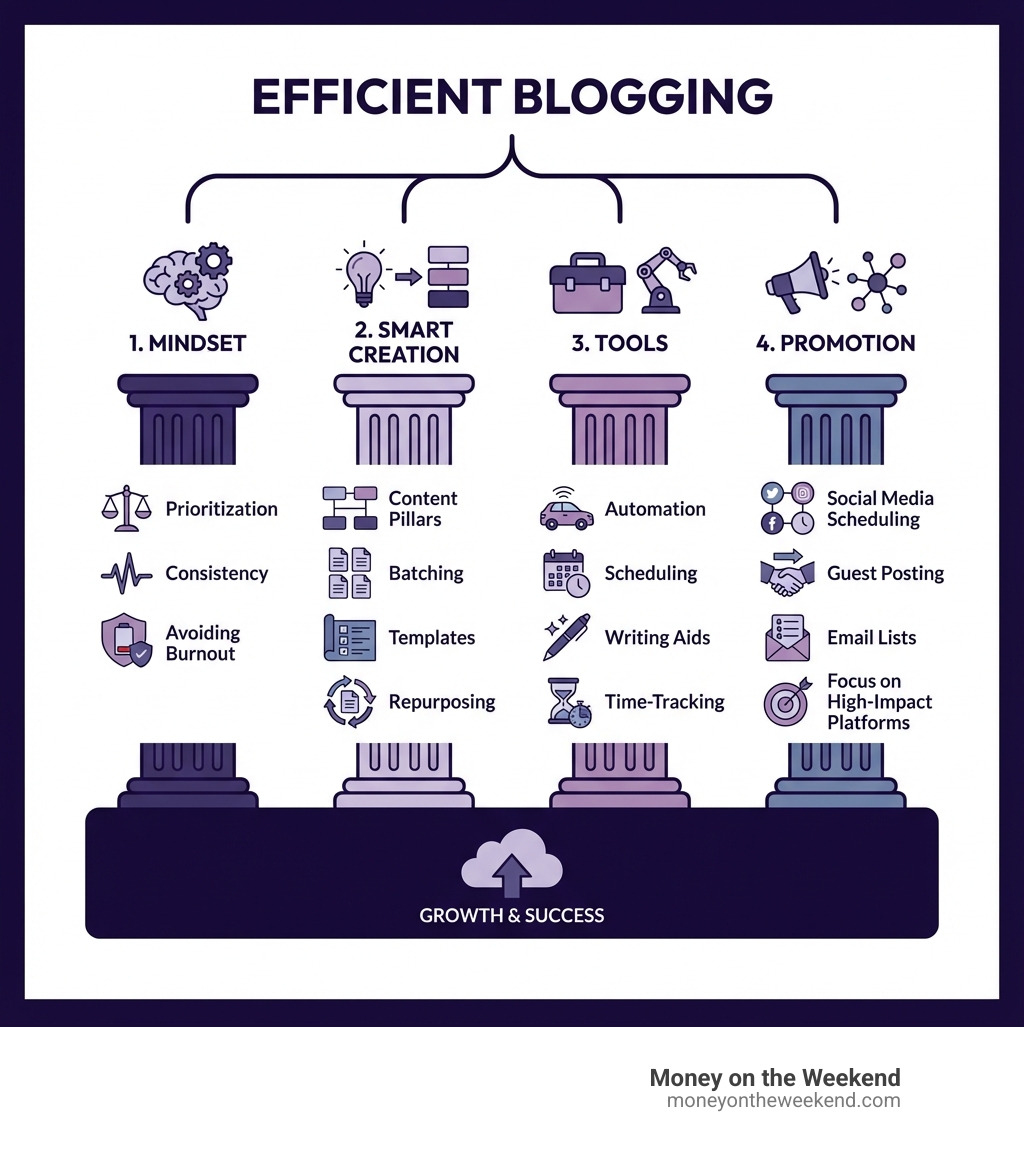
Master Your Mindset and Schedule

When we’re juggling work, family, and personal commitments, the idea of adding “blogger” to our already overflowing plate can feel overwhelming. This is one of the biggest challenges busy people face when trying to blog consistently: finding the time and energy. However, the core idea here is that time isn’t the problem; it’s a matter of valuing one activity over another. If we truly value our blogging goals, we can carve out the time.
A crucial aspect of successful blogging for busy people is adopting the right mindset. We need to prioritize, focus on consistency over frequency, manage our energy, and actively work to avoid burnout. Setting realistic goals, understanding that our journey is unique, and building sustainable habits are key to changing our blogging aspirations into tangible income opportunities. This approach not only helps us maintain our blog but also allows us to enjoy our offline life and build Weekend Income Opportunities that fit our lifestyle.
Create a Realistic Blogging Schedule
Creating a realistic blogging schedule is about understanding our existing commitments and finding small, consistent pockets of time. We don’t need huge, uninterrupted blocks of hours; sometimes, 15-minute bursts of focused work are all it takes.
First, let’s conduct a “time audit.” For a few days, honestly track where our time goes. We might be surprised to find opportunities we didn’t realize existed—perhaps we can cut down on TV time, as one expert suggests reducing it from three hours to 30 minutes daily. This conscious sacrifice can free up significant time for blogging success.
Once we know where our time is spent, we can start time-blocking. This means scheduling specific times for blogging tasks, just like we would for a meeting or an appointment. Even if it’s just 20 minutes for idea generation on a Monday morning and another 30 minutes for outlining on Wednesday evening, these dedicated slots add up.
A weekly planning session, perhaps an hour on Sunday evening, can be incredibly effective. During this time, we can map out our content for the week or even the month using an editorial calendar. This calendar helps us visualize our content strategy, ensuring we have a mix of topics and don’t scramble for ideas last minute. It also allows us to build a buffer of 1-2 posts for those inevitable busy periods, so we never miss a beat. Consistency in our chosen schedule is far more important than trying to blog daily and burning out.
Adopt a Productive Mindset for Blogging for Busy People
Our mindset plays a huge role in successful blogging for busy people. Many new bloggers quit because they let “offline life or online distractions create a general busy-ness that takes out their blogging campaign at the knees.” We need to dissolve these excuses by understanding that time is a matter of value. If blogging is important to us, we will find the time.
One common trap is perfectionism. We might spend hours agonizing over every word or detail. But as one expert wisely noted, “there comes a point when you need to shake yourself out of research mode and force yourself to start writing.” The goal is to get words on the page, and then edit later. “Writing drunk, editing sober,” as the saying goes, can be a surprisingly effective method to overcome the initial “drag” of writing.
Instead of getting bogged down in minor details like SEO plugins or blog names, we should focus on “big wins” – creating remarkable content and leveraging guest posting opportunities. These high-impact activities drive significant results without requiring us to be online 24/7.
It’s also crucial to avoid comparing ourselves to other bloggers. They might have different resources, schedules, or teams. As one expert advises, we should “watch our own lane” and focus on our own progress. Our blogging journey is unique, and celebrating our small wins, no matter how minor they seem, can fuel our motivation. Sharing what we “really feel [we] have to share with the world”—our passion and unique perspective—is what truly connects with readers and makes blogging a rewarding endeavor.
Create Content Smarter, Not Harder

For blogging for busy people, the key isn’t to churn out endless content but to create smarter. We want to build content that can improve over time, becoming more valuable with each passing month. This “smart creation” approach focuses on efficiency, quality, and longevity, ensuring our efforts have a lasting impact. Our Content Creation efforts should be strategic, not simply reactive.
Generate Endless Ideas in Minutes
Running out of blog post ideas is a common frustration, especially when time is limited. But with a strategic approach, we can generate endless ideas in just minutes.
First, identify our blog’s 4 main “pillars” or core content categories. These are the broad topics we love writing about and that resonate with our audience. For example, if our blog is about financial freedom, our pillars might be “Passive Income Strategies,” “Budgeting Tips,” “Investing Basics,” and “Debt Management.”
Once we have our pillars, we can quickly brainstorm post ideas for each. Ask ourselves:
- What have we learned lately within this pillar?
- How can we meet someone else’s need or solve a common problem?
- Can we answer a specific question we get asked frequently?
- How have we overcome a struggle related to this topic?
Tools are our friends here! The Hubspot Blog Topic Generator can give us a quick burst of ideas by simply entering a few nouns related to our niche. We can also set up Google Alerts for our chosen topics to stay updated on new information and trending discussions, providing a constant stream of fresh content angles.
Finally, keep an idea file or a simple notebook handy. Ideas strike at the most unexpected times—during a commute, while waiting in line, or even in the middle of the night. Jotting them down instantly ensures we never lose a potential blog post.
The Power of Batching and Templates
Batching and using templates are game-changers for blogging for busy people. Batching means grouping similar tasks together and completing them in one dedicated session. This significantly reduces “context switching,” where our brain has to reorient itself to a new task, saving immense cognitive load and time.
Here’s a list of blogging tasks we can batch:
- Idea Generation: Brainstorm a month’s worth of topics for all pillars at once.
- Outlining: Create outlines for several posts in one sitting. One expert notes that outlining can cut content production time from 6 hours down to about 60 minutes.
- Drafting: Dedicate a block of time solely to writing first drafts, without editing.
- Image Creation: Design all necessary graphics and social media visuals for multiple posts using tools like Canva.
- Editing & Proofreading: Review and refine several posts at once.
- Scheduling: Load multiple posts into our content calendar and schedule social media promotions for them.
Using a consistent post template further streamlines the writing process. Bloggers who produce a lot of content often use standard structures. For instance, Michael Hyatt has a very specific template that he uses for pretty much every post on his blog. While we might think a template makes posts less interesting, it actually frees up mental energy to focus on the content rather than the structure.
A template helps us ensure all essential elements are included, from a compelling introduction to a strong call to action. We can even strategically write the “easy bits” first, like the introduction, conclusion, value explanation, and a case study. These sections alone can cover roughly 700 words, building momentum before we dive into the main body of the post.
The Busy Blogger’s Toolkit: Essential Tools and Tech
In blogging for busy people, technology isn’t a luxury; it’s a necessity. The right tools and services can be the difference between feeling overwhelmed and effortlessly managing our blog. Investing in premium products and services can genuinely save us time and energy, allowing us to blog more efficiently. From automation to writing aids, there’s a tool for almost every blogging task, designed to streamline our workflow. Our Content Scheduling Tools are a testament to this efficiency.
Automate Your Workflow to Save Hours
Automation is our secret weapon against the clock. Repetitive tasks that eat up valuable time can often be handled by smart software, freeing us up for more creative and strategic work.
Social media schedulers are a prime example. Instead of manually posting to Facebook, Twitter, and Instagram every day, we can use tools like Hootsuite, Agorapulse, or Tailwind (especially useful for Pinterest) to schedule weeks or even months of social media updates in advance. This ensures a consistent online presence without constant manual effort.
Email automation is another time-saver. If we find ourselves answering the same questions repeatedly, we can set up canned email responses. Gmail, for instance, offers this feature, allowing us to send pre-written replies to inquiring emails. We can even automate responses based on specific criteria.
For connecting different online services and creating simple automations, If This Then That (IFTTT) is incredibly powerful. It can do anything from posting our Instagram pictures to our Twitter account (bypassing that pesky issue of Instagram images not showing up in newsfeeds) to sending us an email when specific keywords are mentioned online. These small automations add up, significantly reducing our daily workload.
Essential Writing and Editing Tools for Blogging for Busy People
While automation handles the repetitive, our writing and editing tools help us maintain quality and efficiency in content creation.
For ensuring our writing is clear, concise, and error-free, grammar checkers are invaluable. Tools like Grammarly Premium can catch mistakes we might miss, saving significant editing time. This allows us to focus on the message, knowing the mechanics are being handled.
Readability is paramount for engaging busy readers. The Hemingway App is a fantastic resource that analyzes our text for complex sentences, passive voice, and common errors, suggesting improvements to make our writing bolder and clearer. This ensures our posts are easy to digest, even for those skimming on the go.
Ideas don’t always strike when we’re at our desks. That’s why note-taking apps on our phones or a simple physical notebook are essential. We can quickly jot down blog post ideas, interesting facts, or article snippets as they come to us, ensuring no brilliant thought is lost.
Finally, to truly understand where our time goes and how we can optimize it, time-tracking tools are incredibly insightful. RescueTime, for example, can help us identify how many hours we’re burning on less productive activities, allowing us to make conscious changes to our workflow. One blogger reduced content production time from six hours to about 60 minutes after realizing their inefficiencies with RescueTime. For focused work sprints, apps like BeFocused (for Mac) can help us implement the Pomodoro Technique, ensuring we dedicate undistracted time to our blogging tasks.
Promote and Grow: A Guide to Blogging for Busy People
Creating amazing content is only half the battle; getting it in front of the right audience is the other. For blogging for busy people, promotion needs to be strategic and efficient, focusing on the 80/20 rule: 20% of our efforts should yield 80% of our results. This means leveraging smart tools and collaborations to maximize reach without excessive time investment. When we talk about growing our blog, we’re ultimately talking about growing our potential for Affiliate Marketing Content Ideas & Tips and other income streams.
Efficiently Promote Your Content
Promoting our content doesn’t have to consume all our waking hours. The key is to be intentional and use the tools at our disposal.
As mentioned earlier, social media schedulers are invaluable. We can batch the creation of social media updates for multiple posts and then schedule them across our platforms. This allows us to repurpose one blog post into numerous social snippets—quotes, questions, facts, or image-based teasers—that drip feed across our social channels over days or weeks.
Instead of trying to be everywhere, we should focus on one or two key social media platforms where our target audience is most active. Mastering these platforms will yield better results than spreading ourselves thin across many.
Engagement is vital. We should make it easy for readers to share our content by using social sharing buttons on our blog posts. And when readers comment or engage with us, we should respond. This builds community and loyalty, encouraging further sharing. Promoting other bloggers and engaging in blog commenting ourselves can also foster reciprocal promotion and build valuable relationships.
Leverage Others to Grow Faster
One of the most powerful strategies for busy bloggers to grow their audience is by leveraging the reach of others through guest blogging and collaborations. This is often referred to as a “leveraging activity” because it maximizes our exposure with minimal direct effort on our own platform.
Guest posting on established blogs in our niche can “flood our blog with highly-familiar traffic.” One expert shared how they gained over a million readers in under a year through just two strategies, one of which was guest posting. The process involves identifying blogs with larger audiences, creating unique and valuable content specifically for them, and then promoting that guest post.
Building relationships with other bloggers is crucial for this. We can use a “1-2 Punch” email strategy: first, ask for feedback on an article draft, which leverages the Ben Franklin Effect (people are more likely to help again after helping once). Then, follow up by offering a guest post. This approach builds rapport and increases our chances of success.
The power of collaboration extends beyond guest posts. We can promote other bloggers on social media, engage in joint webinars, or participate in content roundups. Luisa Zhou, a former student, leveraged this concept to net $1.1 million in less than a year by actively engaging with potential clients in free Facebook groups and sharing valuable content. By giving value and building connections, we open doors to new audiences and opportunities without having to build everything from scratch ourselves.
Frequently Asked Questions about Blogging on a Busy Schedule
How often should a busy person blog?
For blogging for busy people, the mantra is “consistency over frequency.” We don’t need to publish daily or even multiple times a week to be successful. In fact, trying to do so often leads to rushed, low-quality content and eventual burnout.
Instead, we should commit to a realistic schedule that we can consistently maintain, whether that’s once a month, twice a month, or once a week. One expert notes that readers rarely unsubscribe due to infrequent posting; they are more likely to leave if quality drops or they feel overwhelmed by volume.
A high-quality, well-researched post published once every two weeks is far more effective than five rushed, thin posts in the same period. The goal is to establish a predictable rhythm that our audience can rely on, building trust and loyalty over time.
How long should a blog post take to write?
The time it takes to write a blog post can vary wildly, but for blogging for busy people, efficiency is key. A survey of professional bloggers indicates that “participants see the best results when they spend 4-6+ hours per in-depth blog post.” However, this doesn’t mean we need to spend that much time on every post, nor does it mean we can’t drastically reduce it with smart strategies.
By implementing techniques like batching tasks, creating detailed outlines, and using templates, we can significantly cut down our content production time. One blogger famously reduced their content production time from six hours to about 60 minutes by using a structured workflow.
We can save time by writing the introduction, conclusion, value explanation, and a case study first, which can cover a substantial portion of the post. Aiming for a length of 1200-1500 words is often ideal for both readers and search engines, and with a solid outline, this becomes much more achievable within a shorter timeframe. The goal is to be efficient, not to sacrifice quality for speed.
Can I really make money blogging with limited time?
Absolutely! Blogging for busy people can absolutely be a lucrative venture, even with limited time. Success in blogging comes from working smart and strategically, not necessarily from logging endless hours.
Many successful bloggers started with limited time, turning their passion into significant income. One new blogger, for example, made over $13,000 in just 10 months and was able to quit her day job within her first year. Another inspiring case is Luisa Zhou, who generated $1.1 million in less than a year by strategically engaging with her target audience online.
The key is to choose a profitable niche that aligns with our interests, has an audience, and offers clear monetization opportunities, such as Affiliate Marketing, selling digital products, or offering services. By focusing on high-impact activities like creating remarkable content, guest posting, and leveraging automation, we can build a significant income stream in our spare time. It’s about maximizing the return on our limited time investment.
Conclusion
Blogging, at its heart, is a marathon, not a sprint. For blogging for busy people, it’s a testament to the power of consistency, strategy, and leveraging the right tools. We’ve seen that by mastering our mindset, creating content smarter, utilizing essential tech, and promoting efficiently, anyone can build a successful and rewarding blog, no matter how packed their schedule. The journey may have its challenges, but with the right systems and strategies, it’s an achievable and incredibly rewarding venture.
At Money on the Weekend, we are dedicated to helping you build these income streams on your own terms, fitting into your life and leading you towards financial freedom. To start turning your blog into a real asset, explore our complete guide on Passive Income: Blogging.