Why Solo Ads Are a Fast Track to Targeted Affiliate Traffic
Solo ads for affiliate marketing are a paid traffic method where you rent another marketer’s email list. This delivers instant, targeted traffic directly to your landing page, often within 24-48 hours of placing an order.
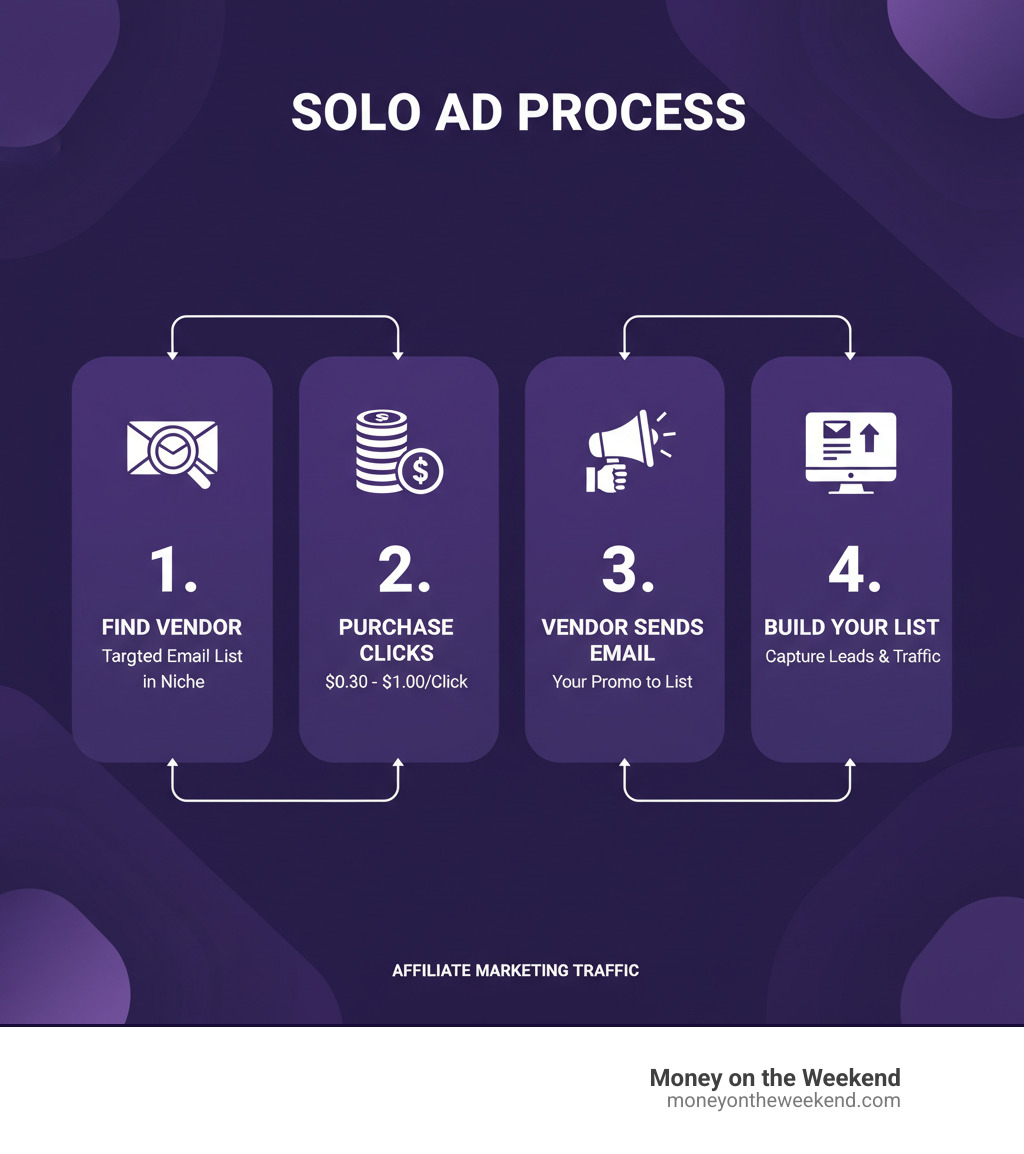
Here’s how solo ads work in 4 simple steps:
- Find a vendor who owns an email list in your niche (like “make money online” or “health and fitness”)
- Purchase clicks at a set price per click (usually $0.30 to $1.00)
- Provide your link and ad copy to the vendor, who sends it to their subscribers
- Capture leads on your landing page and follow up via email to make sales
Solo ads solve a critical problem for new affiliates: getting traffic fast without waiting for SEO or learning complex ad platforms. You pay for clicks, drive traffic, and start building your own email list immediately.
The catch is that quality varies dramatically between vendors. Good vendors deliver converting buyers, while bad ones send bot traffic or disengaged subscribers. Profitability depends on choosing the right vendors and creating a proper sales funnel.
This guide shows you how to budget, vet vendors, and avoid pitfalls to build a sustainable business with solo ads. From a $50 test to scaling past $500 per month, you’ll learn proven strategies based on real-world data.
The Mechanics of Solo Ads: How They Fuel Affiliate Campaigns
Solo ads for affiliate marketing are like renting a vendor’s established email list. You pay them to send your promotional message, or “email swipe,” instantly tapping into their audience instead of building your own from scratch. It’s a form of email advertising that gets you clicks within hours, while other marketers are still waiting for organic traffic or algorithm changes.
What are solo ads and how do they work?
A solo ad means your ad stands alone in an email, sent to subscribers who are already interested in your niche. You’re borrowing the vendor’s established trust with their audience. When they send your email swipe, their audience pays attention.
The transaction is simple: you pay a cost per click (CPC), usually $0.30 to $1.00, and the vendor delivers a guaranteed number of clicks to your link. You only pay for actual clicks, not impressions.
A common mistake is sending traffic directly to an affiliate offer. Instead, direct clicks to a squeeze page for lead generation. This page captures email addresses in exchange for a valuable freebie, like a guide or checklist.
This is crucial because list building turns traffic into a long-term asset. That email list becomes your audience, allowing you to build trust and promote multiple offers over time, creating a sustainable business. The beauty of solo ads is the instant traffic they provide, making them perfect for niche targeting in markets like make money online, health, or personal development.
Why use solo ads for affiliate marketing?
Solo ads solve the biggest problem for new affiliates: getting targeted traffic quickly and predictably.
- Predictable traffic: Order 100 clicks, get 100 clicks. This predictability allows for accurate budgeting, unlike the fluctuations of organic traffic.
- Scalability: Once you find a profitable vendor, scaling is easy: just buy more clicks. If a campaign is profitable at 100 clicks, it will likely be profitable at 500.
- Access to warm audiences: Vendors provide access to subscribers already interested in your niche, not random strangers. They’ve opted in to receive relevant content.
- Testing new offers: Solo ads provide rapid feedback. You can test new affiliate offers or niches in days, not months, to see if they resonate with an audience.
- Building an email asset: Your email list is your most valuable business asset. Solo ads help you build this asset, transitioning you from renting traffic to owning your audience, which is key to financial freedom.
- Speed to market: Need traffic now for a limited-time offer? Solo ads deliver clicks within hours, while competitors are still waiting for ad approvals on other platforms.
This combination of speed, predictability, and list-building power makes solo ads an essential tool for any serious affiliate marketer.
Your Blueprint for a Profitable Solo Ad Campaign
To succeed with solo ads for affiliate marketing, you need a smart plan. It’s not just about buying clicks; it’s about building a foundation for your online income. At Money on the Weekend, we want every dollar you spend to move you toward financial freedom. This requires choosing the right vendors, building an effective funnel, and tracking results for constant improvement.

Finding and Vetting Quality Solo Ad Vendors
Success with solo ads hinges on finding good vendors. Start your search on solo ad marketplaces like Udimi or vendor directories like Solo Ad Vendors Directory | Best Traffic Providers . These platforms often provide reviews, ratings, and seller verification.
Examine seller ratings, sales reports, and what other marketers are saying. Check out testimonials in places like the Facebook community group to gauge a vendor’s quality based on real experiences.
Prioritize vendors offering Tier 1 traffic (from the USA, UK, Canada, Australia, and New Zealand). This audience typically has more buying power and is more likely to convert. Before buying, ask potential vendors key questions:
- How was their email list built? (To avoid scraped or low-quality lists.)
- How often do they email their list?
- What are their average open, click, and conversion rates?
- Do they guarantee a percentage of Tier 1 traffic?
Thoroughly vetting vendors dramatically increases your chances of connecting with a responsive audience interested in your offer.
Crafting a High-Conversion Funnel for Solo Ad Traffic
Never send solo ad traffic directly to an affiliate offer. Instead, guide visitors through a high-conversion funnel to maximize results and build your email list.
- Squeeze Page: The first stop is a squeeze page. Its sole purpose is to capture email addresses. It must be clean, fast-loading, and mobile-friendly. Use a compelling headline that matches your ad and a strong call-to-action (CTA) like “Get Instant Access.”
- Lead Magnet: Offer a valuable lead magnet—a free e-book, checklist, or mini-course—in exchange for an email address. It should solve a specific problem for your audience.
- Bridge Page (Optional): Use a bridge page after opt-in to warm up the lead. A short video or text explaining the benefits of the upcoming affiliate offer can pre-frame it and increase receptiveness.
- Email Follow-Up Sequence: The final, crucial step is an automated email follow-up sequence. These emails nurture leads, build trust, and introduce affiliate offers over time. This process turns a single click into a long-term customer, multiplying your ROI and building a sustainable income.
Tracking, Analyzing, and Maximizing Your ROI
To ensure your solo ads for affiliate marketing campaigns are profitable, you must track your results. Careful analysis and constant optimization are key to maximizing your return on investment (ROI).
Use conversion tracking tools like ClickMagick, Google Analytics, or a marketplace’s built-in features. Tracking pixels show you what happens after a click—opt-ins, sales, etc.—so you know which traffic sources are converting.
Track these key metrics:
- Click-Through Rate (CTR): Percentage of recipients who clicked your ad.
- Opt-in Rate: Percentage of visitors who subscribed on your squeeze page.
- Cost Per Lead (CPL): The cost to acquire one new email subscriber.
- Cost Per Acquisition (CPA): The cost to make one sale. Use a CPA Calculator to determine this.
- Sales Conversion Rate: Percentage of leads who purchased your offer.
Use split testing to improve performance by testing different solo ad swipes, landing pages, and vendors. Use your tracking data to optimize for profitability. Cut ties with underperforming vendors and tweak low-converting landing pages. Continuous refinement directs your budget toward what works, actively building a positive ROI.
Best Niches and Common Pitfalls in Solo Ad Advertising
While solo ads for affiliate marketing are effective, success depends on choosing the right niche and avoiding common traps.
What kind of offers are best suited for solo ad campaigns?
Solo ads perform best in niches where audiences expect promotional emails and are actively seeking solutions. Top categories include:
- Make Money Online (MMO), Internet Marketing (IM), and Business Opportunities (Biz Opp): The most popular solo ad niche. Audiences are seeking income opportunities, making offers for courses, software, and business systems highly effective.
- Health and Wellness: Includes weight loss, fitness, and health solutions. Audiences are actively seeking information, making it a strong niche for email offers.
- Personal Development: This niche includes self-improvement, mindset, and productivity offers that resonate well with audiences looking to better themselves.
- Digital Products: E-books, courses, and software work well due to their instant delivery and clear value proposition, leading to easier conversions.
- Low-Ticket Offers: Offers under $100 serve as great entry points to a higher-value sales funnel.
- CPA/CPL Offers: Get paid when a lead takes an action (e.g., form submission, free trial). Profitable examples include insurance leads or dating sign-ups.
- Webinar Registrations: A fast and effective way to drive sign-ups for webinars that promote an affiliate product.
- High-Ticket Offers (with a proper funnel): Offers over $500 can be profitable, but only with a robust sales funnel that nurtures leads through email before presenting the high-ticket product.
Avoid promoting vague offers, MLMs, or “get rich quick” schemes that lack substantial value.
Common mistakes with solo ads for affiliate marketing and how to avoid them
Avoid these common pitfalls to prevent solo ads from becoming a money pit:
- No Tracking: Not tracking is the biggest mistake. Without it, you’re flying blind. Use tracking pixels and UTM parameters to identify which vendors are profitable and which to cut.
- Sending Traffic Directly to a Sales Page: This wastes money. Solo ad traffic is warm, not hot. Always send it to a squeeze page first to capture the lead and build your list.
- Poor Offer-to-List Match: Ensure the vendor’s list is highly relevant to your offer. Promoting a mismatched product will result in zero sales. Ask vendors about their audience’s interests.
- Not Testing Small: Never invest your whole budget at once. Start with small test buys (100-200 clicks) to vet a vendor and offer. Only scale campaigns that prove to be profitable.
- Overpaying for Clicks: Be mindful of your cost per click (CPC). Paying over $1 per click can make profitability difficult. Aim for a CPC in the $0.40-$0.60 range, especially when starting out.
- No Follow-Up Sequence: The money is in the follow-up. An automated email sequence is essential for nurturing leads, building trust, and promoting offers over time. This is how you maximize ROI.
Frequently Asked Questions about Solo Ads
As you explore solo ads for affiliate marketing, some questions about cost, comparisons, and risks are natural. Here are the answers.
How much do solo ads typically cost?
Solo ad prices typically range from $0.30 to $1.00 per click. This variation depends on several factors:
- Niche: More competitive niches can have higher costs.
- Traffic Quality: “Tier 1” traffic (from the USA, UK, Canada, Australia, New Zealand) costs more because it generally has higher buying power and converts better.
- Seller Reputation: Established vendors with proven results charge more for their high-quality lists.
When starting, budget for small test buys of $50-$100 for 100-200 clicks to test a vendor’s traffic. Be cautious of offers that seem too cheap, as they often indicate low-quality or bot traffic.
How do solo ads compare to social media or search engine ads?
Solo ads have distinct advantages compared to platforms like Facebook or Google Ads, especially for affiliates seeking fast, targeted traffic. Here’s how they compare:
| Feature | Solo Ads | Facebook Ads | Google Ads |
|---|---|---|---|
| Targeting | Niche-specific email lists (interest-based) | Detailed demographic & interest targeting | Keyword-based (intent-based) |
| Speed | Very fast (instant traffic, 24-48 hrs setup) | Fast (quick setup, results within hours) | Moderate (keyword research, ad approval) |
| Cost | Per click ($0.30-$1.00) | Variable (per click, per impression, per conversion) | Variable (per click, highly competitive) |
| Complexity | Relatively simple setup, no complex algorithms | High (complex ad creatives, audience selection, optimization) | High (keyword bidding, ad copy, landing page quality) |
| Learning Curve | Low to Moderate | High | High |
| Account Bans | Very low (vendor-specific) | Moderate to High (strict policies) | Moderate (strict policies, quality score) |
| Audience Temp. | Generally “warm” (pre-interested) | Can be “cold” or “warm” (interest-based) | “Hot” (actively searching for solutions) |
The main advantages of solo ads are their simplicity and low risk. The learning curve is much lower than for Facebook or Google Ads; you simply provide a link and ad copy. The risk of account bans, a common issue on other platforms, is virtually non-existent. Furthermore, solo ads target a “warm” audience—people already interested in your niche—which can lead to higher conversion rates than the “cold” traffic often found on social media.
What are the biggest risks with solo ads and how can I mitigate them?
The biggest risks with solo ads for affiliate marketing are bot traffic (fake clicks), low-quality lists (disengaged subscribers), and unreputable sellers. These can waste your budget and yield poor results. However, you can mitigate these risks with a few key strategies:
- Use Trusted Marketplaces: Stick to trusted marketplaces like Udimi, which vet sellers, filter bot clicks, and provide transparent reviews.
- Start with Small Test Buys: Always test a new vendor with a small purchase (100-200 clicks) to verify traffic quality before committing a larger budget.
- Analyze Your Metrics Relentlessly: Track key metrics beyond clicks, including opt-in rates, sales, and ROI. Cut ties with underperforming vendors quickly.
- Ask Detailed Questions: Ask vendors about their list-building methods and engagement rates. Reputable sellers will be transparent.
- Build Your Own List: The best strategy is to use solo ads to build your own email list. This turns a rented audience into a valuable asset you control.
Conclusion
Solo ads for affiliate marketing are a powerful tool for generating targeted traffic and building your email list with impressive speed. They provide a shortcut to audiences in popular niches like “make money online” and “health and wellness.”
Success isn’t just about buying clicks; it’s about smart strategy. This includes careful due diligence in vetting vendors, building high-converting funnels to capture leads, and tracking performance to maximize ROI. While risks like bot traffic exist, you can mitigate them by using trusted marketplaces, starting with small tests, and analyzing your metrics.
Solo ads are more than a traffic source; they are a catalyst for building your most valuable long-term asset: your email list. This asset is your key to nurturing leads and achieving the sustained financial freedom we champion at Money on the Weekend. Using solo ads for affiliate marketing can be a game-changing step on your journey to earning online income in your spare time.