
Open uping Growth: Affiliate Marketing for Small Businesses
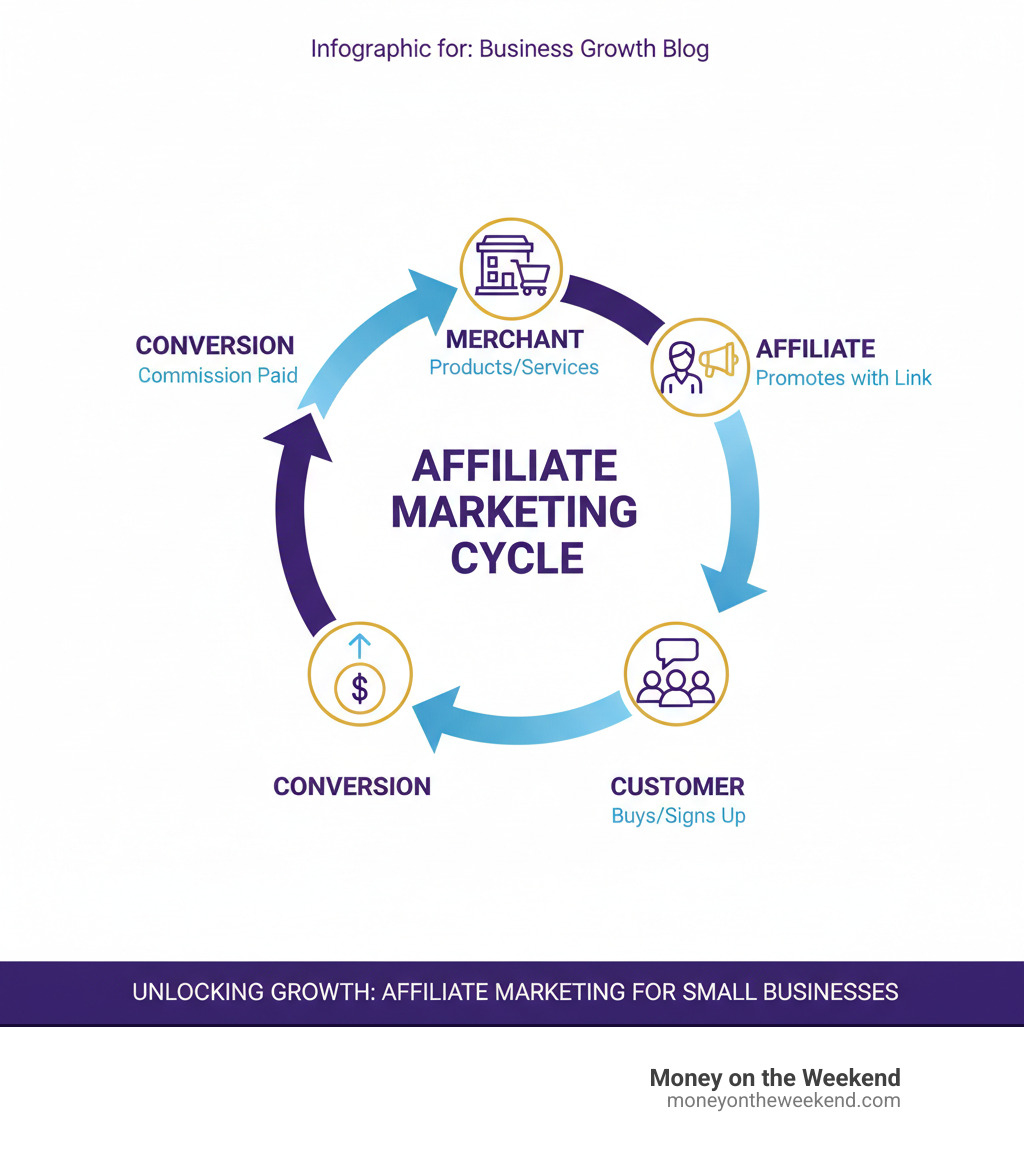
Affiliate marketing for small business is a powerful, performance-based strategy where you partner with others (affiliates) to promote your products or services. You pay them a commission only when they deliver a specific result, like a sale or a lead. This makes it a low-risk, high-reward way to grow your business, boosting brand awareness and reaching more customers without large upfront spending.
For small businesses with limited budgets competing against larger companies, affiliate marketing can level the playing field. It functions as digital word-of-mouth, leveraging the power of trusted recommendations. With the industry projected to grow significantly, this guide will show you how to use this cost-effective tool to find new customers and expand your small business.
Why Your Small Business Should Consider Affiliate Marketing
Unlike traditional advertising, affiliate marketing for small business is a performance-based model where you only pay for results like sales or leads. This makes it an incredibly cost-effective strategy with a potentially high return on investment (ROI). While paid ads might yield an $8 return for every $1 spent, affiliate marketing often averages a $15 return, making it ideal for limited budgets.
Beyond sales, affiliate marketing is a powerhouse for growth. Here’s why it’s a game-changer for small businesses:
- Pay-for-Performance: This is the biggest perk. You only pay affiliates a commission when they deliver a measurable result (a sale, lead, or click). This eliminates upfront costs and ensures every marketing dollar is tied to revenue.
- Access New Audiences: Affiliates like bloggers and content creators have dedicated followings. Partnering with them gives you instant access to engaged audiences you might not otherwise reach.
- Build Brand Credibility: Recommendations from trusted sources are powerful social proof. With 97% of consumers looking for reviews before buying, an affiliate endorsement builds instant credibility and sways purchasing decisions.
- Targeted Marketing: You can partner with affiliates whose audience perfectly matches your ideal customer, leading to higher conversion rates.
- Scalable Growth: Your affiliate program can be scaled up or down as needed. You can recruit more partners or adjust incentives to align with your business goals, allowing for steady, sustainable growth.
How Affiliate Marketing Boosts Your SEO
Affiliate marketing also offers significant SEO benefits that improve your online visibility.

When affiliates link to your site, they create valuable backlinks that signal to search engines that your site is trustworthy. This can improve your domain authority and search rankings. These brand mentions and referral traffic also contribute to your overall online presence and can support local SEO efforts when you partner with local influencers. Affiliates create diverse content—reviews, tutorials, and social posts—that creates more pathways for customers to find you. For more details, see the key benefits of affiliate marketing for small business growth.
Just remember to follow Google’s guidelines for affiliate marketing by ensuring all content provides real value and includes proper disclosures.
Is Your Business Ready? Key Considerations
Before launching an affiliate program, it’s crucial to assess if your business is ready. Affiliate marketing for small business is a powerful tool, but it requires the right foundation for success.
First, examine your profit margins. Can you afford to pay a commission while remaining profitable? Also, consider your product’s appeal. Products with wide appeal or those that solve a common problem tend to attract more affiliates. However, niche products can also succeed with specialized partners. Finally, be prepared for associated costs, including commission payouts, potential software fees, and the time invested in managing partnerships. Ensure your operations can handle a potential surge in sales.
For more on earnings potential, see how much money can you make with affiliate marketing?.
Best Niches and Industries for Success
Certain industries are naturally suited for affiliate marketing:
- Digital Products: Online courses, e-books, and software often have high margins, allowing for generous commissions.
- Health & Wellness: This evergreen market includes everything from supplements to fitness guides, where trusted recommendations are key.
- Home & Garden: Products for DIY projects, decor, and smart home tech are easily integrated into content by home-focused affiliates.
- Personal Finance: Budgeting apps, investment platforms, and financial services often offer high, recurring commissions.
- E-commerce (Specialty Goods): Unique, high-quality items in fashion, beauty, and pet products do well. Commission rates often range from 8% to 18%, according to Referral Candy’s research.
Consider whether your product is a high-ticket vs. low-ticket item. High-ticket items offer larger commissions per sale, while low-ticket items rely on volume. The key is whether your product is unique, solves a problem, and has a passionate audience.
Affiliate Program vs. Referral Program
It’s important to distinguish between affiliate and referral programs. While similar, they serve different purposes.
| Feature | Affiliate Program | Referral Program |
|---|---|---|
| Primary Goal | Acquire new customers, drive sales, expand reach | Leverage existing customer loyalty, encourage word-of-mouth |
| Who Participates | Anyone (bloggers, influencers, publishers, content creators) | Existing customers, friends, family, trusted contacts |
| Motivation | Financial compensation (commission) | Financial incentive (e.g., discount, cash), goodwill, shared value |
| Relationship | Performance-based partnership | Customer advocacy, personal recommendation |
A referral program might be a better fit if you have a loyal customer base, a tight budget for cash commissions, or a very niche product. It’s an excellent way to leverage existing customers and can be a great starting point before launching a full-scale affiliate program.
Understanding the Costs
While affiliate marketing is pay-for-performance, it’s important to understand all potential costs.
- Commission Payouts: This is your main cost—the percentage or flat fee you pay affiliates per conversion. The rate must be competitive yet sustainable for your business.
- Management Costs: This includes fees for affiliate software (monthly subscriptions) or affiliate networks (which often have high setup and monthly fees, plus a percentage of commissions). For many small businesses, networks can be prohibitively expensive, with some taking up to 30% commissions on top of the affiliate’s share.
- Time Investment: Managing a program takes time—recruiting partners, communicating, and analyzing performance.
- Marketing Material Creation: You’ll need to provide assets like banners, product images, and brand guidelines.
The good news is you generally pay no payment for just clicks or impressions, tying your marketing spend directly to results.
The Ultimate Guide to Launching Your Affiliate Program for Small Business
Ready to launch your affiliate marketing for small business program? Breaking the process down into manageable steps makes it straightforward. This guide will walk you through building your program from the ground up.

Step 1: Set Clear and Realistic Program Goals
Vague goals lead to vague results. Use the SMART goal-setting strategy (Specific, Measurable, Achievable, Relevant, Time-bound) to define success. For example, instead of “get more sales,” aim for “increase monthly revenue by 15% through affiliates within six months.”
Track Key Performance Indicators (KPIs) to measure progress:
- Earnings Per Click (EPC): How much you earn per click from affiliate links.
- Cost Per Acquisition (CPA): How much it costs to acquire a new customer.
- Conversion Rate: The percentage of clicks that result in a sale.
- Average Order Value (AOV): The average amount spent by an affiliate-referred customer.
Setting these benchmarks allows you to measure your program’s health and make data-driven improvements.
Step 2: Choose Your Tools and Platforms
Managing an affiliate program requires the right software. While manual tracking with spreadsheets is possible for a few partners, it quickly becomes unmanageable.
For most small businesses, dedicated affiliate management software like UpPromote or LeadDyno is the best choice. These platforms automate signups, tracking, reporting, and commission payments. Many offer free or low-cost starter plans, such as some that start at $0.
Affiliate networks like ShareASale (now Awin), CJ Affiliate, and Impact connect you with thousands of affiliates but come with high costs (setup fees, monthly fees, and commission overrides), making them less suitable for most small businesses.
Whatever you choose, ensure it has core features like reliable tracking links, automated payouts, and robust analytics.
Step 3: Recruit the Right Affiliate Partners
Focus on finding the right partners whose audience aligns with your brand. Look for:
- Bloggers and content creators in your niche.
- Micro-influencers on Instagram, TikTok, or YouTube, who often have highly engaged audiences. Brands are working with them 33% more year over year due to their authenticity.
- Industry experts with podcasts or newsletters.
- Your existing customers, who can be your most authentic advocates.
Vetting is critical. Check that a potential partner’s values align with your brand, review their audience engagement (not just follower count), and assess their content quality. Authenticity is key; one great affiliate is more valuable than ten who are just in it for a commission.
Step 4: Create Your Affiliate Agreement and Onboarding
A solid affiliate agreement protects you and your partners. It should clearly outline:
- Terms and Conditions: Rules for promotion (e.g., no spam, no bidding on branded keywords).
- Commission Structure: The commission rate, cookie duration (tracking window), and any bonus structures.
- Payout Schedule: When and how affiliates will be paid (e.g., monthly via PayPal).
- Disclosure Requirements: Affiliates must legally disclose their relationship with your brand, as required by the Federal Trade Commission (FTC).
- Privacy Compliance: Ensure your tracking methods comply with regulations like GDPR and CCPA.
Once an affiliate joins, provide a welcome kit with their agreement, tracking links, brand guidelines (logos, colors, tone), and high-quality marketing materials (photos, videos, swipe copy). A smooth onboarding process and ongoing support will set your partners up for success.
Mastering Affiliate Partnerships and Campaigns
Launching your affiliate marketing for small business program is just the beginning. To ensure consistent results, you must actively nurture your partnerships and optimize your campaigns. Think of it as tending a garden that needs regular care to flourish.
Designing an Effective Commission Structure
Your commission structure must be attractive to affiliates and profitable for your business. Most small businesses use a Pay-per-Sale (PPS) model, paying a percentage or a flat fee per sale. This is low-risk, as you only pay for actual revenue.
To motivate partners, consider tiered commissions that reward top performers with a higher rate for reaching sales targets. Also, offer a fair cookie duration (e.g., 30-60 days), which is the window an affiliate gets credit for a sale after a click. Research competitor rates to ensure you offer strong incentives while protecting your profit margins. For more ideas, explore our guides on Affiliate Marketing.
Creating Compelling Marketing Materials
Equip your affiliates for success by providing high-quality, on-brand marketing materials. This makes their job easier and ensures brand consistency. Provide them with:
- Brand Guidelines: A simple guide to your logo, colors, and brand voice.
- Banners and Product Images: High-quality visuals in various sizes.
- Product Descriptions: Compelling copy that highlights benefits.
- Email and Social Media Templates: “Swipe copy” they can easily customize.
- Unique Coupon Codes: These entice customers and provide another tracking method.
The more resources you provide, the more effectively your affiliates can promote your products.
Tracking, Measuring, and Optimizing Performance
Affiliate marketing for small business is highly measurable. Use your affiliate software to track clicks, conversions, and commissions in real-time. You can supplement this with Google Analytics for deeper insights.
Regularly analyze your data to identify top-performing affiliates and nurture those relationships. A/B test different offers, commission rates, or landing pages to see what converts best. Maintain open communication with your partners, sharing performance data and celebrating their wins. Finally, be aware of potential affiliate fraud and have fraud prevention measures in place. Consistent tracking and optimization will turn your program into a powerful growth engine.
Frequently Asked Questions about Affiliate Marketing
How do I build long-term relationships with my affiliates?
Successful affiliate marketing for small business is built on strong relationships. Treat affiliates as partners, not just promoters.
- Communicate Regularly: Keep partners engaged with newsletters sharing program updates, new products, and promotions. Be responsive to their questions.
- Offer Exclusive Incentives: Reward top performers with bonuses, higher commission rates, or early access to new products to show your appreciation.
- Create a Community: A private Facebook group or Slack channel allows affiliates to connect, share tips, and feel like part of a team.
- Ask for Feedback: Affiliates have valuable front-line insights. Listen to their suggestions to improve your program and products.
By treating them as true partners, you foster loyalty and turn them into authentic brand advocates.
What are the biggest mistakes to avoid?
Avoid these common pitfalls when starting your affiliate program:
- Choosing the Wrong Partners: Partnering with affiliates whose audience or values don’t align with your brand leads to poor results.
- Setting Uncompetitive Commissions: If your rates are too low, affiliates will promote your competitors instead. Research industry standards.
- Poor Communication: Neglecting your affiliates or responding slowly causes them to lose enthusiasm.
- Neglecting Tracking and Analytics: Without data, you can’t measure ROI, identify top performers, or optimize your program.
- Violating FTC Disclosure Rules: You and your affiliates are legally required to disclose the partnership. Failure to do so can result in fines and damage your brand’s reputation.
- Ignoring Mobile Optimization: With over half of web traffic coming from mobile, a poor mobile experience will cost you sales.
- Not Staying Updated on Regulations: Privacy laws like GDPR and CCPA affect tracking and are constantly evolving. Stay informed to remain compliant. For more, explore common mistakes in affiliate marketing for small business.
How long does it take to see results from an affiliate program?
Affiliate marketing is a long-term strategy, not an overnight success story. Here is a realistic timeline:
- Initial Setup (Weeks): Setting up your program, platform, and marketing materials.
- Recruitment (Weeks to Months): Finding and onboarding the right partners.
- First Sales (Weeks to Months): Early wins may appear quickly, but consistent revenue takes time to build.
- Program Maturity (6-12 Months): This is typically when the program hits its stride. You’ll have identified top performers, optimized campaigns, and established a reliable revenue stream.
Success requires consistent effort, optimization, and relationship-building. The patience pays off in the form of sustainable, passive income.
Conclusion
Affiliate marketing for small business is more than a buzzword—it’s a powerful strategy to expand your reach, build brand credibility, and drive sales without the high upfront costs of traditional advertising. By creating a performance-based program, you ensure your marketing dollars are tied directly to results, making it a low-risk, high-reward channel for growth.
While it requires planning and relationship management, the potential for scalable and sustainable growth is immense. It allows you to build an army of advocates who champion your brand.
At Money on the Weekend, our mission is to guide you toward financial freedom through digital entrepreneurship. Affiliate marketing embodies this spirit, offering a path to create passive income streams and achieve your financial goals.
If you’re ready to open new avenues for growth with a performance-driven marketing channel, it’s time to accept affiliate marketing.
Start building your passive income with affiliate marketing today